
In markets where a single enterprise contract can define a quarter, or even an entire fiscal year, stakes are exceptionally high. Healthcare buying committees are complex, compliance requirements are rigorous, and sales cycles often extend well beyond twelve months. In this environment, broad-based demand generation wastes budget on accounts that will never convert, while account-based marketing (ABM) focuses resources on the organizations most likely to buy.
According to Forrester's global ABM research, ABM programs commonly yield 21% to 50% higher ROI than non-ABM marketing efforts, with nearly a quarter of respondents reporting gains between 51% and 200%. Those numbers explain why the global ABM market was valued at $1.41 billion in 2024 and is projected to reach $3.81 billion by 2030. For healthcare organizations evaluating a b2b healthcare abm agency, the question is no longer whether ABM works. It is which agency model fits your growth objectives, your compliance requirements, and your sales team's readiness.
This article breaks down the ABM agency landscape for healthcare, explains the evaluation criteria that matter most, and covers the technology and optimization practices that separate high-performing programs from those that stall.
Key Takeaways
- Healthcare's buying complexity makes ABM agency selection uniquely high-stakes: The regulatory environment, multi-stakeholder committees, and extended procurement timelines demand a partner with deep industry fluency, not just ABM platform expertise.
- ABM agency models vary widely, and the right fit depends on your internal maturity: Full-service, technology-plus-services, and consulting-plus-execution models each suit different organizational stages, so matching the model to your team's capabilities is essential.
- Evaluation criteria go beyond standard agency vetting: Account selection methodology, personalization depth, multi-channel orchestration, and measurement sophistication all carry outsized weight in healthcare ABM engagements.
- Technology stack decisions and campaign optimization practices determine long-term program performance: The platforms you choose and how your agency partner uses them to iterate on targeting, content, and channel mix directly shape pipeline outcomes.
Why Healthcare Demands a Specialized B2B Healthcare ABM Agency
Healthcare is not a market where generic B2B playbooks translate cleanly. Complex B2B purchasing decisions in healthcare routinely involve large buying committees: clinicians, IT leaders, compliance officers, procurement teams, and C-suite executives all hold influence, and each enters the process with independently gathered research. When multiple departments must align before a purchase moves forward, the number of stakeholders, competing priorities, and internal approval layers multiplies well beyond what most B2B sectors experience.
A b2b healthcare abm agency must navigate this complexity while respecting boundaries that other industries do not face. Understanding how healthcare buying committees are structured is the prerequisite for building ABM programs that reach the right stakeholders. Messaging must comply with HIPAA, FDA, and CMS guidelines. Claims require clinical or operational evidence. Content must resonate across roles as different as a chief nursing officer and a chief financial officer.
The Cost of Getting It Wrong
In healthcare, the margin for error with ABM is smaller than in most B2B sectors. A misstep in messaging compliance, a poorly targeted outreach sequence, or a campaign that ignores buying committee dynamics does not just reduce conversion rates. It damages trust with the stakeholders you need most.
When an ABM agency lacks healthcare fluency, the consequences are tangible:
- Compliance exposure: Campaigns that reference patient data, outcomes claims, or clinical performance without proper substantiation create regulatory risk.
- Wasted cycles: Generic outreach to healthcare buying committees gets filtered out by stakeholders who expect industry-specific value propositions.
- Misaligned targeting: Without understanding of provider vs. payer vs. medtech buying patterns, account selection relies on firmographic data alone, missing the behavioral and intent signals that drive healthcare purchases.
These risks are why coordinated ABM programs deliver an average ROI of 137% when executed by teams that understand the sector. Outcomes Rocket's research consistently shows that healthcare-specific execution, not just ABM methodology, is the differentiator.
ABM Agency Models: Choosing the Right Fit for Healthcare
Not all ABM agencies operate the same way. The three predominant models each offer distinct advantages depending on your organization's internal resources, technology maturity, and strategic goals.
Full-Service ABM Agencies
Full-service partners handle the entire ABM lifecycle. They identify target accounts, develop personalized content, orchestrate campaigns across channels, and report on pipeline impact. For healthcare organizations building ABM programs from scratch, this model provides the fastest path to market. Organizations that are not yet ready for full ABM may benefit from starting with professional lead generation services that build targeting and qualification infrastructure before scaling to account-level orchestration.
The trade-off is control. Full-service engagements require trust in the agency's healthcare knowledge, because the agency is making decisions about which accounts to pursue, what messaging to deploy, and how to engage clinical and administrative stakeholders.
Technology + Services Hybrid
This model pairs platform expertise with managed execution. You retain strategic ownership of your ABM program, while the agency handles implementation, data configuration, and campaign management within your chosen technology stack. It works well when you have strong marketing leadership but lack the technical team to operationalize ABM platforms, intent data feeds, and CRM integrations.
Consulting + Execution Partners
Consulting-led agencies advise on program architecture and selectively execute high-impact campaigns. This model suits organizations with established marketing operations that need healthcare-specific ABM expertise to sharpen targeting, improve personalization, or integrate ABM with an existing account-based marketing strategy.
Evaluation Criteria for a B2B Healthcare ABM Agency
Standard agency vetting covers portfolio, references, and pricing. ABM agency evaluation in healthcare requires going deeper across five critical dimensions.
Account Selection Methodology
How the agency identifies and prioritizes target accounts is the foundation of every ABM program. Strong agencies combine firmographic data with technographic, behavioral, and intent signals. In healthcare, the methodology must also account for organizational structure (is the health system centralized or decentralized?), budget cycle timing, and regulatory environment.
- Ideal customer profile (ICP) development: Does the agency build healthcare-specific ICPs that reflect buying committee composition, not just revenue size?
- Intent data integration: Does the methodology layer third-party intent signals on top of first-party engagement data?
- Account tiering: Does the agency apply tiered strategies (one-to-one, one-to-few, one-to-many) calibrated to healthcare deal sizes and sales cycle lengths?
Precision in account selection is critical because mistargeting is expensive. EMARKETER's B2B research found that 50.2% of B2B marketers say reaching the right buying groups remains their top challenge, and only 17.3% have fully mapped their customer journey stages. In healthcare, where buying committees are larger and more layered than in most B2B sectors, these gaps are amplified. An ABM agency's account selection methodology is the primary mechanism for closing them.
Personalization Capabilities
Personalized outreach in healthcare is not about inserting a first name into a subject line. It is about delivering role-specific value to each member of a buying committee. A chief medical officer needs clinical evidence. A VP of IT needs integration architecture. A CFO needs total cost of ownership analysis.
Evaluate whether the agency can:
- Create role-segmented content: Whitepapers, case studies, and executive briefs tailored to clinical, operational, financial, and technical stakeholders.
- Deliver account-specific experiences: Custom landing pages, personalized ad creative, and tailored email sequences aligned to each account's stage in the buying process.
- Adapt messaging for compliance: All personalized outreach must comply with healthcare regulations, which means the agency needs a review process built into its creative workflow.
Multi-Channel Orchestration
Effective healthcare ABM operates across channels simultaneously: programmatic display, LinkedIn, email, direct mail, events, and sales outreach. The agency must coordinate these touchpoints into a unified experience rather than running disconnected campaigns. Research into how AI is reshaping marketing operations shows that the most advanced programs use AI-driven orchestration to sequence touchpoints based on real-time engagement signals.
Channel allocation is shifting accordingly. EMARKETER data on B2B investment priorities shows that 45% of B2B marketers rank AI-powered marketing tools as their top 2026 investment, followed by events and experiential marketing at 33% and owned media at 32%. For healthcare ABM, this signals that agencies must be fluent in AI-driven orchestration while maintaining the human-led experiential touchpoints, executive roundtables, conference activations, direct mail, that healthcare buying committees respond to.
Measurement Sophistication
A HIMSS-sponsored survey on healthcare data strategy found that while 42% of healthcare leaders use AI for predictive analytics, far fewer apply it to care coordination (33%) or personalized care plans (21%). That gap between experimentation and operational deployment makes measurement capability a critical differentiator among ABM agencies. The right partner should track engagement at the account level (not just the lead level), attribute pipeline to specific campaigns and channels, and connect marketing activity to revenue outcomes.
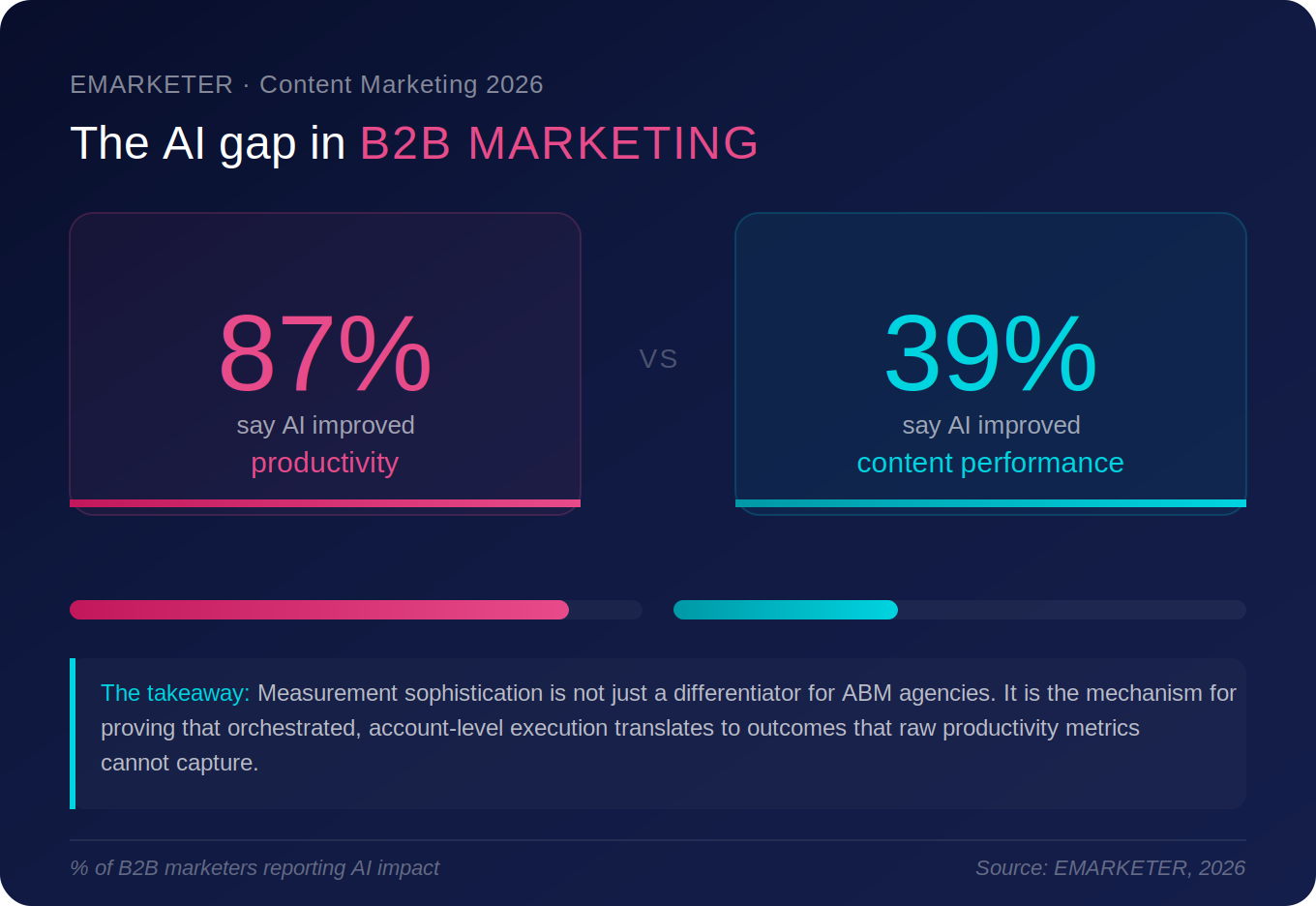
Measurement gaps extend well beyond healthcare. EMARKETER's content marketing research shows that across B2B broadly, AI productivity gains are outpacing measurable performance improvements. Only 39% of marketers report that AI has improved content performance, compared to 87% who say it improved productivity. For ABM agencies, this means measurement sophistication is not just a differentiator; it is the mechanism for proving that orchestrated, account-level execution translates to outcomes that raw productivity metrics cannot capture.
Healthcare Expertise
This criterion underpins all others. The agency must demonstrate understanding of healthcare sales cycles, compliance constraints, buying committee dynamics, and the evidence-based messaging standards that healthcare decision-makers expect. Ask for healthcare-specific case studies, regulatory review processes, and examples of multi-stakeholder campaign architectures.
Campaign Optimization: What Separates High-Performing ABM Programs
Launching an ABM program is the starting point, not the finish line. High-performing programs iterate continuously across four areas.
- Account list refinement: Top programs reassess their target account lists quarterly, incorporating new intent signals, pipeline feedback, and firmographic changes. Accounts that show declining engagement are deprioritized in favor of emerging opportunities.
- Content performance analysis: Every piece of content should be evaluated by role, account tier, and funnel stage. Content that resonates with IT leaders at health systems may underperform with executives at medtech companies. The shifts reshaping how B2B healthcare teams operate, from AI-driven personalization to evolving buyer expectations, mean that content approaches that worked twelve months ago may no longer produce the same results. Continuous testing and iteration is essential.
- Channel mix optimization: Initial channel assumptions rarely hold. Programmatic display may drive awareness efficiently, but LinkedIn InMail might generate more qualified engagement among hospital executives. Conversely, direct mail can outperform digital channels for reaching C-suite decision-makers who are difficult to reach online. Optimization means reallocating budget based on actual account-level response data, not assumptions about where healthcare buyers spend their time.
- Sales feedback integration: The most effective ABM programs build structured feedback loops between sales and marketing. Sales teams report on conversation quality, objection patterns, and competitive insights, and the ABM agency uses this intelligence to refine targeting and messaging. Without this loop, campaigns operate on assumptions rather than ground truth from the accounts you are trying to win. The sales strategies that close healthcare deals are built on exactly this kind of marketing-to-sales intelligence sharing.
According to Forrester's analysis of ABM program maturity, 99% of organizations with dedicated ABM teams report higher ROI compared to traditional marketing. That performance gap widens as programs mature, reinforcing the importance of selecting an agency partner committed to long-term optimization rather than one-time campaign launches.
Technology Stack Considerations for Healthcare ABM
Your ABM agency's technology approach shapes program scalability, data quality, and measurement accuracy. Evaluate the stack across three layers.
- ABM platforms: Solutions like Demandbase, 6sense, and Terminus provide account identification, intent scoring, and campaign orchestration. Your agency should be platform-agnostic or deeply experienced with your current tools, and should configure these platforms to respect healthcare data governance requirements.
- Intent data: Third-party intent data identifies accounts researching topics relevant to your solution. In healthcare, the value of intent data depends on the agency's ability to map intent signals to specific buying committee roles and purchasing timelines. Healthcare organizations frequently cite resource constraints and competing priorities as barriers to digital adoption, which means the accounts that are actively investing in new solutions stand out in intent data. Your agency should be able to isolate those high-intent signals from background noise and translate them into actionable account priorities, often through a healthcare-specific lead scoring model that assigns weighted values to behavioral and firmographic signals.
- CRM integration: ABM only works when it connects to your CRM. The agency should demonstrate experience integrating ABM platforms with Salesforce, HubSpot, or other healthcare CRM environments, ensuring that account engagement data flows into sales workflows and attribution models. In healthcare, CRM configuration must also support multi-stakeholder opportunity tracking, where a single deal involves contacts across clinical, IT, finance, and procurement roles. Agencies that treat CRM integration as an afterthought create data silos that undermine the entire program.
Healthcare organizations that lack a unified data strategy face compounding challenges. As the HIMSS-sponsored research noted earlier, healthcare leaders rank care coordination (60%) and chronic disease management (52%) as the most critical elements of value-based care, yet continue to deprioritize the analytics infrastructure needed to execute on those priorities.
Your ABM agency should help you overcome this barrier by building data workflows that connect account engagement to pipeline outcomes without requiring a separate analytics initiative.
Organizations evaluating ABM technology alongside a broader healthcare marketing agency framework should prioritize platforms that support both ABM-specific orchestration and broader demand generation workflows.
Questions to Ask When Evaluating a B2B Healthcare ABM Agency
The evaluation criteria and technology considerations above give you a framework. These questions translate that framework into a conversation you can use during agency selection.
On account selection and targeting:
- How do you build healthcare-specific ICPs? Look for answers that go beyond firmographics to include buying committee mapping, intent signal layering, and health system organizational structure.
- What data sources inform your account targeting? The agency should name specific intent data providers, explain how they validate contact-level data in healthcare, and describe how often account lists are refreshed.
On execution and personalization:
- Can you show examples of role-segmented campaigns for healthcare buying committees? Ask for work that demonstrates distinct messaging for clinical, financial, IT, and operational stakeholders within the same target account.
- What does your compliance review process look like? The answer should describe a structured workflow, not an informal review. Ask how many campaigns have been flagged or revised through that process.
On measurement and reporting:
- How do you attribute pipeline to ABM activity across long sales cycles? The agency should explain their multi-touch attribution model and how they handle the twelve-to-eighteen-month lag common in healthcare deals.
- What does your reporting cadence look like, and what actions does it drive? Look for agencies that tie reporting to optimization decisions, not just dashboards that summarize activity.
On healthcare expertise:
- What percentage of your client base is in healthcare? Agencies where healthcare represents a small fraction of their book are learning on your budget. Look for partners where healthcare is a core vertical, not an occasional engagement.
- Can you provide references from healthcare organizations with similar buying complexity? Ask to speak directly with marketing or demand gen leads at those organizations, not just executive sponsors.
Conclusion
Selecting a b2b healthcare abm agency is a decision that shapes pipeline quality, sales cycle velocity, and long-term revenue performance. The evaluation criteria covered here, from account selection methodology and personalization depth to measurement sophistication and technology integration, exist because healthcare's buying complexity punishes generalist execution.
According to Deloitte's 2026 US Health Care Outlook survey, 80% of health care executives say regulatory and policy factors will influence their 2026 strategies, even as 43% report feeling uncertain about the industry's near-term outlook. For organizations pursuing growth despite that uncertainty, prioritize healthcare expertise over platform familiarity, demand transparency in measurement and attribution, and ensure the agency model matches your team's internal maturity. If your immediate need is qualified pipeline rather than full ABM orchestration, evaluating a specialized healthcare lead generation agency may be the more targeted starting point.
Sources
- Forrester - Account-Based Marketing Delivers Higher ROI Across Regions (2024) - Global research on ABM ROI performance compared to non-ABM marketing efforts. https://www.forrester.com/report/account-based-marketing-delivers-higher-roi-across-regions/RES181818
- Grand View Research - Account-Based Marketing Market Report (2024) - Market sizing and growth projections for the global ABM industry through 2030. https://www.grandviewresearch.com/industry-analysis/account-based-marketing-market-report
- Forrester - ABM Won, But It's Not Done Changing the Game (2024) - Analysis of ABM program maturity, convergence with demand generation, and organizational alignment. https://www.forrester.com/blogs/abm-won-but-its-not-done-changing-the-game/
- HIMSS and Arcadia - From Insight to Impact: How Top Health Systems Use Data (2025) - HIMSS-sponsored survey on AI adoption in healthcare analytics, value-based care priorities, and barriers to data-driven strategy. https://arcadia.io/resources/arcadia-himss-healthcare-growth-report-2025
- Deloitte - 2026 US Health Care Executive Outlook (2025) - C-suite survey of 120 US health care executives on regulatory impact, growth strategies, AI adoption, and industry uncertainty. https://www.deloitte.com/us/en/insights/industry/health-care/life-sciences-and-health-care-industry-outlooks/2026-us-health-care-executive-outlook.html
- Outcomes Rocket - State of ABM 2025 - Original research on ABM performance, ROI benchmarks, and the role of AI in account-based programs. https://www.outcomesrocket.com/blogs/state-of-account-based-marketing-2025-insights-roi-and-the-rise-of-ai
- Outcomes Rocket - AI in Marketing 2025 - Research on AI adoption rates, automation trends, and productivity gains in marketing operations. https://www.outcomesrocket.com/blogs/ai-in-marketing-2025-widespread-adoption-growing-concerns-and-productivity-gains
- EMARKETER - B2B Marketing Trends to Watch in 2026 - Research on AI investment priorities, content performance benchmarks, and data governance trends in B2B marketing. https://content-na1.emarketer.com/b2b-marketing-trends-watch-2026
- EMARKETER - B2B Ad Budgets Are Growing - Analysis of B2B targeting challenges, buying group reach, and journey mapping gaps. https://content-na1.emarketer.com/b2b-ad-budgets-growing-how-marketers-spend-smarter
- EMARKETER - Content Marketing 2026 - Research on AI's impact on content creation, productivity gains versus performance improvements, and measurement challenges. https://content-na1.emarketer.com/content-marketing-2026

Turn Healthcare Insightinto Accelerated Growth
Our healthcare growth teams work closely with you to design strategies tailored to your unique goals and market dynamics, fully focused on growth.
Book a Strategy Session →
Accelerating your growth with expert strategies in marketing, branding, research & insights, sales and lead generation to maximize healthcare impact.