
B2B healthcare organizations often invest in campaigns, content, and conferences without seeing strong pipeline results. For companies selling into hospitals, health systems, and payer networks, the disconnect between marketing activity and qualified pipeline is rarely about effort, it is about structure.
Healthcare purchasing decisions involve large buying committees spanning clinical, operational, financial, and IT stakeholders, each conducting independent research across months-long evaluation cycles. That complexity requires a lead generation approach built for precision, not volume.
Professional b2b healthcare lead generation services exist to close that gap. These services combine intent data, healthcare-specific targeting, multi-channel execution, and rigorous lead qualification into a managed program designed to deliver sales-ready opportunities. This article explains how those services actually operate: what is included, how pricing works, what ROI tracking looks like, and how long it takes to see results.
Key Takeaways
- Service delivery follows a structured lifecycle: Professional lead generation programs move through defined phases, from strategic intake and targeting to execution, qualification, and optimization, each one calibrated to healthcare's regulatory and buying complexity.
- Technology and human expertise work together: The most effective services layer intent data, predictive analytics, and automation on top of experienced healthcare strategists who understand clinical, operational, and financial buyer priorities.
- Pricing reflects qualification depth, not just lead volume: Cost structures vary widely depending on how precisely leads are qualified, how exclusive the data is, and how many channels the program spans.
- Realistic timelines prevent misaligned expectations: Healthcare lead generation programs typically need 60 to 90 days to ramp before delivering consistent pipeline results, a reality that well-structured SLAs account for from the start.
How B2B Healthcare Lead Generation Services Operate
A professional lead generation service is not a single tactic or tool. It is a managed system that handles targeting, outreach, qualification, and reporting on your behalf, designed around the unique constraints of healthcare marketing. Unlike generalist demand generation vendors, healthcare-focused providers build every workflow around compliance requirements, long procurement cycles, and the multi-stakeholder buying committees that define healthcare purchasing.
The operational model for most services follows a five-stage lifecycle: intake and strategy, targeting and list building, campaign execution, lead qualification, and reporting with continuous optimization.
Intake and Strategic Alignment
Every engagement begins with discovery. The service provider conducts intake sessions to define your ideal customer profile (ICP), map target accounts, identify decision-maker personas, and document messaging guardrails. In healthcare, this phase also involves understanding your compliance environment, including which claims require clinical evidence, how protected health information (PHI) must be handled in CRM workflows, and what regulatory bodies govern your marketing language.
This strategic alignment phase is essential. Without it, even the best targeting data produces leads that your sales team cannot convert. According to Forrester's customer-obsessed growth engine research, firms with high levels of alignment across customer-facing functions report 2.4x higher revenue growth than those without alignment.
The most effective healthcare lead generation programs treat the intake phase as a strategic investment, not an administrative formality. Every targeting decision, messaging guardrail, and qualification criterion established here determines the quality of every lead that follows.
Targeting and List Building
Once the strategy is defined, providers build and refine the prospect universe. This typically involves layering multiple data sources:
- Firmographic data: Organization type, size, geography, specialty, and technology stack (e.g., which EHR system they use).
- Contact-level data: Verified decision-makers by role, seniority, and department within the target account.
- Intent signals: Behavioral data indicating which accounts are actively researching topics related to your solution.
In most B2B categories, buyers have already built a shortlist, chosen a front-runner, and defined their requirements before a single seller conversation takes place. In healthcare, where compliance reviews and multi-stakeholder approvals stretch that anonymous research phase even further, the window to influence a buying committee's preference closes early. This is why intent data for healthcare marketing is not optional. Reaching accounts while they are still forming opinions is the only way to earn a position on the shortlist before it is locked in.
What's Typically Included: Technology, Data, Creative, and Analytics
Professional b2b healthcare lead generation services deliver more than just a list of names. A well-structured engagement bundles multiple capabilities under a single program, eliminating the fragmentation that slows results when you manage individual vendors in-house.
Our research into how AI is transforming marketing operations found that almost 90% of marketers now use AI in their processes. Within lead generation services, this translates to predictive analytics healthcare marketing applications: AI-powered lead scoring, automated content personalization, and real-time campaign optimization that would be cost-prohibitive to build in-house. These capabilities reflect the broader shifts reshaping how B2B healthcare teams operate, where automation and personalization at scale have moved from competitive advantage to baseline expectation.
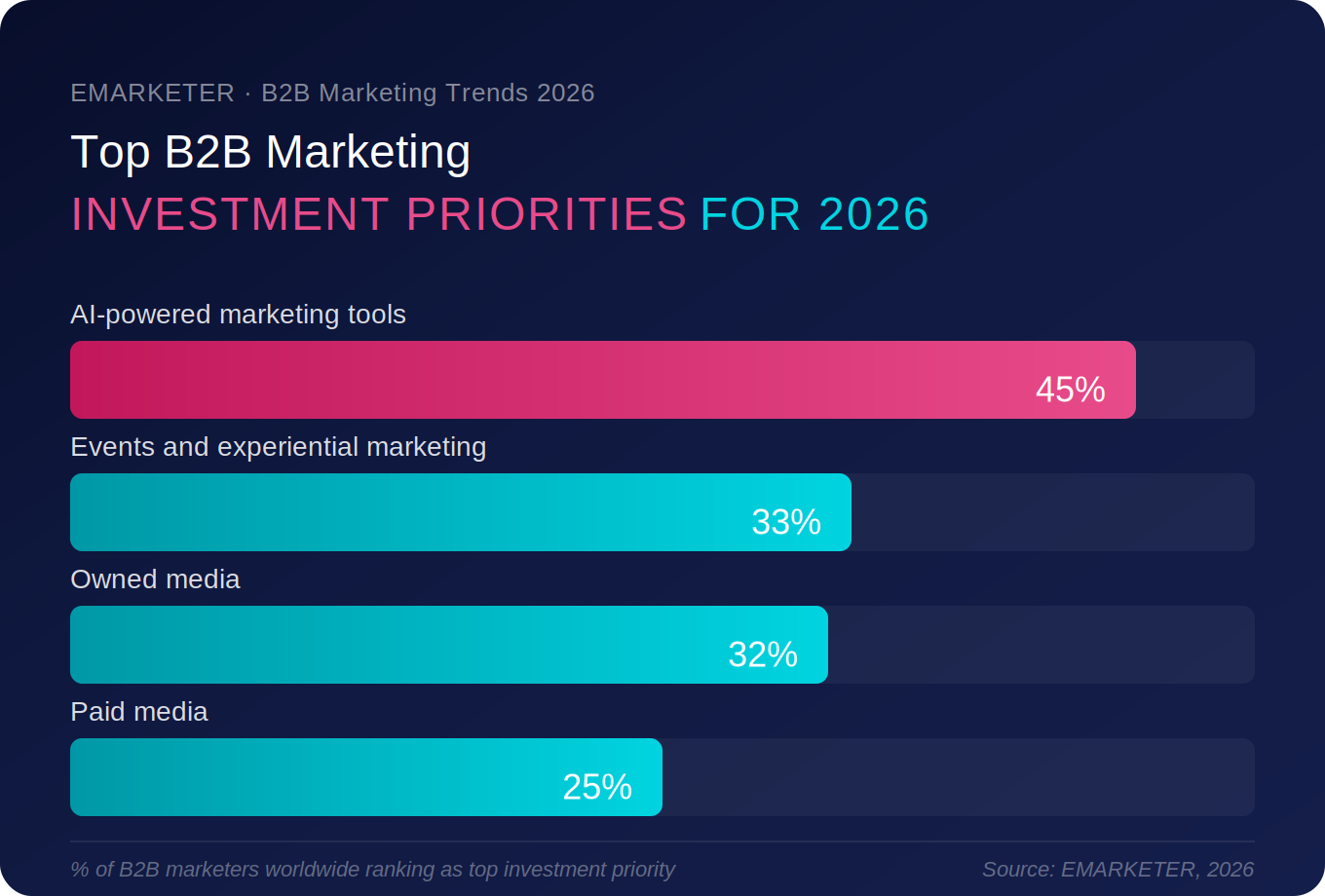
That adoption trajectory is intensifying. EMARKETER's B2B marketing investment data shows that 45% of B2B marketers worldwide rank AI-powered marketing tools as their top investment priority for 2026, ahead of events (33%), owned media (32%), and paid media (25%). However, the same research shows the gains are uneven: while 42% of B2B marketers report AI significantly improved productivity, only 6% say it significantly improved content performance. For healthcare lead generation, this reinforces the importance of pairing AI-driven efficiency with human oversight on qualification and compliance.
Campaign Execution and Lead Qualification
The execution phase is where strategy meets market. Professional services coordinate outreach across multiple channels simultaneously, adjusting tactics in real time based on engagement signals.
Multi-Channel Execution
A Gartner survey of B2B buyers found that 73% of B2B buyers actively avoid suppliers who send irrelevant outreach, reinforcing why generic demand generation fails in healthcare. Meanwhile, Gartner's research on buying group consensus shows that 74% of buyer teams experience unhealthy conflict during the decision process. Professional lead generation services address both dynamics by delivering relevant, persona-specific content to each committee member, reducing the friction that causes deals to stall.
Effective healthcare lead generation rarely relies on a single channel. Instead, services orchestrate coordinated touches across email sequences, paid LinkedIn campaigns, content syndication, programmatic display, and sometimes direct mail or event-based outreach. Each channel targets a different buying committee member at a different stage. Understanding which lead generation channels work best in healthcare helps you evaluate whether a provider's channel mix aligns with how your target accounts actually research and buy.
A HIMSS and Arcadia survey on healthcare data strategy found that while 42% of healthcare leaders use AI for predictive analytics, only 21% apply it to personalized care plans. When most of your target accounts are still closing that gap, your outreach must often educate prospects before it can qualify them, a dynamic that demands sequenced, multi-touch campaigns rather than one-off blasts. McKinsey health media research found that 42% of consumers are more likely to schedule appointments with providers who offer relevant content, a principle that extends to B2B healthcare buying committees who evaluate vendor credibility through thought leadership and educational material.
Lead Qualification Frameworks
Not every response is a lead. Services apply structured qualification criteria to separate interest from intent. This rigor matters because lead quality remains a persistent weak point in B2B marketing. According to EMARKETER's analysis of B2B marketing trends, 53% of B2B marketers say at least 10% of their leads are disqualified by sales due to poor quality, a figure that rises sharply in healthcare, where misaligned targeting against complex buying committees compounds the waste. In healthcare, qualification goes beyond standard BANT (Budget, Authority, Need, Timeline) to include:
- Clinical vs. administrative authority: Is the contact a clinical champion who influences requirements, or a procurement stakeholder who controls budget?
- Buying stage signals: Are they consuming early-stage educational content, or requesting vendor-specific demos and pricing?
- Compliance readiness: Does the account have active budget cycles or procurement timelines that align with your sales motion?
- Account engagement depth: Are multiple contacts from the same account engaging, indicating a buying committee in motion?
The output is typically categorized into tiers:
- Marketing Qualified Leads (MQLs)
- Sales Accepted Leads (SALs)
- Sales Qualified Leads (SQLs)
A healthcare-specific lead scoring model assigns weighted values to each of these tiers, using the behavioral and firmographic signals captured during qualification to rank leads by genuine purchase intent.
The deeper the qualification, the higher the cost per lead, but the greater the conversion rate and pipeline value. Organizations that adopt account-based strategies often find that measuring engagement at the account level, rather than chasing individual leads, produces more reliable pipeline results.
Pricing Models and Cost Drivers
Understanding how b2b healthcare lead generation services price their offerings helps you evaluate proposals accurately and set realistic budget expectations.
Common Pricing Structures
What Drives Cost
Several factors influence what you pay. In healthcare, the primary cost drivers include:
- Qualification depth: An MQL costs significantly less than an SQL that has been verified through a live conversation and confirmed against BANT criteria. The more qualification layers you require, the higher the cost per lead.
- Exclusivity: Shared leads (sold to multiple buyers) cost less than exclusive leads generated solely for your organization. In competitive healthcare segments, exclusivity is often worth the premium.
- Target audience specificity: Reaching C-suite executives at large health systems costs more than targeting mid-level managers at community hospitals. Niche audiences with limited scale command higher CPLs.
- Channel mix: Programs that span multiple channels (paid search, LinkedIn, content syndication, email, programmatic) cost more than single-channel efforts but typically produce higher conversion rates. According to the broader regulatory and compliance framework that shapes healthcare marketing programs, multi-channel approaches also help maintain compliant, consistent messaging across every touchpoint.
- Geographic scope: National campaigns carry higher data and media costs than regional programs targeting specific metro areas or health systems.
With Gartner's CMO Spend Survey showing that marketing budgets remain stalled at 7.7% of company revenue, and 59% of CMOs reporting insufficient budget to execute their strategy, understanding these cost drivers helps you allocate limited resources toward the pricing model that delivers the best return for your specific goals.
Budget pressure is compounded by waste. According to EMARKETER, 58% of B2B marketers identify ad waste as a major concern, with over half estimating losses between 16% and 45% of their total budget. In healthcare, where CPLs are already elevated, reducing waste through precise targeting and qualification becomes a direct lever on program economics.
ROI Tracking and Attribution
Measuring return on investment for lead generation in healthcare is harder than in most industries. Sales cycles that stretch across six to eighteen months, buying committees with a dozen stakeholders, and multiple touchpoints before a deal closes all make attribution complex.
Attribution Approaches
Professional services typically offer multi-touch attribution models that assign credit across the full buyer journey. The most common approaches include:
- First-touch attribution: Credits the initial interaction that brought an account into the pipeline. Useful for evaluating top-of-funnel awareness, but limited in complex healthcare sales.
- Last-touch attribution: Credits the final interaction before a deal is created. Favors bottom-of-funnel tactics and undervalues earlier nurturing.
- Multi-touch (weighted): Distributes credit across all touchpoints, with heavier weighting on key moments like form fills, demo requests, or meeting conversions. This is the standard for healthcare lead generation services, where coordinated ABM programs deliver measurable pipeline returns.
- Account-based attribution: Measures engagement at the account level rather than the individual level, recognizing that healthcare deals involve multiple contacts from the same organization.
SLAs and Performance Expectations
Service-level agreements (SLAs) define the operational contract between you and the provider. In healthcare lead generation, SLAs typically cover:
- Lead volume commitments: A minimum number of qualified leads per month or quarter.
- Lead quality standards: Documented criteria that every delivered lead must meet, including role, title, company type, and engagement threshold.
- Response time guarantees: How quickly new leads are delivered to your CRM or sales team.
- Replacement policies: If a lead fails to meet quality standards upon review, the provider replaces it at no additional cost.
- Reporting cadence: Weekly or monthly dashboards covering pipeline metrics, channel performance, and optimization recommendations.
According to Deloitte's 2026 US Health Care Outlook survey, 80% of health care executives say regulatory and policy factors will influence their 2026 strategies, even as 43% report feeling uncertain about the industry's near-term outlook. As pressure to grow despite that uncertainty intensifies, SLAs become the mechanism that ensures your lead generation investment translates into real accountability, not just activity.
Timeline Expectations: From Ramp to Results
One of the most common missteps in outsourcing healthcare lead generation is expecting immediate results. The reality is that every program needs time to build momentum.
Expect the first 60 to 90 days to function as a learning and calibration period. Lead volume will be lower, qualification criteria may shift, and both teams will need to establish feedback loops. By month three or four, you should see consistent lead flow and sufficient data to evaluate ROI. Programs that achieve strong results by month six typically maintain and improve performance through continuous optimization.
Healthcare's longer sales cycles mean that pipeline generated in the first quarter may not convert to revenue for another six to twelve months. The 6sense Buyer Experience Report confirms that the average B2B buying cycle now lasts 10.1 months, and in healthcare, where compliance reviews and multi-stakeholder approvals extend timelines further, that number often stretches to twelve or eighteen months. Build this lag into your ROI model from the start, and ensure your leadership team understands the timeline before measuring success.
Conclusion
Professional b2b healthcare lead generation services bring structure, technology, and healthcare expertise to the challenge of building qualified pipeline. From strategic intake and intent-driven targeting through multi-channel execution and rigorous qualification, these services compress the operational complexity that slows most in-house teams.
The value is not just in lead volume. It is in the qualification depth, the compliance-aware execution, and the attribution infrastructure that connects marketing spend to revenue outcomes.
As you evaluate providers, focus on their healthcare experience, their data sources, their qualification process, and their willingness to be held accountable through meaningful SLAs. If your pipeline strategy has matured to the point where account-level orchestration is the priority, a specialized healthcare ABM agency may deliver stronger returns than a volume-focused lead generation model.
Sources
- 6sense - Buyer Experience Report - Primary research on when and how B2B buyers engage sellers, including anonymous buying behavior, vendor selection patterns, and buying cycle timelines. https://6sense.com/science-of-b2b/buyer-experience-report-2025/
- Forrester - Customer-Obsessed Growth Engine Alignment - Research on how sales, marketing, and product alignment drives revenue growth and profitability in B2B organizations. https://www.forrester.com/press-newsroom/customer-obsessed-growth-engine-alignment/
- HIMSS / Arcadia - From Insight to Impact: How Top Health Systems Use Data (2025) - HIMSS-sponsored survey on AI adoption in healthcare analytics, value-based care priorities, and barriers to data-driven strategy. https://arcadia.io/resources/arcadia-himss-healthcare-growth-report-2025
- Deloitte - 2026 US Health Care Executive Outlook (2025) - C-suite survey of 120 US health care executives on regulatory impact, growth strategies, AI adoption, and industry uncertainty. https://www.deloitte.com/us/en/insights/industry/health-care/life-sciences-and-health-care-industry-outlooks/2026-us-health-care-executive-outlook.html
- Gartner - CMO Spend Survey - Annual survey of CMOs and marketing leaders on budget allocation, channel investment, and strategic priorities. https://www.gartner.com/en/newsroom/press-releases/2025-05-12-gartner-2025-cmo-spend-survey-reveals-marketing-budgets-have-flatlined-at-seven-percent-of-overall-company-revenue
- Gartner - B2B Buyer Preferences Survey (2025) - Survey of 632 B2B buyers on outreach preferences, digital self-service, and seller engagement patterns. https://www.gartner.com/en/newsroom/press-releases/2025-06-25-gartner-sales-survey-finds-61-percent-of-b2b-buyers-prefer-a-rep-free-buying-experience
- Gartner - Buying Group Consensus Survey (2025) - Research on internal conflict dynamics within B2B buying teams and the impact of consensus on deal quality. https://www.gartner.com/en/newsroom/press-releases/2025-05-07-gartner-sales-survey-finds-74-percent-of-b2b-buyer-teams-demonstrate-unhealthy-conflict-during-the-decision-process
- McKinsey - Health Media: How Consumer Content Informs the Future of Healthcare - Research on health content consumption, trust dynamics, and content-driven scheduling behavior. https://www.mckinsey.com/industries/healthcare/our-insights/health-media-how-consumer-content-informs-the-future-of-healthcare
- Outcomes Rocket - AI in Marketing 2025 - Original research on AI adoption rates, automation trends, and productivity gains across marketing operations. https://www.outcomesrocket.com/blogs/ai-in-marketing-2025-widespread-adoption-growing-concerns-and-productivity-gains
- Outcomes Rocket - State of ABM 2025 - Original research on ABM performance, ROI benchmarks, and the rise of AI in account-based programs. https://www.outcomesrocket.com/blogs/state-of-account-based-marketing-2025-insights-roi-and-the-rise-of-ai
- EMARKETER - B2B Marketing Trends to Watch in 2026 - Research on AI investment priorities, lead quality benchmarks, and data governance trends shaping B2B marketing. https://www.emarketer.com/content/b2b-marketing-trends-watch-2026
- EMARKETER - B2B Ad Budgets Are Growing - Analysis of B2B ad budget growth, ad waste concerns, targeting challenges, and channel investment priorities. https://www.emarketer.com/content/b2b-ad-budgets-growing-how-marketers-spend-smarter

Turn Healthcare Insightinto Accelerated Growth
Our healthcare growth teams work closely with you to design strategies tailored to your unique goals and market dynamics, fully focused on growth.
Book a Strategy Session →
Accelerating your growth with expert strategies in marketing, branding, research & insights, sales and lead generation to maximize healthcare impact.