
Outcomes Articles
Guide to B2B Healthcare Marketing: Strategy, Frameworks & Metrics
January 5, 2026
The healthcare industry stands at a critical inflection point. As digital transformation accelerates and buyer expectations evolve, your marketing strategy must adapt or risk falling behind. The B2B healthcare sector is rapidly growing, with over 140 health tech unicorns with a valuation of approximately $320 billion, creating unprecedented competition for your organization's attention.
This sector is uniquely complex because it operates under stringent regulations, long decision-making cycles, and involves multiple stakeholders across clinical and administrative roles. Your success depends on mastering these complexities while delivering measurable results. This guide provides actionable strategies to help you navigate b2b healthcare marketing challenges and drive meaningful growth.
Key Takeaways
- B2B healthcare buying decisions are slow and risk-averse, which requires sustained, educational engagement across the entire research process.
- Regulatory compliance shapes every marketing activity, and accuracy, privacy, and proper claims are essential for protecting organizational trust.
- High-value content such as clinical case studies, whitepapers, and educational webinars drives the strongest influence on early-stage research.
- Multi-touch measurement and attribution are critical for demonstrating which marketing efforts move opportunities through long and complex sales cycles.
- AI adoption, predictive analytics, and privacy-first technologies are becoming central to competitive differentiation in modern healthcare marketing.
Understanding the B2B Healthcare Marketing Landscape
B2B healthcare marketing focuses on promoting and selling products or services to hospitals, clinics, health systems, and other medical organizations. These buyers represent a wide range of roles, each with their own priorities, workflows, and decision criteria. Understanding this complexity helps you create messaging that resonates across clinical, operational, financial, and technical teams.
Who Are Your Healthcare Buyers?
Your audience spans multiple specialized buyer groups, each with unique challenges and expectations around how they evaluate and build trust with vendors. No single value proposition appeals to all of them, which makes role-specific messaging essential.
Key Buyer Groups in Healthcare
- Hospitals and Health Systems: Large clinical organizations focused on outcomes, cost control, and regulatory compliance.
- Hospital Administrators: Leaders responsible for operational efficiency, resource planning, and overall performance.
- Procurement Managers: Buyers who evaluate pricing, contracts, and vendor risk.
- Clinicians and Medical Leaders: End-users concerned with patient outcomes, workflow fit, and clinical accuracy.
- Healthcare IT and Data Leaders: Technical stakeholders evaluating integration, interoperability, security, and long-term scalability.
Why Tailored Messaging Matters
Each buyer group evaluates solutions through a different lens. Targeted content helps you address their concerns, accelerate internal alignment, and strengthen your position throughout the buyer journey.
The Changing Buyer Journey
Healthcare buyers now complete most of their research independently before speaking with vendors. They review solutions, compare capabilities, and assess credibility long before requesting a demo or starting a formal evaluation. This shift puts greater pressure on your content to guide early discovery and shape buyer perceptions before any direct interaction.
Research across industries, including healthcare, shows that buyers spend about 70% of their buying journey doing independent research before speaking with vendors. This means your content and SEO strategy must educate prospects early, build trust, and position your solution as a strong option long before they reach out.
Critical Challenges in B2B Healthcare Marketing
B2B healthcare marketing faces obstacles that require specialized strategies, strict compliance, and long-term engagement. Teams must navigate complex regulations, extended buying cycles, and large decision-making groups that evaluate solutions from multiple angles.
Navigating Complex Regulatory Requirements
Healthcare marketing must comply with HIPAA privacy rules, FDA regulations around medical claims, and FTC advertising guidelines. These requirements shape how organizations manage email campaigns, social media content, website tracking, and any communication that references patient information or clinical performance.
- Privacy and compliance: Ensure all tools meet HIPAA standards, maintain business associate agreements, and avoid unauthorized use of protected health information.
- Claims and messaging: Avoid unverified clinical claims and follow FDA rules when discussing outcomes or product capabilities.
- Digital tracking: Use tracking tools that meet privacy standards and obtain the proper consent for data collection.
Non-compliance can lead to significant penalties and erode trust with healthcare buyers who place high value on privacy and accuracy.
Managing Extended Sales Cycles
Healthcare organizations evaluate new technologies cautiously, and buying cycles remain long. Recent research shows the average sales cycle for healthcare technology purchases is around twelve months, with many extending significantly beyond a year.
- Sustained nurturing: Provide consistent, valuable touchpoints throughout the long decision-making process.
- Content depth: Develop resources that support early research, middle evaluation, and late-stage justification.
- Steady communication: Maintain visibility without overwhelming prospects who move through lengthy internal reviews.
Addressing Multiple Stakeholders
Healthcare purchasing decisions often involve complex buying groups with diverse priorities. Research from HIMSS Media shows that up to nine stakeholders may participate in evaluating a single solution, each bringing a different perspective.
- Role-specific messaging: Clinicians focus on workflow and outcomes, finance teams assess ROI, and IT leaders evaluate interoperability and security.
- Comprehensive content: Build resource libraries that support all decision-makers involved in the evaluation.
- Aligned communication: Tailor messaging for each role while maintaining a consistent value narrative across the buying group.
Effective B2B Healthcare Marketing Strategies
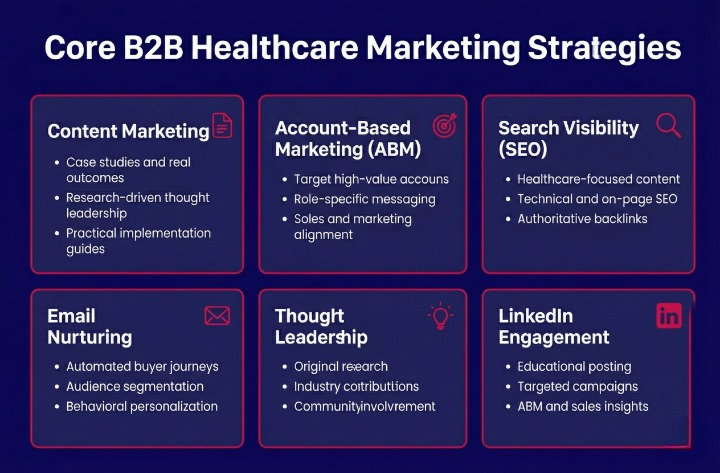
These strategies perform best when executed within a coordinated framework that aligns messaging, channels, analytics, and long buyer journeys across healthcare organizations.
1. Develop a Robust Content Marketing Foundation
High-quality content educates rather than sells, offering practical insights to healthcare professionals who rely on credible, detailed information. Your materials should guide early research, support evaluation, and reinforce trust at every stage of the decision process through creative formats that resonate.
- Clinical case studies: Highlight outcomes, ROI, and workflow improvements supported by real-world data.
- Whitepapers and research reports: Address industry challenges with thorough, well-supported analysis.
- Educational webinars: Offer learning opportunities while showcasing your expertise and solution capabilities.
- Implementation guides: Show prospects how your solution fits into clinical, operational, and IT workflows.
2. Implement Account-Based Marketing (ABM)
ABM enables personalized engagement with high-value hospitals, health systems, and payer organizations. Tailored messaging resonates more deeply across buying committees made up of diverse clinical, operational, and financial stakeholders. Our ABM report shows that 71.2% of organizations already use ABM, reflecting its maturity as a core B2B marketing strategy.
- Target account selection: Use intent data and firmographic fit to identify the most promising accounts.
- Customized content: Create role-specific assets for clinicians, finance leaders, IT teams, and administrators.
- Sales–marketing alignment: Coordinate outreach, timing, and messaging to ensure a unified buyer experience.
3. Optimize for Search Engine Visibility
Most B2B buyers start their research on Google, with 71% beginning the process with a simple search query. For healthcare decision-makers comparing vendors, researching solutions, and validating credibility, search plays a central role in shaping early consideration.
Strong search visibility and digital presence ensures your organization appears during this critical discovery phase, where buyers actively evaluate clinical, operational, financial, and IT solutions. Ranking for the right queries positions your brand as a trusted resource before sales engagement begins.
Key SEO Focus Areas:
- Authoritative content: Create content aligned with healthcare-specific search patterns across clinical, operational, and IT categories.
- Technical SEO: Improve crawlability, site speed, structured data, and mobile performance.
- High-quality backlinks: Earn citations from reputable healthcare and health-tech publications to strengthen credibility.
- Local SEO: Optimize for geographic signals, especially for organizations serving defined regions.
4. Leverage Email Marketing for Nurturing
Email remains a dependable channel for maintaining engagement during long evaluation cycles, especially when buyers compare solutions over weeks or months. According to DemandLoft, B2B healthcare email open rates remain above 35%, underscoring email’s effectiveness when messaging is relevant and well-timed.
- Automated nurture sequences: Deliver content aligned with buyer intent and lifecycle stage.
- Segmentation: Tailor messaging to clinical, financial, technical, and administrative audiences.
- Personalization: Use behavioral and engagement data to increase relevance and impact.
5. Build Trust Through Thought Leadership
Thought leadership shapes early perceptions and positions your organization as a credible resource long before buyers engage with sales. Consistently providing valuable insights helps accelerate trust-building across the buying group.
- Original research: Publish insights aligned with current industry challenges.
- Industry contributions: Write for healthcare publications or speak at conferences and webinars.
- Community presence: Participate in associations, professional groups, and expert panels relevant to your audience.
6. Utilize LinkedIn for Professional Engagement
LinkedIn offers strong access to healthcare executives, evaluators, and technical decision-makers in a professional setting. Its targeting capabilities allow precise outreach without unnecessary spend.
- Consistent posting: Share educational content that reinforces your expertise and brand authority.
- Group participation: Engage in healthcare-focused communities to expand visibility.
- Sponsored campaigns: Target specific job titles, organizations, or regions.
- Sales Navigator insights: Support ABM efforts with account intelligence and relationship signals.
Measuring ROI and Marketing Performance
Demonstrating the value of your marketing investments requires tracking the right metrics and establishing clear attribution models. Understanding how prospects move through the B2B healthcare marketing funnel helps teams measure channel effectiveness and identify where engagement is most likely to convert into pipeline.
Essential Healthcare Marketing Metrics
Cost Per Lead (CPL) and Cost Per Acquisition (CPA) form the foundation of healthcare marketing ROI. However, you need a comprehensive dashboard of metrics to understand true performance.
Track these critical indicators:
- Customer Acquisition Cost (CAC): Total marketing and sales spend divided by the number of new customers or accounts acquired.
- Lead Quality Score: Percentage of marketing-qualified leads that become sales-qualified opportunities.
- Conversion Rate: Percentage of leads that become customers across different channels.
- Customer Lifetime Value (CLV): Total revenue expected from a customer relationship over time.
- Marketing ROI: Revenue generated divided by marketing costs, expressed as a percentage.
- Pipeline Velocity: Speed at which opportunities move through your sales funnel.
Establishing Attribution Models
Attribution complexity challenges many healthcare organizations. Prospective users and healthcare teams often research online, request information, and evaluate solutions across multiple channels. Multi-touch attribution helps you understand which touchpoints contribute most to conversions.
Implement tracking systems that capture the entire buyer journey, use UTM parameters consistently across all campaigns, integrate your marketing automation platform with your CRM, and analyze which content pieces influence decision-making at each stage.
Budget Allocation and Performance Optimization
Recent research suggests healthcare marketing budgets shrank from 9.6% of total revenue in 2023 to 7.2% in 2024. Leaner budgets call for precise channel spending. You must allocate resources strategically based on performance data.
Review your channel performance quarterly, shift budget to high-performing campaigns quickly, test new channels with small allocations before scaling, and maintain a balanced mix across awareness, consideration, and decision-stage tactics.
Emerging Trends Shaping Healthcare Marketing
Staying ahead of industry trends positions your organization for continued success as the healthcare market evolves.
Artificial Intelligence and Predictive Analytics
AI is reshaping B2B healthcare marketing by improving data analysis, personalizing outreach, and enabling smarter, faster decision-making. Our recent analysis of AI adoption across more than 1,200 marketers highlights how quickly these technologies are becoming foundational to modern marketing operations.
Leverage AI for lead scoring and prioritization, predictive analytics to identify accounts showing strong buying signals, chatbots for early prospect engagement, and content personalization based on user behavior. The right marketing technology stack enables these capabilities while maintaining compliance. These capabilities help healthcare organizations deliver more relevant experiences, streamline marketing workflows, and accelerate pipeline performance at scale.
Telehealth and Digital Health Expansion
Telehealth and digital health adoption have accelerated in recent years as healthcare providers seek efficient, scalable, and patient-centric solutions. This shift has created new opportunities for marketers to position their offerings within the broader digital transformation of healthcare.
The opportunity for marketers lies in aligning messaging to address the growing demand for virtual care delivery tools, remote-monitoring capabilities, and workflow optimization across clinical and operational teams.
Position your solutions within this digital transformation narrative by highlighting virtual-care capabilities, seamless integration with existing systems, and measurable ROI through improved efficiency, reduced operational friction, and stronger clinical outcomes.
Privacy-First Marketing Approaches
The U.S. Office for Civil Rights has emphasized that tracking pixels on healthcare sites often capture PHI without user awareness, violating HIPAA. Marketers must ensure all data is either anonymized or processed by a HIPAA-compliant partner with a valid Business Associate Agreement (BAA).
Adopt privacy-first marketing technologies, implement consent management platforms, use aggregated and anonymized data for targeting, and maintain transparent data collection practices.
Conclusion
B2B healthcare marketing requires a sophisticated approach that blends educational content, regulatory compliance, and measurable performance. Success depends on understanding the complex buyer journey, addressing multiple stakeholders with tailored messaging, and maintaining consistent engagement throughout extended sales cycles.
Global healthcare advertising spend is projected to rise from $44.56 billion in 2025 to $67.87 billion by 2033, growing at a 5.4% CAGR. As investment increases, so does the pressure to demonstrate clear ROI. Healthcare organizations that embrace data-driven strategies, prioritize thought leadership, and adopt technologies that support privacy-first and AI-enabled marketing will be best positioned to build trust, accelerate pipeline performance, and stay competitive in a rapidly evolving landscape.
Sources
- Brand Auditors - B2B Healthcare Marketing in 2025: Your Comprehensive Guide - Comprehensive overview of B2B healthcare marketing strategies and digital channels. https://brandauditors.com/blog/b2b-healthcare-marketing/
- Keragon - B2B Healthcare Marketing: 2025 Guide - Insights on healthcare technology market growth and strategic marketing approaches. https://www.keragon.com/blog/b2b-healthcare-marketing
- B2B Marketing Organization - B2B Healthcare Marketing in 2025: Strategies, Tools, Compliance & Case Studies - Detailed analysis of compliance requirements, stakeholder dynamics, and strategic approaches. https://www.b2b-marketing.org/b2b-healthcare-marketing-in-2025-strategies-tools-compliance-case-studies-for-success/
- B2B Marketing Organization - B2B Healthcare Marketing Strategies: How to Win in 2025 - Trends and competitive strategies for healthcare marketers. https://www.b2b-marketing.org/b2b-healthcare-marketing-strategies-how-to-win-in-2025/
- Callbox Inc - B2B Healthcare Marketing in 2025: Trends to Drive Growth - Analysis of buyer journey and marketing importance in healthcare. https://www.callboxinc.com/growth-hacking/b2b-trends-drive-healthcare-marketing/
- MedicoLeads - 2025's Top B2B Healthcare Marketing Trends - Data analytics and personalization trends in healthcare marketing. https://blog.medicoleads.com/healthcare-marketing-trends/
- Medical Flow - B2B Healthcare Marketing Success Guide for 2025 - Budget projections, email marketing statistics, and content marketing effectiveness. https://medicalflow.co/blog/b2b-healthcare-marketing/
- Digital Silk - All 37 Healthcare Marketing Statistics That Drive Results In 2025 - Comprehensive healthcare marketing statistics including digital ad spending and patient behavior. https://www.digitalsilk.com/digital-trends/healthcare-marketing-statistics/
- Health Launchpad - The Changing Buyer Journey: Key Insights for Healthcare B2B Marketers - Research on buyer journey complexity and lead quality focus. https://healthlaunchpad.com/buyer-journey-insights-for-b2b-healthcare-marketers/
- Downing et al. - Harnessing Internet Search Data as a Potential Tool for Medical Diagnosis: Literature Review - Research on integrating internet search behavior with clinical data for earlier diagnosis and insights into health conditions.https://pmc.ncbi.nlm.nih.gov/articles/PMC11862766/
- DemandLoft - The Complete Guide to B2B Healthcare Marketing: Strategies, Statistics, and Success - Comprehensive overview of B2B healthcare marketing best practices, digital strategy implementation, and key trends for engaging healthcare decision-makers.
https://demandloft.com/blog/b2b-healthcare-marketing/ - Market Data Forecast - Healthcare Advertising Market Size & Growth Report, 2025–2033 - Global market analysis showing growth of healthcare advertising spend, leading regional trends, and digital media’s increasing share.
https://www.marketdataforecast.com/market-reports/healthcare-advertising-market - Health Union - Why Pharma and Healthcare Advertising Spending Continues to Rise - Analysis of rising digital ad spend in healthcare for 2025, driven by industry evolution, personalized engagement, and precision-targeted strategies.
https://health-union.com/blog/digital-ad-spend-increasing-in-healthcare/

Turn Healthcare Insightinto Accelerated Growth
Our healthcare growth teams work closely with you to design strategies tailored to your unique goals and market dynamics, fully focused on growth.
Book a Strategy Session →
Accelerating your growth with expert strategies in marketing, branding, research & insights, sales and lead generation to maximize healthcare impact.