
Outcomes Articles
Healthcare Marketing Agency Framework for B2B Success
January 4, 2026
You navigate a healthcare environment defined by long sales cycles, regulated messaging, and multi-stakeholder decision-making. These conditions make traditional B2B tactics ineffective because they overlook how hospitals, payers, and medical groups evaluate products and services.
A specialized healthcare marketing agency helps you work through this complexity with structured strategy, compliant content, coordinated campaigns, and the systems that support long buyer journeys. In this guide, you’ll learn how a full-service framework aligns messaging, channels, analytics, and account engagement to strengthen your B2B performance.
Key Takeaways
- Healthcare is different: Regulated messaging and complex buyers require specialized, structured marketing systems.
- Frameworks create clarity: Strategy, execution, analytics, and optimization must operate as a single connected system.
- Data drives decisions: Healthcare marketing analytics and CRM workflows improve outcomes and revenue alignment.
- Expertise matters: A specialized healthcare marketing agency reduces risk and accelerates long procurement journeys.
- ABM elevates performance: Personalized programs work well with large healthcare organizations and multi-role buying committees.
Understanding the Healthcare Marketing Landscape
Healthcare buyers make decisions slowly because purchasing power spreads across clinicians, administrators, IT leaders, and financial teams. Each group evaluates solutions differently, so your marketing must deliver clear, validated, and compliant messaging that satisfies all groups.
Why Healthcare Marketing Requires Its Own Framework
You work within systems governed by HIPAA, FDA, CMS, and industry-specific guidelines. These rules shape your narrative by limiting the claims you can make and requiring careful oversight. A missing disclaimer or unsupported benefit statement can create delays or compliance issues.
You also face longer procurement cycles compared to typical B2B industries. Stakeholders expect educational content supported by clinical or operational evidence that helps them justify decisions to committees and compliance reviewers. Most importantly, 72% of medical buyers begin their research with search, and B2B buyers are often 60-90% through their decision process before contacting a vendor, making early visibility essential for success
These conditions highlight the need for a framework designed specifically for healthcare organizations.
Why Healthcare Is Unique
- Regulated environments: Messaging must follow HIPAA, FDA, CMS, and sometimes ISO guidelines.
- Complex decision-makers: Clinicians, administrators, and IT or finance leaders influence decisions.
- Slow procurement cycles: Evaluations often require months or years depending on product category.
- Evidence-driven expectations: Buyers seek validated clinical or operational outcomes.
- High-risk decisions: Solutions influence patient care, safety, and workflow efficiency.
These factors make healthcare one of the most challenging B2B environments, requiring a structured approach to B2B healthcare marketing.
What a Healthcare Marketing Agency Actually Does
A healthcare marketing agency brings specialized knowledge that aligns messaging, channels, content, analytics, and compliance requirements. You get structured support designed to match healthcare buyer behavior and long procurement cycles.
Generalist agencies often misunderstand clinical value propositions, regulatory rules, or stakeholder expectations. A healthcare-focused partner helps you prevent missteps that slow growth or introduce unnecessary risk.
Core Services You Rely On
A healthcare marketing agency provides strategic clarity, operational execution, technical insight, and long-term optimization. You receive support across content development, paid media, analytics, medical device marketing, and structured demand generation programs.
Digital channels dominate modern healthcare marketing, with over 72% of healthcare ad budgets now allocated to online marketing efforts, reinforcing the need for strong digital execution and technical expertise.
These services fall into several essential categories.
Core Service Areas
- Messaging and positioning: Industry-aware narratives aligned with stakeholder priorities.
- Content creation: Clinical stories, whitepapers, guides, and technical explainers through healthcare content marketing.
- B2B healthcare campaigns: Multi-channel programs across search, social, and industry publications.
- Healthcare lead generation: Targeted programs focused on high-intent healthcare audiences.
- Medical device marketing: Evidence-based content aligned with regulatory requirements.
- Healthcare marketing analytics: Cross-channel reporting and attribution models.
- ABM for healthcare: Personalized engagement programs for high-value accounts.
Together, these capabilities create a cohesive ecosystem that supports every stage of the healthcare buyer journey.
Why Full-Service Solutions Drive Better B2B Outcomes
Fragmented marketing slows execution and increases compliance risk. When messaging, content, paid media, and analytics live inside separate workflows, you struggle with inconsistent communication, longer review cycles, and incomplete attribution.
A unified approach gives you structured governance, faster approvals, and more reliable results. For a deeper look at what integration actually requires, see what full-service healthcare marketing really means. This is critical in healthcare because buyers evaluate credibility across every touchpoint and expect disciplined, evidence-driven communication.
The Limitations of Fragmented Marketing
Fragmentation leads to mismatched claims, duplicated efforts, and disconnected campaign logic. You may also lose visibility into which programs influence pipeline development because no single team owns the entire buyer journey.
Compliance becomes harder because inconsistencies across materials require additional reviews. These issues cause delays, reduce engagement, and increase overall marketing costs.
How Integrated Frameworks Improve Results
A full-service healthcare marketing agency aligns strategy, execution, analytics, and optimization under one coordinated system. You gain a single source of truth that strengthens performance and reduces operational friction.
These improvements become clear when you evaluate the benefits of unified systems.
Key Benefits of Full-Service Support
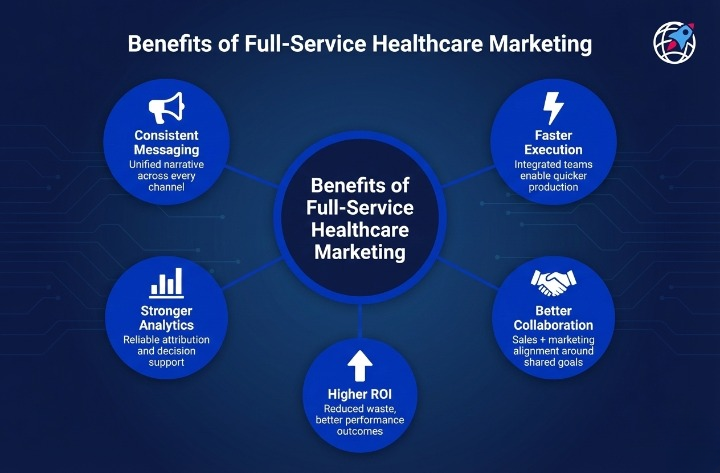
- Consistent messaging: You maintain a unified and compliant narrative across every channel.
- Faster execution: Integrated teams accelerate production and campaign activation.
- Stronger analytics: You gain reliable data for attribution and decision-making.
- Better collaboration: Sales and marketing align around shared goals and timelines.
- Higher ROI: Cohesive operations reduce waste and strengthen pipeline performance.
These benefits matter most in healthcare because long sales cycles magnify inefficiencies and reward operational consistency.
A Full-Service Healthcare Marketing Agency Framework
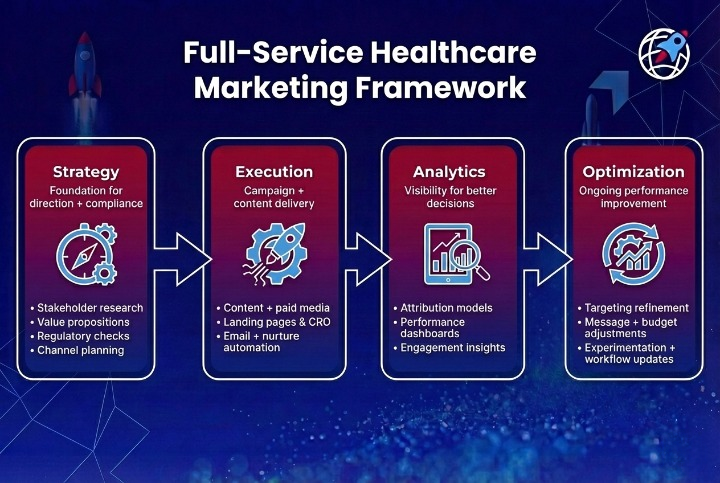
A structured framework helps you navigate the complexity of healthcare sales cycles. When your agency unifies strategy, execution, analytics, and optimization, your marketing becomes predictable, compliant, and more effective.
1. Strategy
Strategy establishes the foundation that guides your messaging, channel choices, and content priorities, which then get translated into a quarterly marketing plan with defined KPIs. You define stakeholders, value propositions, and regulatory constraints early to avoid slowdowns later.
Strategy includes several essential components that shape your direction.
Strategic Components
- Buyer and decision-maker research
- Clinical, operational, and financial value propositions
- Regulatory checks for compliant messaging
- Competitive analysis and market mapping
- Multi-channel planning based on buyer behavior
These activities are often structured through tools like healthcare SWOT analysis, helping teams evaluate internal capabilities alongside external market forces before defining priorities.
Together, these elements help you build a strategic foundation that aligns with healthcare’s unique purchasing dynamics.
For a practical, real-world perspective on how strong healthcare marketing strategy drives success, hear directly from Saul Marquez, CEO of Outcomes Rocket, in this insightful breakdown.
2. Execution
Execution translates your strategy into campaigns, content, and multichannel engagement. You rely heavily on educational content because healthcare buyers expect clarity, credibility, and evidence-supported detail.
Execution activities fall into several operational categories.
Execution Components
- Creation of clinical and educational content
- Paid media programs across search, social, and niche healthcare outlets
- Landing pages and conversion flows optimized for compliance
- Email automation and nurture sequences
- Event support for conferences and medical showcases
These execution elements help you deliver consistent value across the long journeys healthcare buyers take.
3. Analytics
Analytics give you visibility across long and complex procurement cycles. Because healthcare buying isn’t linear, you need attribution models that measure influence across clinical, operational, and financial stakeholders.
Analytics includes several core components that strengthen your decision-making.
Analytics Components
- Multi-touch attribution
- Cross-channel performance dashboards
- Content engagement insights
- Budget optimization recommendations
- Compliance-safe tracking methods
These analytical capabilities help you identify what truly moves buyers forward and where optimization creates the highest ROI.
4. Optimization
Optimization ensures your programs improve over time rather than remaining static. You refine targeting, adjust budgets, and update messaging based on real-world performance data.
According to our latest report on AI in marketing, 89.6% of marketers now use AI in their processes, reinforcing how technology-driven optimization has become essential to modern marketing performance. Many of these shifts reflect broader healthcare marketing trends shaping how B2B organizations adapt and grow.
Optimization unfolds through several recurring actions.
Optimization Steps
- Improving targeting based on engagement signals
- Refining content to increase relevance and clarity
- Reallocating budgets to higher-performing channels
- Running experiments on messaging and CTAs
- Updating nurture workflows as data evolves
These actions support long-term consistency and help your marketing stay aligned with changing buyer expectations.
Using ABM for Healthcare to Target High-Value Accounts
Account-based marketing is highly effective for your healthcare organization because influence is concentrated within a small number of high-value accounts.
These organizations rely on committees of clinicians, administrators, IT leaders, and financial stakeholders. Each group evaluates your solution differently, so you need coordinated and personalized communication that addresses their specific concerns.
With ABM, you focus your efforts on the accounts that offer the strongest revenue potential. According to our report on the state of ABM, coordinated programs deliver an average ROI of 137%, with nearly half of organizations reporting that ABM generates their highest return, reinforcing how alignment accelerates results in complex healthcare buying cycles.
Instead of broad campaigns, you deliver targeted messaging that reaches each decision-maker and builds engagement across the full committee. This approach helps you make progress in long, complex procurement cycles where trust and clarity matter.
Key Elements of Healthcare ABM
- Tiered account lists: Helps you identify the healthcare organizations with the highest potential for impact.
- Personalized assets: Gives each stakeholder content that reflects their clinical, operational, or technical priorities.
- Multi-channel orchestration: Ensures your message reaches decision-makers across search, social, email, events, and industry platforms.
- Sales and marketing coordination: Aligns both teams so outreach remains consistent, compliant, and relevant throughout the evaluation process.
- Pipeline monitoring and reporting: Shows where each account stands, how they are engaging, and where additional support may be needed.
ABM empowers you to influence complex committees more effectively, build early trust, and guide strategic accounts through extended evaluation cycles.
How Using a CRM Strengthens ABM and Long Buyer Journeys
Effective ABM depends on having clear visibility into your accounts, the stakeholders involved, and how they engage with your marketing. A healthcare CRM provides this foundation by organizing key information about clinicians, administrators, and technical reviewers inside a unified system. HIPAA-compliant platforms like HubSpot and Salesforce Health Cloud offer the data management and automation capabilities these complex sales processes require. This allows you to personalize communication, maintain alignment across teams, and manage long decision cycles with greater control.
A CRM also makes ABM measurable. With account-level data, engagement signals, and sales activity in one place, you can better understand how your outreach influences progression through the pipeline.
What CRM Enables Inside Healthcare ABM
- Account and stakeholder visibility: Gives you a complete map of who is involved in the decision and how each person interacts with your content.
- Segmentation for role-specific messaging: Supports more relevant communication by specialty, department, influence level, or engagement behavior.
- Engagement scoring and prioritization: Highlights accounts showing meaningful interest so your team knows where to focus next.
- Coordinated outreach and sales enablement: Improves timing and consistency in communication across marketing and sales.
- Reliable attribution and pipeline clarity: Lets you connect ABM efforts to account movement, opportunity creation, and revenue outcomes.
When you combine ABM with a healthcare-focused CRM, you gain a scalable system for managing complex committees, delivering more relevant value, and strengthening your pipeline across long healthcare procurement cycles.
Healthcare Lead Generation That Works
Lead generation in healthcare prioritizes quality over quantity. Because buyers expect educational value and credible insights, your campaigns must emphasize clarity, evidence, and practical relevance, reflecting how healthcare organizations build trust through marketing.
You attract fewer leads than typical B2B industries, but they are more qualified and more aligned with long-term revenue opportunities.
How Healthcare Lead Generation Differs
Healthcare requires intent-driven programs, supported by strong content and precision targeting. Educational content forms the backbone of this approach because it builds trust and differentiates your expertise through creative approaches that cut through noise.
Healthcare lead generation relies on several proven channels.
Proven Lead Gen Channels
- Industry publications and niche platforms
- Search marketing for specialized queries
- Webinars and expert-led sessions
- SEO-driven thought leadership
- Clinical storytelling and case studies
These channels work well because they match how healthcare stakeholders explore and evaluate solutions.
How Medical Device Marketing Fits Into the Framework
Medical device marketing requires compliance, scientific accuracy, and technical clarity. Buyers expect validated claims, comparative data, and meaningful outcomes that reflect real clinical scenarios.
Agencies help you balance regulatory expectations with persuasive and role-specific content.
Why Medical Device Marketing Requires Precision
You must communicate complex information while following FDA guidelines and supporting clinicians, administrators, and procurement teams. This balance requires expertise in clinical writing, compliance processes, and multi-stakeholder communication.
Medical device marketing includes several essential components.
Essential Components of Medical Device Marketing
- Regulatory-aligned messaging
- Clinical evidence storytelling
- Persona-specific communication
- Channel strategies for medical devices
- Sales enablement materials
These components support accurate, compliant, and persuasive communication that meets the expectations of medical device buyers.
How to Choose the Right Healthcare Marketing Agency
Choosing a partner requires evaluating expertise, regulatory experience, analytics maturity, and the ability to support full-funnel healthcare programs. You need a partner who understands clinical messaging, stakeholder behavior, and healthcare compliance.
Agencies with deep healthcare experience help you reduce risk, accelerate approvals, and achieve more consistent performance across all channels.
Key Evaluation Criteria
The best agency brings a blend of strategic clarity, operational maturity, and compliance knowledge. They support you with systems that align content, campaigns, analytics, and sales enablement.
Use this checklist to evaluate potential healthcare agency partners.
Evaluation Checklist
- Demonstrated healthcare expertise
- Regulatory knowledge (HIPAA, FDA, CMS)
- Strong analytics capabilities
- CRM and workflow integration support
- Proven ABM execution
- Full-funnel program experience
- High-quality clinical and educational content
These criteria help you select a partner capable of supporting your long-term growth and operational needs.
Conclusion
Success in healthcare marketing comes from aligning strategy, compliant execution, analytics, and ongoing optimization into a single, well-coordinated system. A specialized healthcare marketing agency supports this alignment and helps you navigate regulatory pressure, multi-stakeholder buying groups, and long procurement cycles with confidence.
When this framework is applied consistently, your marketing becomes clearer, more credible, and more predictable in its impact. It gives you a reliable way to build trust with healthcare decision-makers, reduce risk across every stage of the buyer journey, and create sustainable B2B growth in a highly regulated and competitive environment.
Sources
- https://www.sermo.com/business/hcp-sentiment-study-series/
- https://www.linkedin.com/posts/evanogden_healthcaremarketing-physicianmarketing-medicalpracticegrowth-activity-7358512281330077698-Y9gX
- https://www.digitalsilk.com/digital-trends/healthcare-marketing-statistics/?utm_source=chatgpt.com
- https://www.hhs.gov/hipaa/for-professionals/privacy/index.html
- https://www.hhs.gov/hipaa/for-professionals/security/index.html
- https://www.hhs.gov/hipaa/for-professionals/privacy/guidance/marketing/index.html
- https://www.fda.gov/medical-devices/device-advice-comprehensive-regulatory-assistane/how-study-and-market-your-device
- https://www.fda.gov/medical-devices/device-advice-comprehensive-regulatory-assistance/medical-device-labeling-basics
- https://www.cms.gov/medicare/health-safety-standards/certification-compliancehttps://www.cms.gov/medicare/health-plans/managed-care-marketing
- https://www.iso.org/sectors/health
- https://brandauditors.com/blog/b2b-healthcare-marketing/
- https://www.thespotonagency.com/a-guide-to-b2b-healthcare-marketing-how-to-attract-and-convert-in-2025
- https://www.activemarketing.com/blog/b2b-marketing/b2b-marketing-company-fundamentals-for-healthcare-success/
- https://www.kunocreative.com/blog/b2b-healthcare-marketing-strategies
- https://medicalflow.co/blog/b2b-healthcare-marketing/
- https://revnew.com/blog/how-to-leverage-abm-for-healthcare-leads
- https://www.bostondigital.com/insights/why-account-based-marketing-key-success-healthcare-marketers
- https://www.syneoshealth.com/insights-hub/account-based-marketing-marketing-strategy-simplifies-health-system-account-outreach

Turn Healthcare Insightinto Accelerated Growth
Our healthcare growth teams work closely with you to design strategies tailored to your unique goals and market dynamics, fully focused on growth.
Book a Strategy Session →
Accelerating your growth with expert strategies in marketing, branding, research & insights, sales and lead generation to maximize healthcare impact.