Outcomes Articles
Your Medtech Prototype Works. What Could Still Stop Production?
October 26, 2026
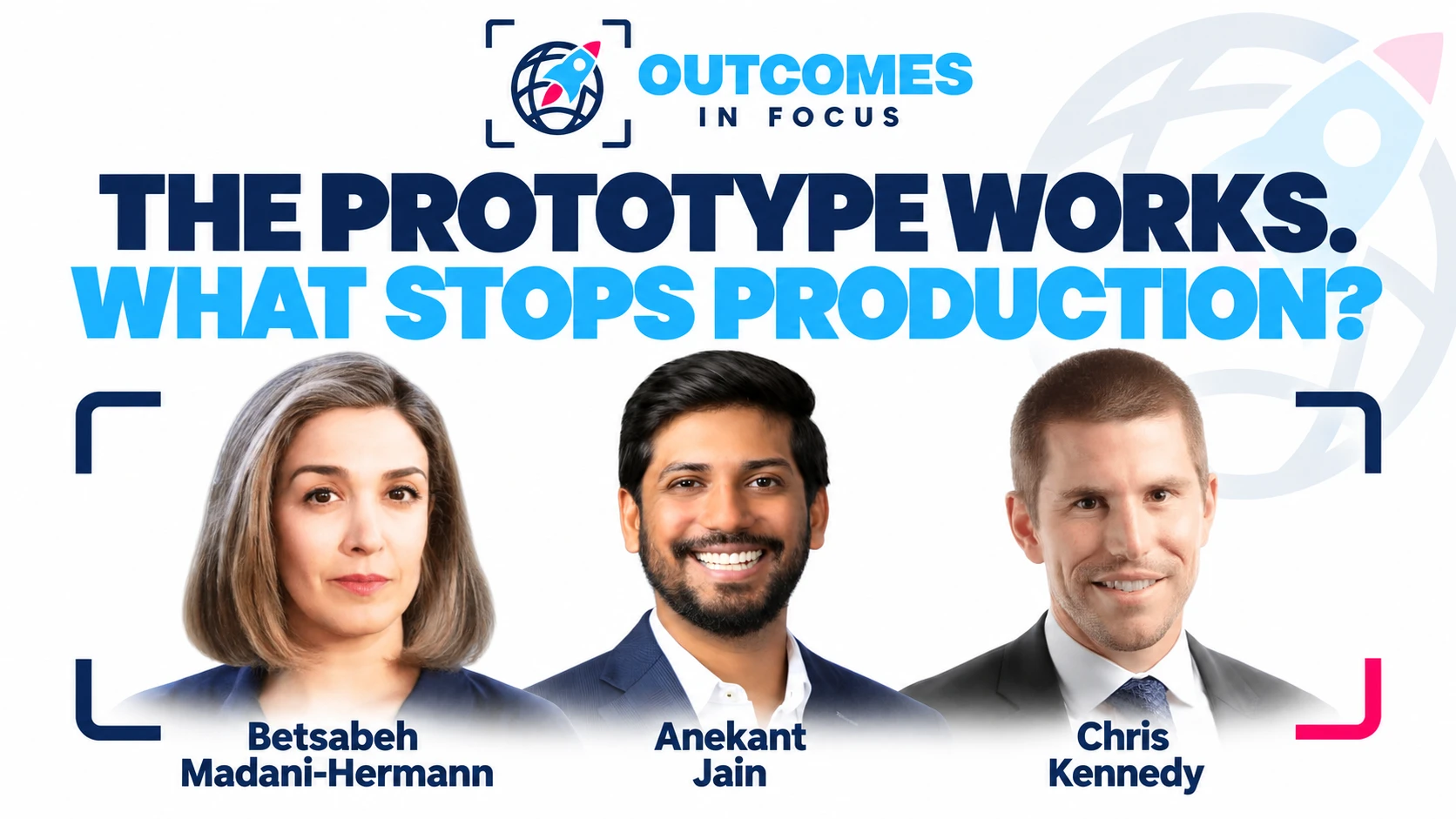
Featuring insights from Betsabeh Madani-Hermann, Anekant Jain, and Chris Kennedy hosted by our CEO, Saul Marquez.
The prototype works. The next milestone can still fail because a needed purchase takes too long. In an Outcomes Rocket interview, Betsabeh Madani-Hermann describes a Philips team uncovering that kind of procurement dependency before it became a surprise. They did it by imagining their promising project had already failed, then asking why.
That exercise, a premortem, shifts attention from the successful demonstration to the assumptions behind the next commitment. For a medtech founder preparing to scale, a supplier delay, an unqualified process or an unassigned specialist responsibility can matter as much as the prototype's performance. More enthusiasm for the design won't answer those questions.
Before committing to production, test what still has to be true. Betsabeh's planning practice, Anekant Jain's industrial manufacturing perspective and Chris Kennedy's account of continuing software work offer three ways to examine the gap. The result should be a specific uncertainty, an owner and a finding that could change the investment decision.
Use the Premortem to Expose the Untested Dependency
Betsabeh, then Global Head of Research at Philips, describes challenging the optimism around an exploratory innovation program within its first few weeks. The team imagines the project has been shut down three years into the future, then investigates what went wrong. This is a planning exercise, not a reported account of that project actually failing.
The exercise forces a distinction between problems the team can control and dependencies outside its direct control. Internal obstacles might be addressed through changes in planning, resources or execution. External dependencies may require earlier conversations, stronger relationships or preparation for circumstances the team cannot dictate.
One of Betsabeh's examples involved procurement. During a premortem, the team recognized that purchasing processes could become an unexpected obstacle. Something needed for the project might take too long to obtain, threatening a milestone. Procurement hadn't previously received much attention in these early exploratory programs, where purchasing concerns were more commonly associated with larger product lines.
Recognizing that dependency allowed the team to begin conversations and education earlier. Betsabeh described that preparation as helpful, although the interview doesn't establish that a specific delay was prevented.
For a medtech founder preparing to scale, the application is practical. Imagine the next production milestone has been missed. Was an outside supplier unable to deliver? Did the team underestimate the work required to qualify a process? Was a critical responsibility left without someone equipped to handle it?
Those questions are an adaptation of Betsabeh's practice, not a Philips manufacturing protocol. Their value comes from identifying assumptions while there's still an opportunity to investigate them.
Betsabeh also explained an important limitation. A premortem reduces risk without eliminating it. Even well-prepared projects can miss milestones because of unexpected findings, changing strategies or circumstances that planning cannot resolve. Philips' exploratory programs sometimes have to stop when those milestones aren't met.
Preparation should make those decisions better informed, including the decision to stop rather than keep funding an assumption that hasn't held up.
For a manufacturing project, the next assumption to test is whether the intended result can be produced repeatedly under the required conditions.
Test the Manufacturing Promise, Not Just the Shape
Anekant Jain, Manager, Polymer Technologies at EOS at the time of his Outcomes Rocket interview with Saul Marquez, makes an important distinction between 3D printing and industrial additive manufacturing. Creating a part demonstrates what's technically possible. Manufacturing that part consistently introduces requirements that a successful prototype may never have tested.
Anekant identifies qualification, scalability, yield, turnaround and uptime as essential considerations in industrial manufacturing. Each raises a different question. Can the process meet the intended product's requirements? How much acceptable output can it produce? What happens when production volume increases? Can orders be completed within the required timeframe, and can the equipment operate reliably enough to support that schedule?
A single successful prototype doesn't establish all of these conditions. The team needs evidence from the intended manufacturing process, materials and operating conditions.
Apply that distinction to the premortem. If the next milestone is reliable production, an attractive sample is not the entire evidence package. Qualification, acceptable yield and equipment availability belong in the discussion before a team promises delivery at a larger volume. These are questions to investigate, not failures reported by Anekant.
His interview also highlights the difficulty of qualification in advanced manufacturing. New materials and production techniques create opportunities for customized implants, prosthetics and other applications, but technical possibility doesn't establish that a particular manufacturing process is qualified or that its output is clinically suitable.
Before the next commitment, product, manufacturing and quality leads should identify the evidence already available, the tests still needed and who owns each unresolved requirement. Acceptance criteria must reflect the actual device, material and intended use. Anekant's interview offers useful areas to examine, not universal performance thresholds.
The remaining work also requires people who can own it after the demonstration team moves on.
Assign the Capabilities That Must Continue
A production plan can name the equipment and still leave the continuing work without an owner. For products that depend on software, that gap extends well beyond the initial build.
Chris Kennedy, Vice President of Partnerships at Prolucid Technologies at the time of his Outcomes Rocket interview, describes this challenge from the medical-device software perspective. Prolucid develops software for devices, connected applications and cloud-based medical technologies, supporting work that extends into design controls, quality systems and cybersecurity.
Chris explains that medtech founders already face demanding responsibilities involving product development, regulation, reimbursement and quality management. Building and maintaining a specialized software team adds another substantial commitment. Bringing in an experienced partner is one option, but his account doesn't establish that outsourcing is necessarily faster, cheaper or more effective than building internally.
For a product that requires software, the scale-up premortem should examine what happens after initial development. Who maintains the software when requirements change? Who manages interfaces between the device and connected systems? Who investigates cybersecurity concerns or unresolved quality issues? These responsibilities need capable owners, whether the work happens internally or through a specialist provider.
Not every manufactured medical product requires this software capability. Identify the specialist work the intended product actually needs. Avoid adding unnecessary functions or assuming that obtaining external expertise transfers away the manufacturer's responsibilities.
A prototype can succeed while leaving continuing work poorly defined. Identifying that work, determining who can perform it and assigning responsibility gives the team another assumption to investigate before committing additional resources.
The next milestone should now rest on explicit evidence and ownership, not confidence borrowed from the prototype.
Make the Next Commitment Conditional on What You Learn
Before committing to the next stage of production, bring your program, product, manufacturing and quality leads together for a scale-up readiness review. Include procurement and software specialists where those dependencies apply.
Use the premortem to create a decision record for each significant concern:
- Assumption: What is the team counting on being true?
- Available evidence: What has the team actually demonstrated?
- Unresolved dependency: What could still prevent the next milestone?
- Responsible owner: Who will investigate or complete the necessary work?
- Decision-changing result: What finding would cause the team to change the commitment?
This is an editorial application of the premortem approach, not a validated manufacturing protocol. The review cannot substitute for qualification, safety evidence or product-specific regulatory requirements.
Use the findings to proceed, revise or stop through your organization's established decision-making process. If procurement is the concern, involve the purchasing owner before accepting the milestone. If repeatability is unproven, identify the manufacturing evidence needed. If continuing software work is unassigned, settle the capability and ownership question before treating the build as complete.
A working prototype earns the next question, not an automatic yes to the next commitment.
About the Conversations
These are three separate Outcomes Rocket conversations, not a shared case study. During the time of recording, the guest names and titles were as follows: Betsabeh Madani-Hermann, Global Head of Research at Philips. Anekant Jain, Manager, Polymer Technologies at EOS. Chris Kennedy, Vice President of Partnerships at Prolucid Technologies.
Resources

Turn Healthcare Insightinto Accelerated Growth
Our healthcare growth teams work closely with you to design strategies tailored to your unique goals and market dynamics, fully focused on growth.
Book a Strategy Session →
Accelerating your growth with expert strategies in marketing, branding, research & insights, sales and lead generation to maximize healthcare impact.