Outcomes Articles
Your Clinical AI Has an Answer. Can a Clinician Check It?
October 14, 2026
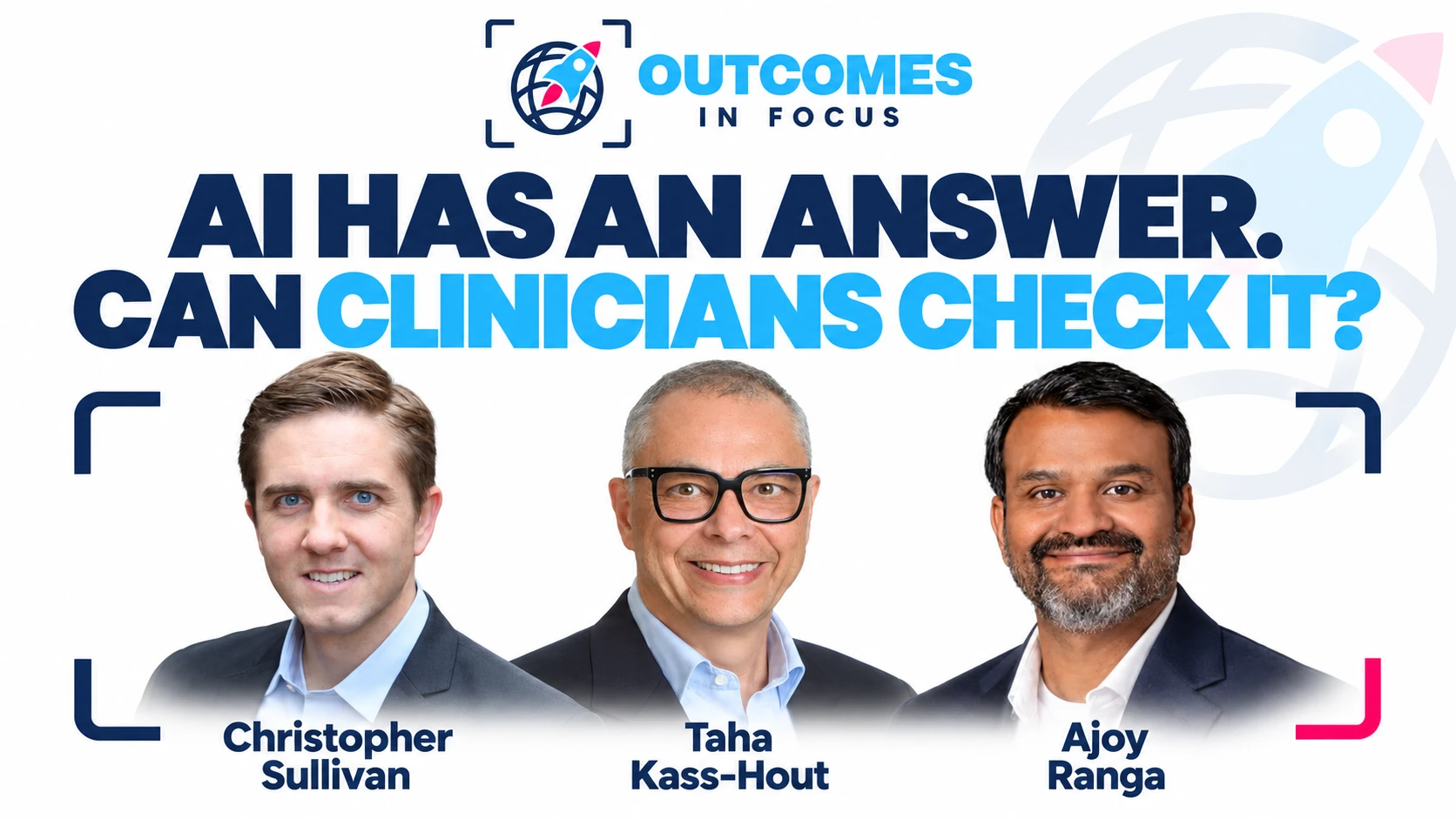
Featuring insights from Christopher Sullivan, Taha Kass-Hout, and Ajoy Ranga hosted by our CEO, Saul Marquez.
Your clinical AI has produced an answer. Can the team show a clinician where it came from, who keeps that information current and who can correct it? If those questions are difficult to answer in a review, they will still need owners after deployment.
Christopher Sullivan drew a useful distinction in his discussion of UpToDate Connect: delivering clinical content through an interface and maintaining the knowledge behind it are separate responsibilities. An impressive application still needs people who own updates and corrections.
Bring those people into the next prototype review or content-licensing discussion. Agree on source access, update responsibilities, human review and support before signing a deployment agreement. Once clinicians build a workflow around the application, changing those arrangements becomes harder.
Who Keeps the Clinical Knowledge Current?
Christopher described UpToDate Connect as an API-based mechanism that allows digital-health companies to provide existing UpToDate information inside their own applications. The underlying clinical content hadn't changed. The delivery arrangement lets clinicians reach it within the software they use, rather than leaving that workflow for a separate lookup.
His concern was that engineering capability and clinical editorial capability aren't interchangeable. Some technology companies can build and distribute a sophisticated application without having clinicians or an established editorial process to maintain the knowledge it depends on. Others have access to content but don't treat maintenance as their core operation.
At Wolters Kluwer, Christopher described physicians, nurse practitioners and pharmacists continually contributing to its clinical information products. He also discussed an announced UpToDate Connect integration with Lumeris's Tom primary care platform. This illustrates how maintained knowledge can be delivered within an AI-supported workflow. The partnership announcement does not independently establish reduced burnout, better treatment decisions or clinical outcomes.
A content agreement therefore needs more than permission to retrieve a source. Who is responsible for updating evidence after the application goes live? The parties should identify the source steward, how changes are communicated, how previous versions are handled, how errors are reported and who investigates a reported defect. Those duties need staff, defined access and recurring resources.
Can the Clinician Follow the Source?
Taha Kass-Hout described a perinatal care application that GE HealthCare co-designed with HCA Healthcare and clinicians across twelve hospitals. The intended workflow brings maternal vital signs, fetal information, monitoring traces and relevant protocols into one view. Instead of piecing together information from disconnected screens, the clinician can examine relevant signals together.
That design illustrates why source visibility is a usability requirement. A clinician needs to know where information originated and whether the detail being presented applies to the situation in front of them. A citation isn't particularly useful when it is detached from the conclusion the system displays, or when its timing and context remain hidden.
Taha discussed access controls, records of who accessed data, logs of system actions and explanations linking AI-supported decisions to their underlying information. These are capabilities and principles he described, not independent proof that every control performs reliably in clinical use. The perinatal collaboration provides a concrete workflow example, but the available accounts do not establish comparative patient outcomes or confirm that every broader control was tested in that application.
A product review should make the question tangible. Can the clinician identify which information supports this particular answer? Can they inspect its source and context without asking an engineer to reconstruct the application's internal process? Can they distinguish an answer that needs a closer look from information that is relevant to their immediate task?
Who Can Review, Correct, or Roll Back an Answer?
Suppose a clinician finds that an AI-supported answer appears outdated or doesn't fit a patient's circumstances. Source visibility supplies a starting point, but it doesn't determine who investigates, whether the output remains available during the investigation or how other users are notified when something changes. Those responsibilities have to exist beyond the screen.
Taha described controls intended to support this work: tracking access, recording actions, tracing decisions and rolling back a change when an algorithm isn't doing what it should. These are useful requirements to examine with a vendor. The description alone does not prove a control is operational in every deployment or independently validated. Reversing a software change is also different from reversing a clinical decision someone has already acted upon.
Ajoy Ranga added an organizational perspective from UST. He discussed governance approaches that could accommodate organizations with different financial and technical resources and the need for human oversight when AI is used in healthcare. That places an obligation on both the product vendor and the organization choosing to use it: a person needs the authority, information and time to evaluate a concern.
Who can act when the information needs correcting? A clinical reviewer may determine the significance of an issue, a content partner may maintain the underlying evidence, an engineering team may control the application and a healthcare organization may decide whether to continue using it. Without agreed responsibilities, every group can assume another group is handling the response.
The operational process should specify where concerns go, how they're triaged, who can update or suspend the output and how changes are communicated. An action record should make investigation possible without exposing information to people who aren't authorized to see it. A rollback procedure needs a defined scope and a responsible operator. These choices depend on intended use and the consequences of an error, rather than one generic rule for every clinical application.
Can the Team Sustain These Responsibilities?
Ajoy raised a practical concern about governance for smaller healthcare organizations. Large enterprises may fund dedicated AI governance programs. Smaller organizations still need protections appropriate to their use, although they may not be able to employ the same teams or run the same infrastructure. Ajoy described adapting governance frameworks to different organizational sizes and resources rather than applying one expensive arrangement everywhere.
Response time is part of this equation. A clinician trying to complete a task may find an application difficult to use if every answer takes too long. Ajoy discussed inference performance and computing hardware as possible technical considerations. Faster computation can require additional resources, and the budget also has to accommodate maintaining clinical evidence, reviewing incidents and supporting the system after deployment.
The data isn't always tidy, either. Ajoy described working with messy and redundant data rather than waiting for perfect inputs. That makes data ownership, reconciliation and handling incomplete information part of the production plan. A larger context window doesn't eliminate hallucinations or provide a guarantee of accuracy, and technical design choices need to be judged against the actual intended workflow.
Ajoy also discussed how relatively small teams can build prototypes, demonstrate a user experience and change direction quickly. That's useful for deciding whether the design solves a problem worth pursuing. A successful demonstration doesn't prove that the organization can afford to operate the result. Licensing, computing, data maintenance, monitoring and correction support continue after the prototype review.
For a founder, these costs belong in the commercial agreement, alongside the responsibilities they fund. Identify who pays for new clinical-content versions, who maintains access and action records, who makes clinical reviewers available and who responds when an answer is challenged. Compare the expected response and review performance with the available staff and resources. A platform can work technically while the proposed operating arrangement remains unaffordable.
Put the Responsibilities on the Table
Before your next clinical prototype review, content-licensing agreement or deployment commitment, bring the content owner, product and engineering leads, and designated clinical reviewer into the same discussion. Include the buyer's clinical, IT/security, legal, operational and finance representatives as their responsibilities and budgets require.
Prepare a trust responsibility map that names who owns:
- Clinical content: Current evidence, sources and versions.
- Traceability: Access records and logs of system actions.
- Human review: The designated reviewer and the authority to act on a concern.
- Corrections: Where reports go, who investigates and how users are told about changes.
- Rollback: What can be reversed, who can do it and the procedure's limits.
For each responsibility, record an accountable owner, staff and budget, evidence of readiness and an escalation process. Ask the team to demonstrate what a clinician can see and do when an answer needs checking. This map is an editorial synthesis informed by three separate conversations, not a framework jointly endorsed by the guests.
Use the review to agree to a defined intended use, narrow the clinical reliance where controls remain incomplete or defer the deployment commitment until critical gaps have owners and adequate supporting evidence. Accuracy, intended-use suitability, regulatory requirements and clinical outcomes still need their own assessment. Assigning responsibility cannot substitute for those tests.
Christopher's distinction between delivering clinical knowledge and maintaining it should shape the agreement you sign. A fast answer still needs a source a clinician can inspect and a process for challenging and correcting it.
Before the next review ends, choose one answer and ask the team to follow its source, report a concern and demonstrate who can act. Record any gap, its owner and the evidence needed to close it. Make the deployment decision within the intended use and controls the team can actually support.
About the Conversations
These are three separate Outcomes Rocket conversations, not a shared case study. During the time of recording, the guest names and titles were as follows: Christopher Sullivan, Vice President and General Manager of Pharmacy and Health Technology Solutions at Wolters Kluwer. Taha Kass-Hout, Global Chief Science and Technology Officer at GE HealthCare. Ajoy Ranga, Chief Digital Officer of Healthcare at UST.
Resources
Christopher Sullivan on embedding maintained clinical evidence
Taha Kass-Hout on clinical AI workflows and traceability
Ajoy Ranga and Ashok Chennuru on responsible healthcare AI deployment

Turn Healthcare Insightinto Accelerated Growth
Our healthcare growth teams work closely with you to design strategies tailored to your unique goals and market dynamics, fully focused on growth.
Book a Strategy Session →
Accelerating your growth with expert strategies in marketing, branding, research & insights, sales and lead generation to maximize healthcare impact.