Outcomes Articles
When Big Tech Supplies the AI, What Must MedTech Still Own?
November 6, 2026
A medtech company can partner with a technology provider to access powerful AI capabilities. But when a clinician asks why a product's output can be trusted, the medical technology company still needs an answer.
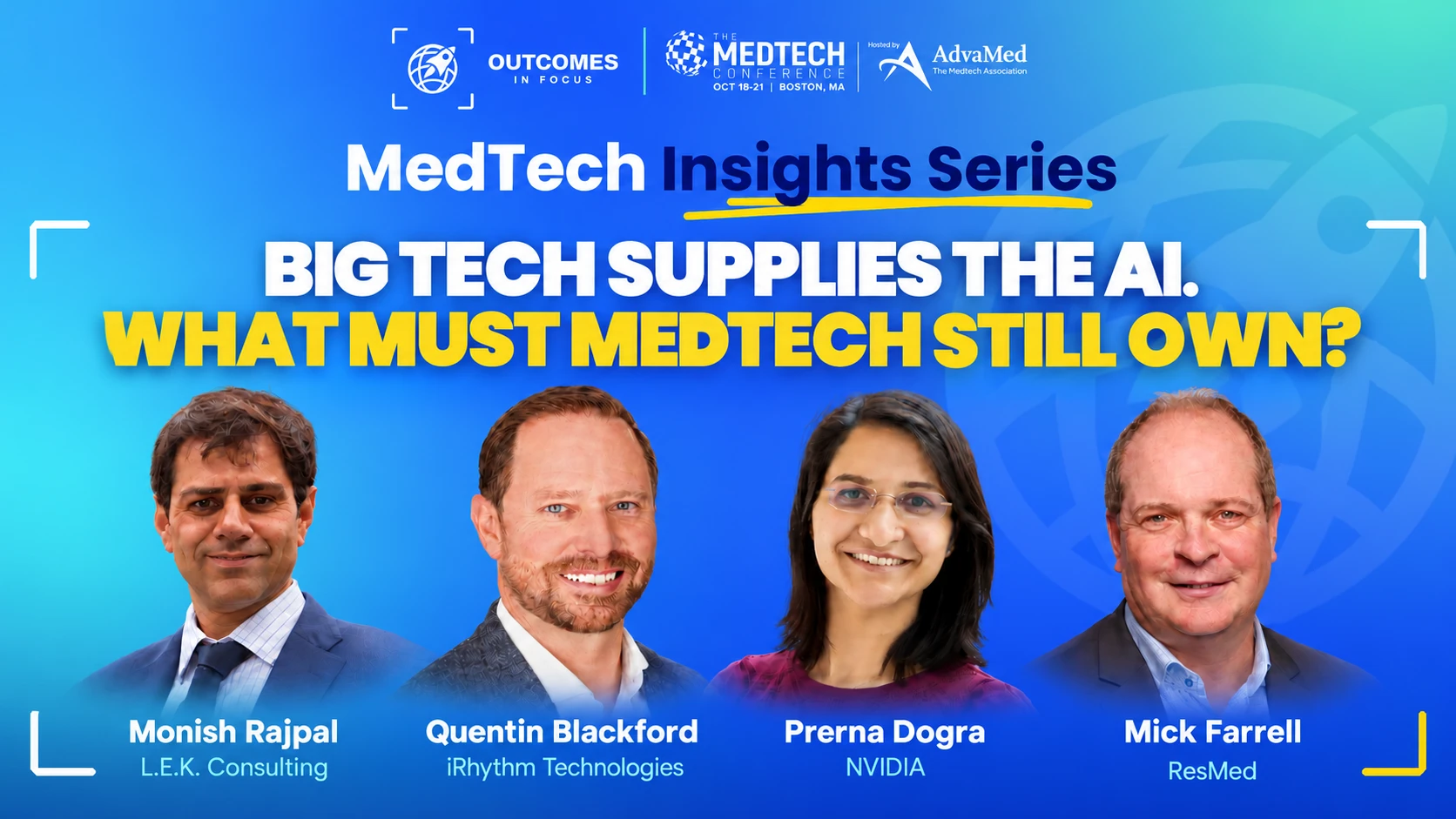
That's one of the challenges explored during "The Big Tech Question: Partner, Build, or Compete?" at The MedTech Conference in Boston on October 19, 2026.
The session was moderated by Monish Rajpal, Managing Director at L.E.K. Consulting, and featured Quentin Blackford, President and CEO of iRhythm Technologies; Prerna Dogra, MedTech product and developer ecosystem leader at NVIDIA; and Mick Farrell, Chairman and CEO of ResMed.
The discussion examined how medtech companies are approaching relationships with major technology providers as AI becomes increasingly important to healthcare innovation.
The opportunity is significant, but so is the question of what a company should build itself, what it can gain from a partner and which capabilities it must continue to own.
Technology Isn't the Same as Clinical Expertise
AI models, computing infrastructure and development tools can give medical technology companies access to capabilities that would be difficult or expensive to develop independently.
But those capabilities don't automatically include the clinical knowledge that makes a healthcare product useful.
During the panel, participants discussed the relationship between general AI capabilities, expertise specific to healthcare and the proprietary knowledge companies develop over time.
One example involved combining years of sleep and respiratory knowledge with broadly available AI algorithms.
The algorithms could help put that knowledge to work. But the accumulated clinical understanding and evidence remained essential to the product.
That distinction matters when deciding where to invest.
A company may benefit from using outside infrastructure while continuing to develop the clinical expertise that differentiates its technology.
For leaders evaluating an AI partnership, the question becomes: Which capabilities can we access through a partner, and which knowledge must remain inside our organization?

Patients Expect Connected Experiences
The discussion also explored how patients increasingly expect their healthcare information to work with familiar consumer technologies.
Health applications, smartphones and wearables have shaped expectations around how people access and interact with information.
But creating those connections requires coordination between different technologies and organizations.
A medical device may work well independently while creating friction when someone tries to use its information elsewhere.
For medtech companies, this makes interoperability, privacy and security important considerations when evaluating technology partnerships.
The experience also needs to support the product's clinical purpose.
Making health information available through a familiar interface can improve accessibility, but it doesn't replace the evidence or expertise behind the technology.
The challenge is to make connected experiences useful while maintaining appropriate responsibility for the information being shared.
Know What You Need From a Partner
The panel also distinguished between partnerships that support innovation and those that help companies reach the market.
A technology provider may offer tools that accelerate development.
Another partner may help bring a product to more customers.
Those are different objectives, and understanding the problem a partnership is intended to solve matters.
For example, if a medtech company needs access to computing capabilities that are already widely available, building the same infrastructure internally may not be the best use of its resources.
But if the company's challenge is reaching healthcare customers, adding another technical capability may not address the underlying problem.
Before pursuing a partnership, leaders need to understand what is currently limiting progress.
Is it technology? Clinical expertise? Integration? Commercial reach?
The answer should inform which capabilities the company develops and where outside support would add the most value.
Keep Accountability Close to the Product
The conversation also raised an important consideration as AI becomes more embedded in medical technology.
A company needs people who can evaluate its technology's output, understand the limits of the underlying information and explain how it supports the intended clinical application.
That expertise becomes especially important when general AI capabilities are combined with proprietary data or clinical knowledge.
A partnership may make the technology more powerful, but it should also leave the company better equipped to understand what it delivers.
For medtech leaders considering a new technology relationship, a useful exercise is to identify three things:
What is the customer or clinical problem the partnership should help solve?
What expertise must the company retain to evaluate and explain the solution?
What specific capability will the partner contribute?
These questions can help teams distinguish between a partnership that removes a genuine obstacle and one that creates a new dependency.
The panel's discussion points toward a practical way to approach Big Tech relationships.
Use outside capabilities where they strengthen the product. Continue investing in the clinical knowledge, evidence and judgment needed to make that product useful.
Because when a clinician asks why an output deserves trust, the medtech company needs to be able to explain it.
About the Conversation
This article draws on "The Big Tech Question: Partner, Build, or Compete?" at The MedTech Conference in Boston on October 19, 2026.
The discussion was moderated by Monish Rajpal, Managing Director at L.E.K. Consulting, and featured Quentin Blackford, President and CEO of iRhythm Technologies; Prerna Dogra, MedTech product and developer ecosystem leader at NVIDIA; and Mick Farrell, Chairman and CEO of ResMed.
The session explored how medical technology companies can work with technology providers while maintaining the expertise and accountability required for healthcare applications.

Turn Healthcare Insightinto Accelerated Growth
Our healthcare growth teams work closely with you to design strategies tailored to your unique goals and market dynamics, fully focused on growth.
Book a Strategy Session →
Accelerating your growth with expert strategies in marketing, branding, research & insights, sales and lead generation to maximize healthcare impact.