Outcomes Articles
When Arend Schuurman Became the Patient, Every Specification Got Personal
November 20, 2026
Arend Schuurman was used to the captain's seat. As an EMT, he took care of the person on the stretcher. As a quality engineer, he worked with the specifications that products had to meet. Then he became the patient, dependent on decisions and work he could no longer control.
He described the change as humbling. Product safety had always mattered to him. Now the life affected by those specifications was his own.
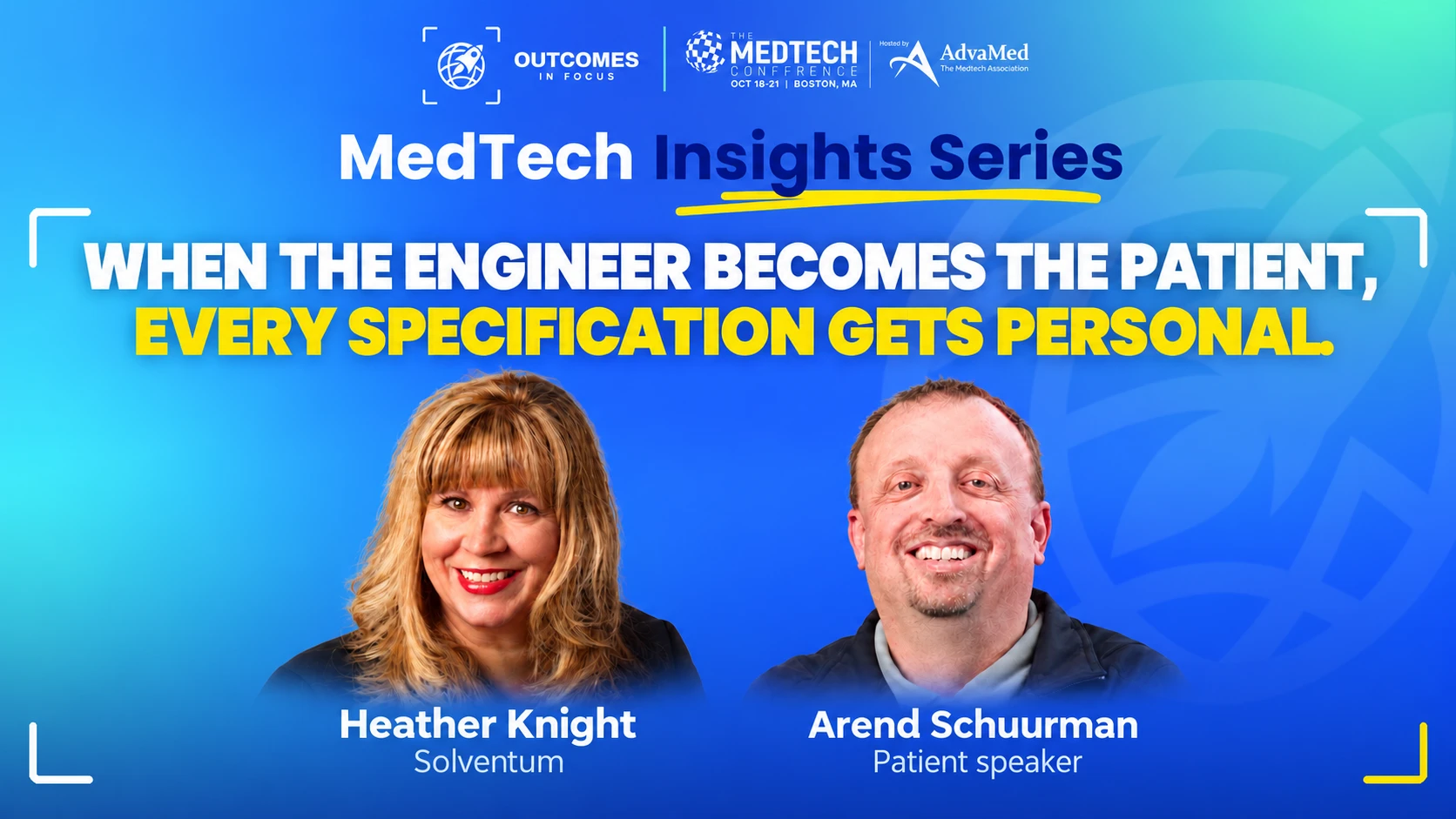
In quality and operations work, the task can become more visible than the person it protects. A spreadsheet records whether a requirement was met. It cannot keep the patient present in every conversation. Heather Knight, Solventum chief commercial officer, moderated "Patient Story: Solventum" at The MedTech Conference. Her guest was Arend Schuurman, a Solventum quality engineer sharing his experience as a patient.
The Specification Had His Name on It
At The MedTech Conference, Arend explained how becoming a patient changed the meaning of requirements he already knew professionally. Standards and specifications stopped being distant features of his job. He was relying on other people to get them right.
Arend already understood product requirements. What changed was that he could no longer be the person checking everything himself.
People receiving care make that handoff without sharing an engineer's knowledge. They depend on work performed far from the bedside, by colleagues they will never meet. A routine decision in receiving or production can sit inside that chain even when no patient is visible to the person making it.
Take a familiar check and ask what it protects. What uncertainty has to be resolved before work can continue? Keep the technical requirement exact, and explain why it matters to the person receiving care.
His Family and Community Got Someone Back
When Arend described recovery, he named the people who got him back. His children had their father. His wife had her husband. His colleagues had their teammate.
Then the circle widened. His school board had its chairman back. He also drove a school bus, another role in which people counted on him to show up. These were ordinary responsibilities, and that was their force. His return mattered in places a product team would never see on a clinical record.
Arend was describing his own recovery. It did not promise another patient's result, but it showed how many people depended on one person's return.
The Quality Question He Learned From Ice Cream
Arend traced one of his ways of thinking about quality to an earlier education in dairy science and manufacturing. Asked to assess a bowl of ice cream, he initially thought in technical measurements. His instructor brought the question closer: would he take it home and give it to his family?
He now carried that question into medical products. Would he be comfortable having the product used on himself, his child, his spouse or someone else close to him? The question made uncertainty harder to dismiss as somebody else's problem.
It is a prompt for attention, not a substitute for acceptance criteria or evidence. Personal confidence cannot prove that a product meets a specification. But unease should send a colleague back to the requirement, the unresolved question and the established route for raising it.
Arend also refused to confine quality to one department. He described contributions across Solventum's Brookings facility, from receiving and custodial staff to engineers and production colleagues. Each had different work to perform. Each was part of the product's story.
Take a recurring task and ask colleagues how it protects the person receiving care. Check whether they know where to take a concern and whether the next function receives what it needs. Clarify an uncertain handoff through the existing quality process.
Arend returned to work with his own experience inside that explanation. The next specification he reviewed could belong to someone else's father, teammate or school bus driver. The numbers were still there. So was the person depending on them.
About the Conversation
This article draws on Patient Story: Solventum, a session at The MedTech Conference on October 19, 2026. Heather Knight, Solventum's chief commercial officer at the time of the conference, served as moderator. The discussion connected a personal experience of receiving care with responsibility for the products patients depend on.
Featuring Arend Schuurman, a patient speaker bringing an engineering and emergency-care perspective to the consequences of quality work.
Resources
The MedTech Conference 2026 official agenda
Solventum's profile of Arend Schuurman

Turn Healthcare Insightinto Accelerated Growth
Our healthcare growth teams work closely with you to design strategies tailored to your unique goals and market dynamics, fully focused on growth.
Book a Strategy Session →
Accelerating your growth with expert strategies in marketing, branding, research & insights, sales and lead generation to maximize healthcare impact.