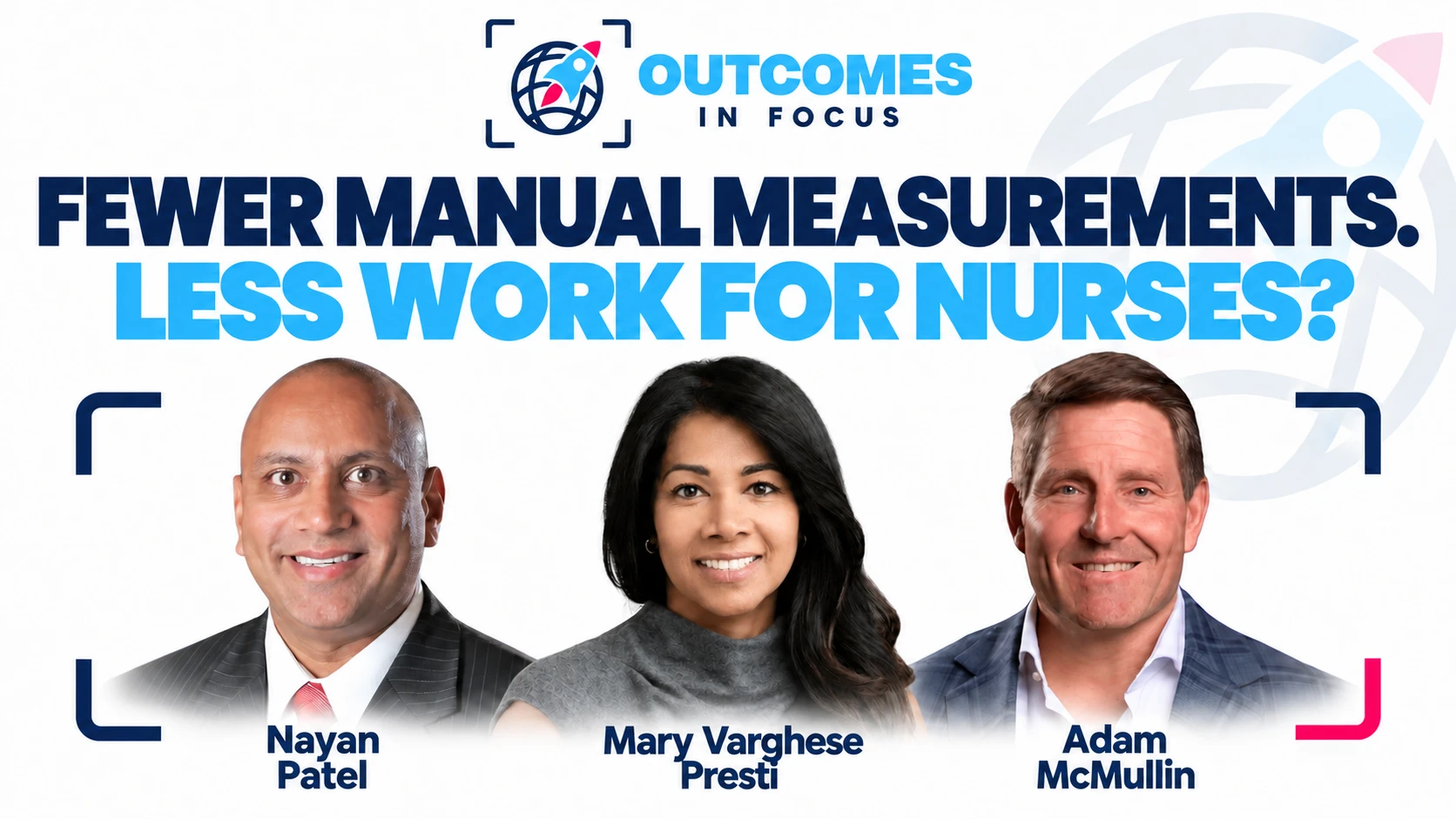
Featuring insights from Nayan Patel, Mary Varghese Presti, and Adam McMullin hosted by our CEO, Saul Marquez.
The monitor takes the measurement. A nurse still has to decide what needs attention. That is the tension behind contactless monitoring's promise to remove manual work: fewer bedside checks may help, but they do not tell a nursing leader what happened to the rest of the shift.
In his Outcomes Rocket interview, Nayan Patel of Neteera describes technology intended to reduce manual measurement tasks without adding a wearable. Information review, response, verification and documentation still need owners. If a deployment moves effort from one task to another, counting only the activity eliminated can make a changed workload look like a lighter one.
Follow the whole work pattern before expanding the deployment. Start with the sensor's intended task, examine the behavior that documentation tools ask of nurses, then name who can fix the workflow after launch. Three separate interviews provide those perspectives. The useful result is not a promise of time saved, but a defensible decision about what to keep, change or narrow.
Name the Task the Sensor Is Supposed to Remove
Manual vital-sign checks involve more than collecting a measurement. Nurses may also need to prepare equipment, record the results and determine whether the information requires attention. Contactless monitoring offers a way to remove some of that manual measurement work. The question is how much of the surrounding work remains.
In his Outcomes Rocket interview, Nayan Patel, Senior Vice President and General Manager of Transformation and Digital Health at Neteera, describes a wall-mounted device that uses high-frequency radar to detect heart rate, respiratory rate, movement and sleep-related information. It works through clothing and bedding without requiring a wearable or camera.
The intended benefit is straightforward: nurses can spend less time performing certain manual checks. But collecting a measurement and making it useful are different jobs.
Nayan explains that Neteera can transmit information into an electronic medical record, yet he questions whether sending every measurement there serves clinicians. His emphasis is on providing relevant notifications through existing nurse-call environments and other communication channels.
That distinction creates several practical questions. Who reviews the notification? Who determines whether a patient needs attention? Does the response require additional documentation? What happens when the information needs verification?
Without a wearable, some attachment, charging and removal tasks may no longer be necessary. Clinical judgment, operational responsibilities and privacy obligations still need attention.
Nayan also emphasizes clinician involvement in adoption. Nurses need to help determine whether the technology fits their work rather than becoming another task layered onto it.
For a pilot, the useful starting point is to identify the manual check expected to disappear, then observe what happens around it. Record which activities stop, which remain and which appear elsewhere. The interview establishes the intended benefit, but doesn't provide a measured reduction across an entire shift.
A different nursing technology makes the hidden side of that trade easier to see: changing how information is captured can change the work itself.
Look for the Behavior the New Workflow Asks of Nurses
A half-eaten meal, a partly full catheter bag and a patient who hasn't gotten out of bed: the interview with Mary Varghese Presti uses these observations to show how much a nurse can notice without saying it aloud. Documentation technology changes the task when those observations need to be spoken so they can reach the record. This is an example from the discussion, not a patient case reconstructed here.
Mary, Corporate Vice President of Microsoft Health and Life Sciences at the time of her interview with Saul Marquez, discusses an approach shaped by conversations with nursing executives, managers and frontline staff. The episode explores why understanding nurses' actual work matters when developing documentation technology, rather than simply adapting a physician's tool and assuming the workflow is the same.
Physicians frequently document through narrative notes that describe an assessment and treatment plan. Nursing documentation often requires structured flowsheets covering vital signs, fluid intake and output, pain scores and other observations. Capturing those details calls for a different technological approach.
The example introduces an easily overlooked change. Instead of observing silently and entering information afterward, nurses may need to describe what they're seeing during the patient interaction. The intended reduction in later keyboard work comes with a different communication habit. That habit deserves attention in training and in the evaluation, not just in the product demonstration.
Whether the trade improves the shift depends on how it works in practice. Does speaking observations interrupt the interaction or help capture details that might otherwise require later entry? Do nurses need to review the resulting fields? Does the information reach the right place without additional correction?
Those questions require observing actual nursing work rather than assuming that automatic documentation produces automatic savings. Microsoft's example concerns documentation, not Neteera's contactless sensor, but it exposes a consideration that applies to evaluating either technology: removing an action can change the behavior surrounding it.
Those effects may emerge after launch, which makes continuing clinical ownership part of the evaluation rather than a support extra.
Keep Someone Responsible for the Changing Workflow
Installing a technology is one decision. Keeping it useful as staffing, patient needs and clinical responsibilities change requires continued attention. Someone needs to hear when the workflow creates unexpected work and have the authority to do something about it.
Saul's Outcomes Rocket conversation with Adam McMullin, CEO of AvaSure, describes this continuing responsibility. AvaSure provides virtual care and smart-room technology, and the discussion describes nurses participating in sales, product management and customer success. Clinical involvement is presented as ongoing work, not a one-time endorsement before installation.
Clinicians can help determine how technology fits routines before implementation, identify problems during adoption and explain what needs to change afterward. The interview emphasizes process design, change management and ongoing customer relationships as staffing, needs and technology evolve. The practical question is whether those relationships can produce a correction when frontline experience contradicts the original plan.
It's a reported organizational approach, not measured proof of workload reduction. Still, it raises an important question for any monitoring deployment: Who owns the workflow after the installation team leaves?
A nursing operations leader might identify that manual checks have decreased while documentation or coordination requirements have increased. The clinical implementation owner and technology partner then need a way to examine those findings, agree on changes and determine who can authorize them.
Simply collecting complaints or reporting that clinicians are using the system won't resolve the problem. Someone must be responsible for revising procedures, addressing technical issues and checking whether those corrections actually reduce the burden.
The AvaSure conversation also emphasizes technology partnerships, but does not establish a shared deployment with Neteera or Microsoft's nursing documentation tools. The relevant lesson is continuing responsibility as work changes, not a recommendation to combine these products.
The pilot's most useful result is an account of the whole work pattern and a decision about what to change next.
Evaluate the Whole Shift with the People Doing the Work
Before expanding a contactless monitoring deployment, bring frontline nurses, the nursing operations lead, the clinical implementation owner and the technology owner together to examine what actually changed.
Choose a defined workflow and compare it before and after implementation. Include measurement, information review, responses, documentation and coordination with other departments. Ask nurses which activities disappeared, which became easier and which now require additional attention. Keep three distinct entries in the record:
- Work removed: Which manual activities actually stopped, rather than simply moving to another person?
- Work changed: Which remaining tasks now require a different habit, tool or handoff?
- Work added: Which reviews, responses, corrections or coordination tasks appeared with the deployment?
Assign someone to assess those findings and identify who has authority to revise the process. If manual checks decrease but documentation or coordination increases, determine whether the workflow needs adjustment before expanding it. Use appropriate clinical and safety reviews rather than interpreting the exercise as evidence for staffing reductions or improved patient outcomes.
The goal is a defensible decision about continuing, modifying or narrowing the deployment, followed by another look at the work after changes are made. Installation alone doesn't answer whether nurses have more time for patient care.
Have the accountable clinical owner return to the same nurses after a change and check whether it helped. A workflow correction that exists only in the implementation plan has not yet answered the original question.
Count the work that leaves the shift, not just the task that leaves the bedside.
About the Conversations
These are three separate Outcomes Rocket conversations, not a shared case study. During the time of recording, the guest names and titles were as follows: Nayan Patel, Senior Vice President and General Manager of Transformation and Digital Health at Neteera. Mary Varghese Presti, Corporate Vice President of Microsoft Health and Life Sciences. Adam McMullin, CEO of AvaSure.
Resources
Building Bridges Across the Healthcare Ecosystem with Adam McMullin, CEO of AvaSure

Turn Healthcare Insightinto Accelerated Growth
Our healthcare growth teams work closely with you to design strategies tailored to your unique goals and market dynamics, fully focused on growth.
Book a Strategy Session →
Accelerating your growth with expert strategies in marketing, branding, research & insights, sales and lead generation to maximize healthcare impact.