Outcomes Articles
What Happens When Medtech Design Moves Closer to Manufacturing?
November 17, 2026
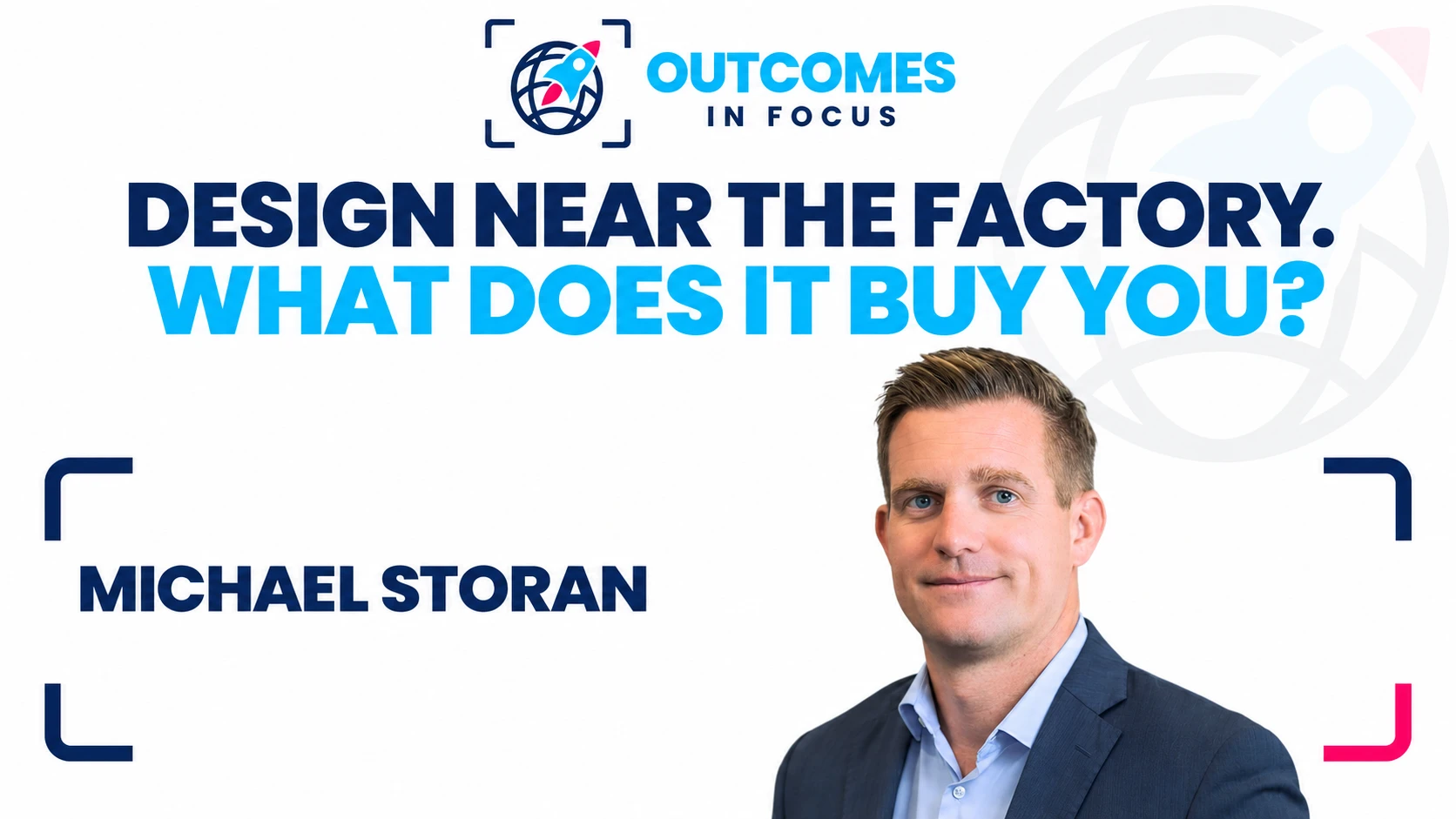
Featuring insights from Michael Storan, Vice President of Life Sciences at IDA Ireland, in a conversation on the Outcomes Rocket podcast with our CEO Saul Marquez, recorded at The MedTech Conference 2026.
A medical device can perform exactly as intended during development and still face significant challenges when it's time to manufacture at scale. Materials behave differently at higher volumes, production processes introduce new constraints, and design decisions that once seemed straightforward can become expensive to change once manufacturing begins. These challenges raise an important question for medtech companies: What would happen if manufacturing expertise played a larger role earlier in product development?
During The MedTech Conference in Boston, Michael Storan, Vice President of Life Sciences at IDA Ireland, shared how Ireland's medtech industry is evolving to address this opportunity. After decades of developing manufacturing capabilities, some companies in Galway are bringing product design and manufacturability work closer to their production facilities. That proximity creates opportunities for engineers, suppliers, and manufacturing specialists to collaborate while important product decisions are still being made.
How Ireland Built a Manufacturing Ecosystem That Supports Innovation
Ireland's position as a global medtech manufacturing hub developed through decades of investment and industry experience. Companies such as Medtronic and Boston Scientific helped establish a strong manufacturing foundation, attracting engineering talent and supporting the growth of specialized suppliers with expertise in areas such as molding, extrusion, and complex medical device production.
Over time, that concentration of expertise created an ecosystem where companies could access much more than manufacturing capacity. Experienced process engineers, quality specialists, suppliers, and technical partners became part of the infrastructure supporting the industry. For companies developing new products, this accumulated knowledge can help identify potential manufacturing challenges before they become costly problems.
Consider a product engineer designing a component that must meet precise dimensional requirements. The engineer understands the clinical and functional requirements, while a manufacturing specialist can assess whether those specifications can be maintained consistently during production. Bringing those perspectives together early creates an opportunity to evaluate the design against real manufacturing capabilities before the product moves further into development.
Michael described how some Galway companies are extending their manufacturing expertise into earlier stages of product design and manufacturability. This evolution reflects a broader opportunity for medtech companies to connect innovation with the practical knowledge required to produce devices reliably at scale.
Why Proximity Between Design and Manufacturing Matters
Product development and manufacturing are closely connected, but they don't always operate together from the beginning. When product engineers make decisions without early manufacturing input, teams may discover production constraints only after specifications have been finalized, leaving fewer options for adjustments.
For example, a component may require a particularly tight tolerance to function correctly in one part of a device. A manufacturing engineer might help determine whether that same tolerance is necessary throughout the entire component or whether the design could be adjusted without compromising its intended function. Having this conversation earlier allows the team to consider alternative materials, processes, or specifications while the design remains flexible.
The value extends beyond individual engineering decisions. When product development teams have access to experienced suppliers and manufacturing specialists, they can better understand which capabilities already exist and which requirements may need additional testing. Instead of treating manufacturability as a concern that begins after design, companies can incorporate it into the development process.
For medtech leaders evaluating where to establish or expand operations, this changes how a manufacturing location should be assessed. Available facilities, operating costs, and workforce capacity remain important, but so does the surrounding network of people who can help a company develop, refine, and manufacture its next generation of products.
Michael explained that IDA Ireland supports companies exploring international expansion by helping organize site visits and introductions to relevant industry contacts. Those visits provide an opportunity to evaluate the depth of a local ecosystem, including the engineering expertise, suppliers, and development capabilities available beyond the walls of a prospective facility.
How Digital Manufacturing Is Expanding These Capabilities
The relationship between design and manufacturing is becoming increasingly important as digital technologies create new ways to evaluate and improve production processes. Michael highlighted Digital Manufacturing Ireland and its exploration of technologies such as machine vision and digital manufacturing systems, which can help companies examine how their operations perform and where improvements may be possible.
Machine vision, for example, can support the inspection of manufactured components by checking defined characteristics against established requirements. Digital manufacturing tools can also help teams analyze processes and explore how changes might affect production. These capabilities introduce additional opportunities to connect engineering decisions with information gathered throughout manufacturing.
However, adopting new technology requires more than identifying a promising application. Manufacturers still need to understand what problem a system will solve, how its performance will be evaluated, and whether it can operate effectively within existing quality and production requirements. Access to experienced engineers and technical partners can help companies make those evaluations with greater clarity.
This is where a developed manufacturing ecosystem offers another advantage. As new technologies emerge, companies can draw on an established network of technical expertise to explore their applications rather than approaching every manufacturing challenge independently. The combination of industry experience and emerging technology can support more informed decisions as products and production requirements evolve.
What Medtech Leaders Should Consider Before Their Next Expansion
Michael's perspective suggests that companies evaluating a new manufacturing location should look beyond what a facility can produce today. The surrounding ecosystem may influence how effectively the company can develop future products, respond to manufacturing challenges, and introduce new processes as its business grows.
One practical starting point is to identify a current product development challenge and use it to evaluate prospective locations. Rather than focusing exclusively on available space or production capacity, ask which local suppliers, engineering specialists, or technical partners could help address that challenge. Understanding the capabilities available around a facility can reveal opportunities that a conventional site comparison might overlook.
Ireland's experience demonstrates how decades of manufacturing investment can create a foundation for continued innovation. As design, manufacturing, and digital technologies become more connected, medtech companies have an opportunity to rethink where important product decisions should happen and who should be involved in making them.
The question for leaders planning their next expansion is whether they are selecting a location solely to manufacture existing products or choosing an ecosystem that can help shape the products they will develop next. Considering both can lead to a more complete understanding of the long-term value of a manufacturing investment.
About the Conversation
Michael Storan, Vice President of Life Sciences at IDA Ireland, joined Saul Marquez at The MedTech Conference 2026 in Boston to discuss how Ireland became a global medical device hub. Their conversation covers decades of manufacturing investment, the growth of specialized engineering expertise, international expansion, and emerging opportunities in digital manufacturing.
Resources

Turn Healthcare Insightinto Accelerated Growth
Our healthcare growth teams work closely with you to design strategies tailored to your unique goals and market dynamics, fully focused on growth.
Book a Strategy Session →
Accelerating your growth with expert strategies in marketing, branding, research & insights, sales and lead generation to maximize healthcare impact.