Outcomes Articles
What Does It Take to Bring Medical Innovation Into Patient Care?
October 26, 2026
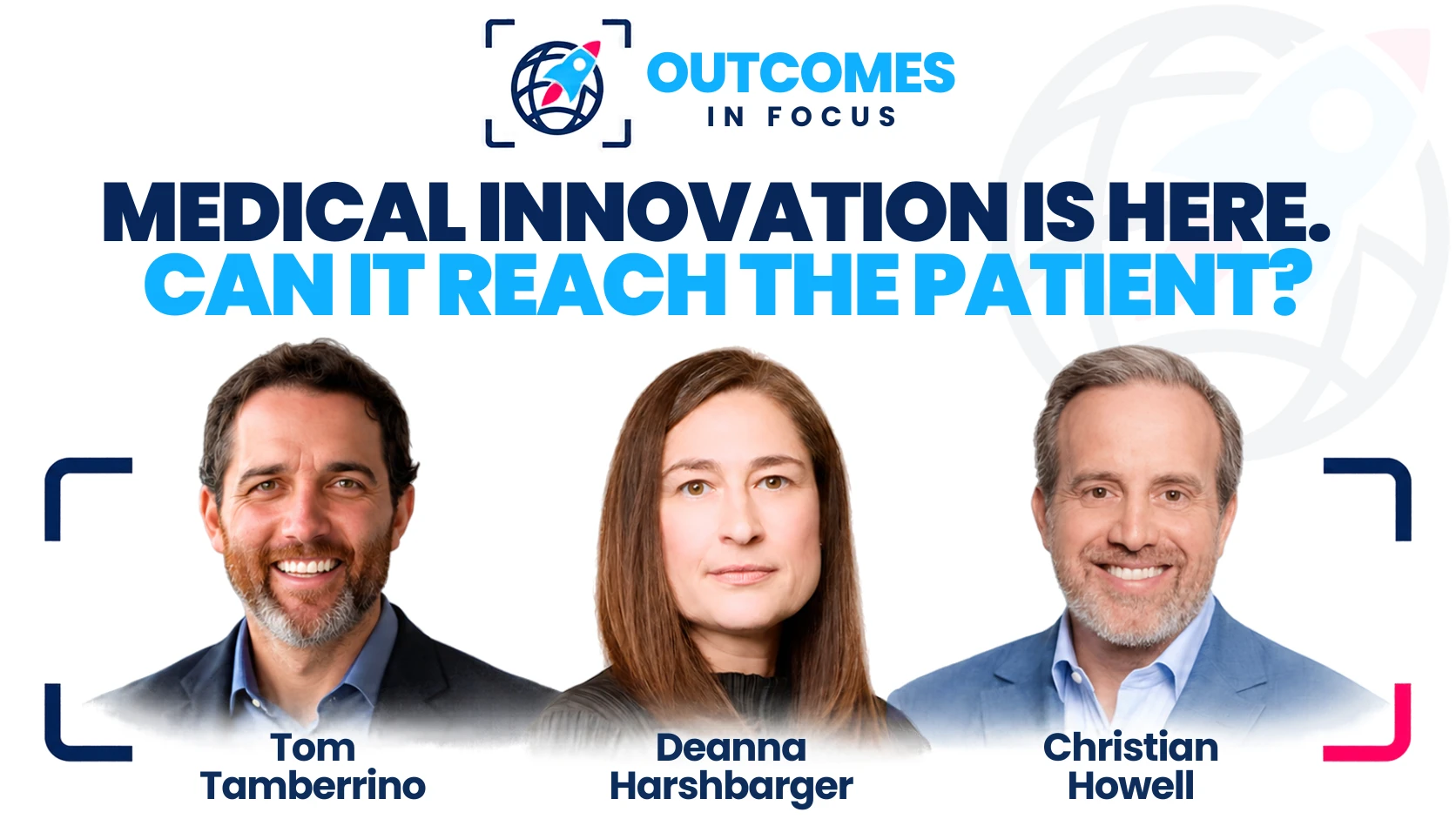
Featuring insights from Tom Tamberrino, Deanna Harshbarger, and Christian Howell hosted by our CEO, Saul Marquez.
A promising medical technology can address an important clinical need and still face significant challenges before it becomes available to patients. Developing the treatment is one part of the process. Companies must also demonstrate its value, navigate regulatory and reimbursement requirements, and make sure healthcare providers can deliver it.
These challenges emerged in three separate conversations on the Outcomes Rocket podcast with our CEO Saul Marquez. Christian Howell of Cognito Therapeutics, Inc. discussed building clinical evidence for an emerging Alzheimer's therapy. Deanna Harshbarger of Cala Health shared her experience navigating regulatory and reimbursement barriers. Tom Tamberrino of Profound Medical explored the infrastructure and operational considerations involved in expanding access to MRI-guided treatment.
Each conversation addresses a different part of the journey from medical innovation to patient care.
Together, they highlight three important questions for medtech leaders: What evidence will support adoption? What needs to happen for patients to gain access? And can healthcare providers realistically deliver the treatment?
The answers depend on the technology, the patient population and the care setting. But understanding these challenges can help companies identify what is needed to move an innovation closer to clinical practice.
Build Evidence That Supports Adoption Decisions
Before a new medical technology can become widely available, companies need evidence that supports its clinical value and intended use.
But different stakeholders may need different information to make their decisions.
Christian Howell, CEO of Cognito Therapeutics at the time of his Outcomes Rocket interview, discussed this challenge while describing the company's development of a noninvasive therapy for Alzheimer's disease.
In the June 2026 conversation, Cognito was preparing for important clinical study results while working toward a potential path to market. Christian discussed the evidence needed to support clinical validation, regulatory discussions, reimbursement planning and communication with patients and families.
The interview illustrates how evidence development extends beyond demonstrating that a technology has scientific potential.
Regulators need information relevant to safety and effectiveness. Clinicians need to understand the clinical evidence and limitations when evaluating a treatment. Payers consider evidence relevant to their coverage decisions. Patients and families need understandable information about potential benefits, risks and treatment expectations.
These audiences may rely on overlapping evidence, but they are evaluating different questions.
For a company developing an emerging therapy, that means thinking carefully about which decisions its evidence will need to support.
Christian also discussed partnerships intended to connect diagnosis with treatment delivery. That work reflected another consideration: preparing for how a therapy might eventually reach the patients it is intended to serve.
At the time of the interview, important clinical questions remained unanswered. The conversation should therefore be understood as an account of the company's development strategy, rather than evidence of the therapy's current regulatory status or clinical effectiveness.
For medtech leaders, the practical lesson is to identify the decisions that lie ahead and determine what evidence each decision-maker will need.
A promising clinical result may be an important milestone. Companies still need to understand how that result contributes to the broader path toward adoption.
Navigate the Barriers Between Approval and Patient Access
Clinical evidence helps establish the foundation for a medical technology, but bringing that technology to patients also involves regulatory and reimbursement decisions.
Deanna Harshbarger, CEO of Cala Health at the time of her Outcomes Rocket interview, shared how the company navigated these challenges while developing a noninvasive treatment for people living with tremor.
Cala's experience involved several distinct milestones, including pursuing the FDA's De Novo pathway, developing reimbursement codes, obtaining a payment determination and securing a local Medicare coverage determination.
The process included repeated setbacks.
Rather than treating every obstacle as the same problem, Deanna described how the team examined the reasons behind individual decisions and continued working toward the requirements needed to move forward.
Her experience highlights an important distinction in medical technology commercialization: regulatory authorization, coding, payment and coverage are related, but they answer different questions.
Regulatory authorization addresses whether a product may be marketed for its intended use under the applicable requirements. Coding determines how a service or technology is reported. Payment decisions address reimbursement amounts or methodologies. Coverage decisions establish the circumstances under which a payer will cover a service or technology.
Progress in one area doesn't automatically resolve the others.
For example, securing a reimbursement code doesn't establish that every payer will cover a treatment. A payment determination may provide important information without establishing the financial viability of a particular care setting.
Understanding these distinctions helps companies identify which access questions remain unresolved and what evidence or action is needed next.
Cala's experience also demonstrates the importance of persistence and precision. When a company encounters a setback, the next step depends on understanding the specific issue rather than treating the entire pathway as one obstacle.
For MedTech leaders, this means developing a market-access strategy that accounts for the different decisions required to make treatment available.
A technology may demonstrate promise and achieve meaningful regulatory progress while important questions about payment and coverage remain.
And even when those barriers are addressed, healthcare providers must still determine how the technology fits into patient care.
Make Sure Healthcare Providers Can Deliver the Treatment
A technology may have supporting clinical evidence and a developing reimbursement pathway, but healthcare facilities still need the equipment, personnel and workflows required to use it.
Tom Tamberrino, Chief Commercial Officer of Profound Medical Inc., explored this challenge in his Outcomes Rocket interview about MRI-guided ultrasound treatment for prostate tissue.
The company's TULSA-PRO technology uses MRI for treatment planning and guidance. Tom described how the procedure can be performed in hospital MRI environments and discussed the potential to expand access through ambulatory and office-based settings.
The opportunity comes with practical considerations.
Some ambulatory surgical centers and office-based facilities already have MRI equipment. Many do not. For facilities without the required infrastructure, offering MRI-guided treatment may involve a significant operational and financial decision.
Tom also discussed Medicare reimbursement developments that he believed could help support business models for larger urology practices considering MRI-guided procedures, potentially including investment in MRI infrastructure.
However, the availability of a reimbursement pathway is only one part of determining whether a particular facility can offer the treatment.
Healthcare providers still need to examine equipment availability, scheduling capacity, staffing requirements and patient workflow.
Tom described a procedure involving general anesthesia, physician placement of treatment devices, MRI-guided planning and automated ultrasound delivery.
The interview included an estimated ablation time of 30 to 90 minutes, depending on the treatment area.
That estimate is useful for understanding one component of the procedure. It does not establish the total time a patient occupies the MRI suite or the number of procedures a facility can perform in a day.
Preparation, treatment planning, staffing, room turnover and recovery all contribute to the operating model.
Before introducing a new treatment, a facility needs to evaluate these requirements alongside its existing services and resources.
For commercial teams, that means working with clinical, operational and financial stakeholders to understand whether the proposed model is practical for the specific site.
Tom's perspective adds an important dimension to the broader adoption conversation.
Even when a technology has a viable route to market, delivering it at the point of care can require additional infrastructure, operational planning and investment.
Connect Clinical Evidence, Market Access and Delivery
The experiences of Cognito Therapeutics, Cala Health and Profound Medical involve different technologies, patient populations and stages of development.
They should not be treated as a single commercialization pathway or as evidence that every medical technology follows the same sequence.
What connects them is the need to address several distinct challenges before an innovation can become part of patient care.
Christian's conversation highlights the importance of developing evidence that supports clinical, regulatory and reimbursement decisions.
Deanna's experience illustrates the work involved in navigating the separate milestones that influence access to treatment.
Tom's perspective shows why healthcare delivery capabilities matter when evaluating whether a technology can be introduced into a particular care setting.
These challenges can overlap, and progress in one area may influence the work required in another.
For medtech companies evaluating their path toward adoption, it can be useful to bring clinical, regulatory, market-access, commercial and operational leaders together around three questions:
Clinical evidence: What decisions must our evidence support, and which important questions remain unanswered?
Market access: Which regulatory, coding, payment and coverage milestones have been achieved, and what remains unresolved?
Clinical delivery: What equipment, personnel, workflows and resources will healthcare providers need to offer the technology?
For each question, identify what is already supported by evidence, what remains an assumption and who is responsible for resolving the uncertainty.
This approach can help teams distinguish between a milestone that represents meaningful progress and one that still leaves important adoption barriers in place.
Bringing Innovation Closer to Patients
Medical innovation creates opportunities to improve care, but the path from developing a technology to making it available to patients involves many decisions.
A company may have encouraging clinical evidence while reimbursement questions remain open. Another may have made significant progress on market access while healthcare facilities still need to determine how the treatment fits their operations.
Each situation requires a different response.
The conversations with Christian Howell, Deanna Harshbarger and Tom Tamberrino show why medtech leaders need to consider evidence, access and delivery together, while recognizing the distinct challenges each presents.
For companies working to bring new treatments forward, the goal is to identify the barriers that matter most for their technology and build a practical plan to address them.
The question is not simply whether an innovation is promising. It is what still needs to happen for that innovation to reach the patients who could benefit from it.
About the Conversations
This article draws on three separate conversations from the Outcomes Rocket podcast with Saul Marquez. Each guest discussed a different aspect of medical technology development, commercialization and adoption.
Guest names and roles reflect the time of their respective interviews:
- Christian Howell, CEO of Cognito Therapeutics, discussed evidence development and the challenges involved in bringing an emerging Alzheimer's therapy toward potential clinical use.
- Deanna Harshbarger, CEO of Cala Health, shared her experience navigating regulatory, reimbursement and market-access requirements for a noninvasive tremor treatment.
- Tom Tamberrino, Chief Commercial Officer of Profound Medical, discussed MRI-guided ultrasound treatment and the infrastructure, workflow and business-model considerations involved in expanding access.
These conversations represent different technologies and circumstances. Their combined lessons are presented as an editorial analysis of common adoption challenges, rather than as a shared case study.
Resources
How Health Economics Drives Medtech Growth with Christian Howell, CEO of Cognito Therapeutics

Turn Healthcare Insightinto Accelerated Growth
Our healthcare growth teams work closely with you to design strategies tailored to your unique goals and market dynamics, fully focused on growth.
Book a Strategy Session →
Accelerating your growth with expert strategies in marketing, branding, research & insights, sales and lead generation to maximize healthcare impact.