Outcomes Articles
The Visit Is Over. Who Handles the Patient's Next Problem?
October 26, 2026
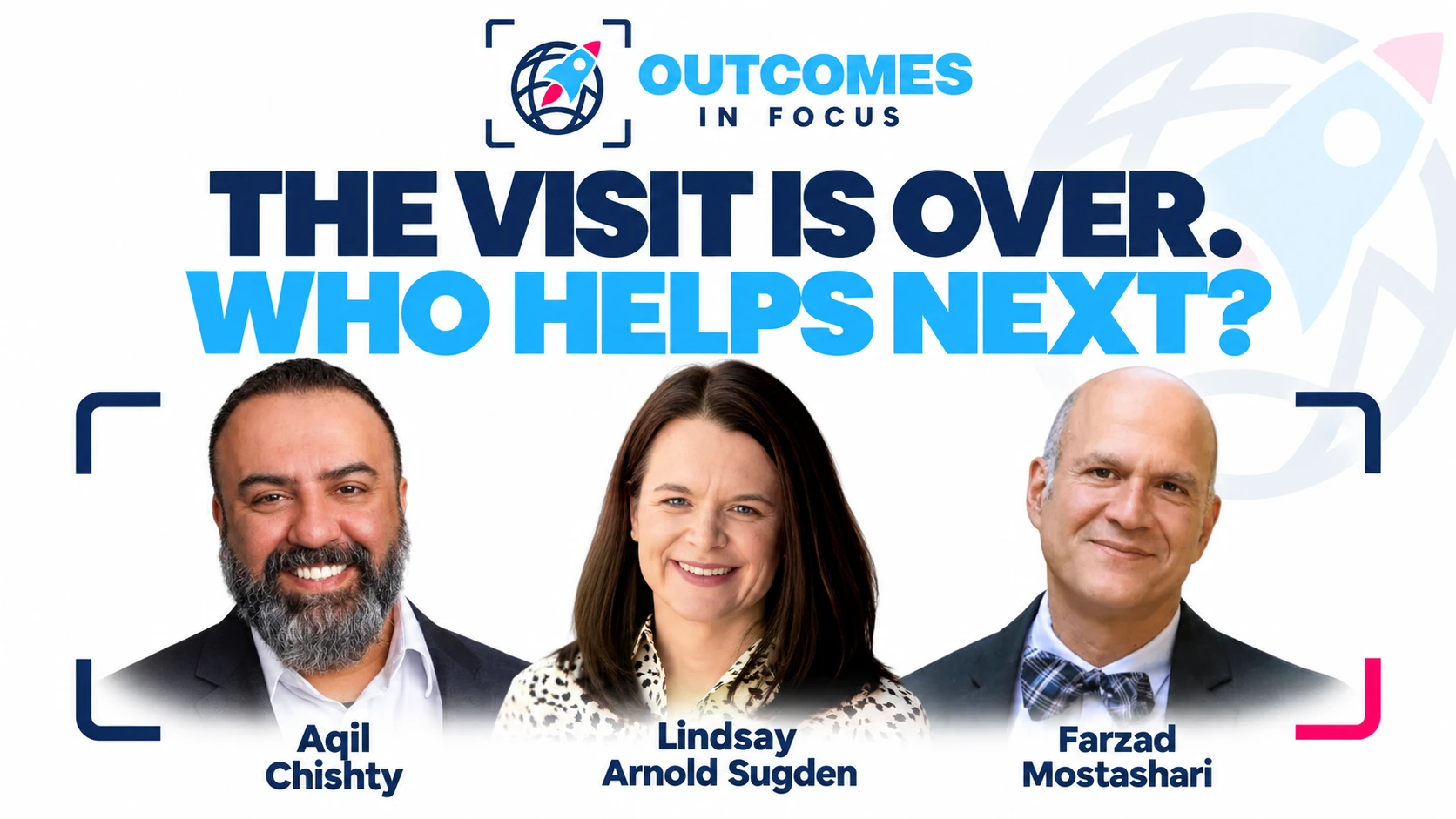
Featuring insights from Aqil Chishty, Lindsay Arnold Sugden, and Dr. Farzad Mostashari hosted by our CEO, Saul Marquez.
A patient can leave a visit with a clear care plan and no practical way to carry it out. The prescription still needs refilling. The next appointment requires a ride. If nobody has agreed to help, another check-in can document the problem without moving it toward a solution.
For a practice buying continuous-care support, the question is not simply how often someone calls. It's what happens after the patient explains the problem. A busy physician needs help that resolves appropriate practical tasks and brings clinical concerns back to the care team, not another channel that quietly returns every responsibility to the practice.
Before approving the service, trace one recurring need from the first contact to the next responsible person. Three separate Outcomes Rocket interviews help examine the pieces: assistance between visits, a capable receiving provider, and the staffing and incentives that keep the work going. The useful test is whether the patient reaches a next step, not whether the service records another interaction.
Make the Gap Between Visits Someone's Job
In his Outcomes Rocket interview, Aqil Chishty, CEO of TimeDoc Health, describes a care coordination model built around regular contact with patients managing chronic conditions. He says the team typically reaches out once or more each month, helping patients schedule appointments, navigate prescription refills and arrange transportation. The point is practical support between the visits a physician can provide.
The frequency matters less than what happens during those conversations. TimeDoc recruits and trains care coordinators to understand patient needs and work with different types of organizations, including health systems, physician groups and federally qualified health centers. A patient managing several chronic conditions may need help finding an affordable medication program, while another needs assistance arranging a follow-up visit. The coordinator has to understand the concern, identify useful resources and recognize when the clinical team needs to get involved.
Aqil describes TimeDoc's coordinators as maintaining contact with patients between appointments and alerting physicians when an issue requires clinical attention. Their role gives the practice additional awareness of practical and emerging needs, without making coordinators substitutes for the physician.
That boundary belongs in the service design. Specify what the coordinator can resolve, what requires a clinician and how the clinical team receives the concern. Making those limits explicit protects the physician's role while giving coordinators a clear job to do.
Ask the prospective service to walk through a realistic request with your staff. A patient who cannot afford a refill needs a different response from one whose concern requires medical judgment. Aqil describes both helping patients find medication-assistance resources and escalating issues to physicians. Your practice needs to understand how those different paths will work locally.
These questions should produce specific responsibilities rather than another promise of patient engagement. A monthly call may uncover a transportation problem, but the service agreement should establish who helps arrange the ride. When the concern requires medical judgment, the practice needs a defined path back to its clinical team.
A team can identify a need without having the right service available to address it. That makes the next handoff part of the design, too.
Give the Next Referral Somewhere to Land
A primary-care physician may recognize that a patient needs behavioral-health support without having the time or specialized resources to provide it during a routine appointment. Lindsay Arnold Sugden, CEO of SOL Mental Health, discussed this pressure with Outcomes Rocket host Saul Marquez, emphasizing the importance of a reliable outpatient partner when patients need additional care.
The referral itself is only one step. Patients still need an appointment they can access, care that fits their clinical needs and coverage that makes treatment affordable. Lindsay says primary-care practices need partners capable of supporting patients the same day or the next day, with care that is often affordable through insurance-network participation. The interview describes what referring teams need, rather than verifying appointment availability for every patient or location.
Lindsay argues that primary-care teams need accessible behavioral-health partners who coordinate treatment and share relevant information back with the referring practice. That communication can help the original care team understand what happens after a patient is connected with another clinician.
SOL's model brings therapists and psychiatric clinicians into one outpatient practice, offering patients access to different kinds of support without requiring them to navigate separate organizations for every need. Lindsay also describes weekly clinician supervision and case reviews that allow providers to discuss complex cases and coordinate treatment. Those practices illustrate how SOL organizes care, although the interview does not establish that they produce superior clinical outcomes.
For a referring practice, the evaluation should continue after the referral is sent. Can the patient reach the appropriate clinician? Does the receiving organization support coordination when needs change? How does relevant information return to the original care team?
Mental health is one example of this receiving-service responsibility, not the next step for every patient. The practical concern is whether a referral leads to accessible, coordinated care rather than another task left for the patient to manage.
A staffed contact team and an accessible partner both require time and resources. The practice still needs a way to sustain that work.
Make Prevention Sustainable for the Practice
Providing support between appointments takes more than hiring coordinators or adding software. Someone has to fund the work, give staff time to perform it and establish how information moves between the support service and clinical team. Dr. Farzad Mostashari, co-founder and CEO of Aledade, approaches this challenge through primary-care arrangements designed to reward prevention.
Farzad argues that changing technology or payment arrangements alone isn't sufficient. His approach calls for changes in how primary-care teams organize and deliver care, alongside the tools and financial incentives that support those efforts.
Farzad emphasizes bringing primary-care physicians, delivery teams and policymakers into the process, then changing the workflows that affect patients. Technology can help practices organize information and support care-delivery workflows. The practice still needs people responsible for acting on that information.
He also emphasizes the time required for prevention. Unlike a service reimbursed immediately after a visit, preventing complications may require consistent attention over years. That longer horizon influences how Aledade approaches its relationships with practices and investments in technology.
For a practice considering between-visit support, the operating questions are specific. Who budgets for the coordinators? Which team manages the handoffs? What does the technology help staff accomplish? What evidence will the practice review over time to determine whether the service is working?
Aledade's experience concerns primary-care value-based arrangements. Its financial model cannot automatically be applied to every specialty or outpatient service. Still, Farzad's operating distinction gives buyers a useful way to examine whether the responsibilities identified earlier can be supported consistently.
A service can have compassionate staff and useful technology and still leave a practice unsure who funds the next hour of work. Connect the budget to the responsibilities already identified: assistance, clinical escalation, referral coordination and follow-up. That is where a promise of continuous care becomes an operating commitment.
Trace One Need Through the Service
Before approving or expanding a continuous-care service, bring the practice's clinical lead, operations lead, service owner and finance representative together. Include the receiving provider when another service is involved. Founders should work through this exercise with the buying team rather than relying on a general promise of better engagement.
Start with one recurring need, such as a patient requiring help scheduling a follow-up appointment. Trace what happens from the first request until the next responsible person takes over.
Create a short responsibility map with five explicit commitments:
- First contact: Who receives and acknowledges the patient's concern.
- Practical assistance: Who handles the task within the service's scope.
- Clinical or referral handoff: When another professional is needed and who makes the connection.
- Return information: How the practice learns what happened and what remains unresolved.
- Ongoing support: Who staffs and funds the work after the initial rollout.
Use that map to make a bounded decision. Proceed when responsibilities and handoffs are clear. Redesign the service where ownership remains uncertain. A completed map establishes operational accountability, not proof of improved clinical outcomes.
For the follow-up appointment, that means knowing who helps arrange it and what happens if the patient still cannot get there. Recording the barrier is only the beginning of the job.
Before adding another contact channel, decide who owns the next action.
About the Conversations
These are three separate Outcomes Rocket conversations, not a shared case study. During the time of recording, the guest names and titles were as follows: Aqil Chishty, CEO of TimeDoc Health. Lindsay Arnold Sugden, CEO of SOL Mental Health. Dr. Farzad Mostashari, Co-Founder and CEO of Aledade.
Resources
Meeting Patients Where They Are Through Continuous Care with Aqil Chishty, CEO of TimeDoc Health

Turn Healthcare Insightinto Accelerated Growth
Our healthcare growth teams work closely with you to design strategies tailored to your unique goals and market dynamics, fully focused on growth.
Book a Strategy Session →
Accelerating your growth with expert strategies in marketing, branding, research & insights, sales and lead generation to maximize healthcare impact.