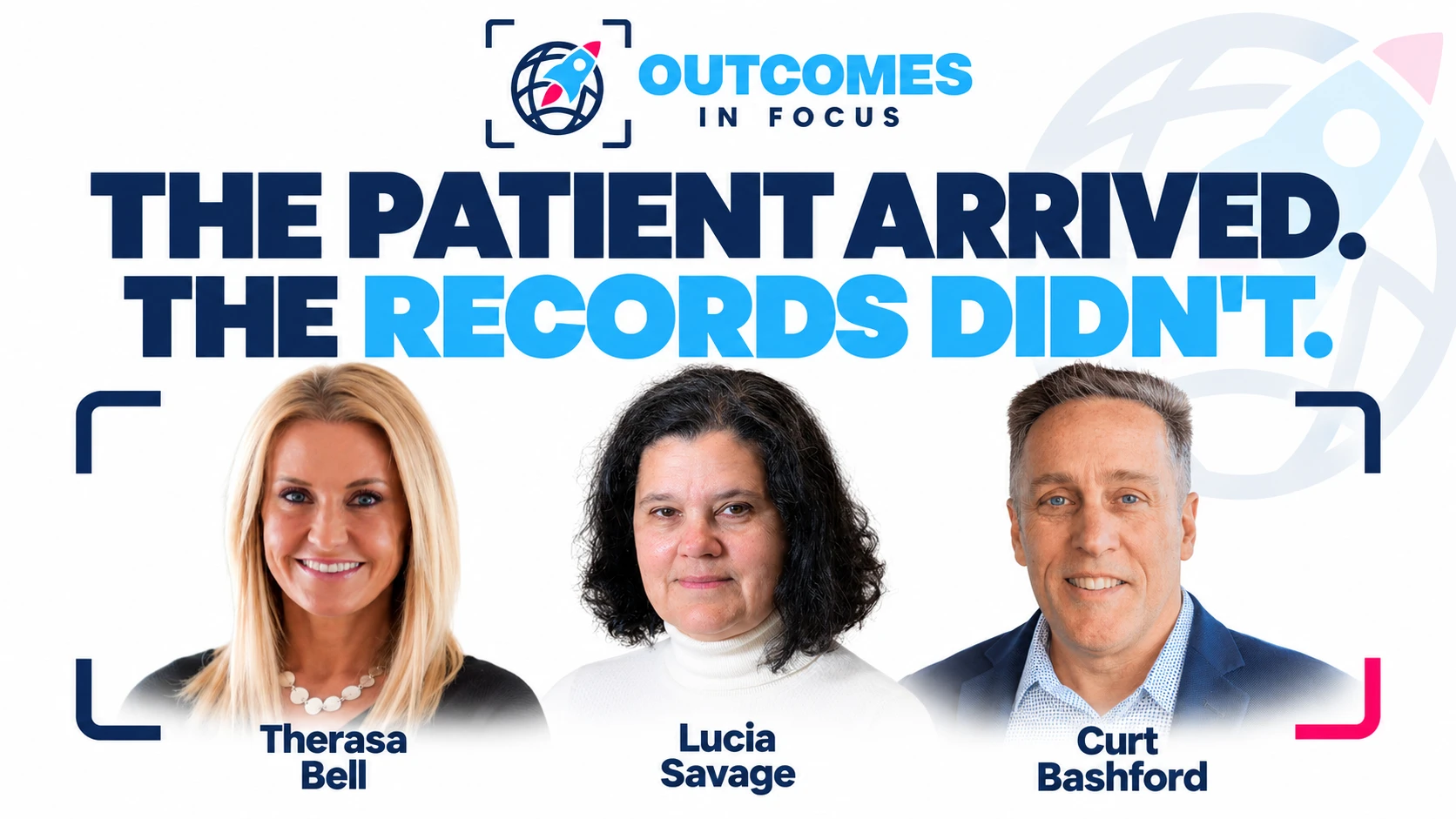
Featuring insights from Therasa Bell, Lucia Savage, and Curt Bashford hosted by our CEO, Saul Marquez.
When Therasa Bell brought her father to a skilled-nursing facility, his medical records hadn't made the trip with him. Her father was 85 and living with Parkinson's. As President and Co-Founder of Kno2, she'd spent years working on connections between healthcare providers. Yet she could see this information gap in her own family.
That gap matters when you're about to sign a hospital integration agreement, deploy emergency communications or expand a post-acute network. The connection may pass a data-exchange test while the next care team still lacks what it needs. Find that out while the scope can still change.
To test connected care interoperability, follow one patient transition through to the receiving user. Have that person retrieve the records and explain whether the clinical context is usable. Check who can participate, how the connection will be supported and what happens when it fails.
Start With the Receiving Team
What does the next care team actually need to know? A physical therapist, behavioral health provider, dentist and emergency physician may all need information about the same patient, but they're looking for different things. Therasa described this distinction during her Outcomes Rocket conversation. A connection designed around one care setting won't necessarily supply the right material to another.
She also pointed to an uneven history of investment in health information exchange. Hospitals and physician offices received substantial attention, while skilled-nursing facilities, home health agencies and other organizations outside acute care could be harder to bring into the network. If you're planning a hospital-to-skilled-nursing transfer, confirm which receiving system participates. An interface that exchanges data between two hospital applications doesn't prove the next facility can retrieve it.
The next question is which information belongs in the handoff. A receiving clinician might need medication information, recent notes or context relevant to the transition. Discuss that with the care team instead of transmitting everything available and assuming more is better. Ask when the information is needed and where it belongs in the normal workflow.
There's an economic constraint as well. Therasa described designing participation for organizations ranging from a part-time physical therapy practice to a major hospital or payer. The example illustrates different budgets and technical resources, not verified current Kno2 prices. If the smaller organization can't afford to connect or maintain the exchange, your rollout may depend on participation that never becomes routine.
Bring the receiving team into planning before the architecture is fixed. Confirm the system, required information, costs and support arrangements. Even when those questions check out, does the person who needs the record have a usable way to reach it?
A Digital Record Still Needs a Usable Access Route
Lucia Savage encountered that distinction when she requested notes from her own doctor's visit. She asked the office to put them in her patient portal so she could download them. Someone at the office said privacy rules wouldn't permit that route. When Lucia proposed having the notes printed and sealed for pickup, the office agreed.
Lucia could obtain the information, but she had to drive to collect paper records rather than use the digital channel. She described that historical experience in her Outcomes Rocket conversation. The office's explanation belongs to that encounter, and doesn't establish current patient-access law.
Her family-caregiving experience raises a related but separate concern. Lucia spoke about caring for children and older relatives and needing information to advocate for them. A patient, an authorized caregiver and a receiving clinician may need different records and permissions. Access for one group doesn't establish that another has what it needs.
Can the intended person obtain the record without an unnecessary detour? Test it with actual users and appropriate authorization. Ask them to locate a test record and retrieve the required details without an engineer navigating the system for them. If the process depends on another phone call, manual export or outside help, document that dependency.
A product can meet its technical exchange requirement while staff must still print, forward or explain information. That work has a cost and an owner. Make it visible before signoff. Once access works, the next question is whether the arriving information has enough context for the clinical decision.
Clinical Context Has to Survive the Transfer
Curt Bashford described a practical emergency medical services example. A paramedic responding to a suspected heart attack can transmit a 12-lead ECG to a hospital, but the receiving cardiologist may also need the medic's observations. Curt explained how General Devices developed tools to combine a tracing with the medic's voice report, supplying a fuller account.
He described a related challenge in stroke care. The patient's presentation can change between the first emergency response and a neurologist's examination. Earlier imagery or video can help convey what responders observed. Curt also said video isn't always necessary. For some injuries, a still image may provide the needed information with less complexity.
The format should follow the clinical use case and fit the work happening in the field. Curt cautioned against technology distracting from patient care. These are described design applications, not independent proof that the tools improved survival or treatment speed.
The connection must also work where the handoff happens. Curt recalled a Tucson telemedicine deployment around 2007 that connected ambulances with a hospital over a wireless network. It operated where coverage was available, but coverage gaps constrained use. Planned expansion then encountered funding problems after the 2008 downturn.
That historical account doesn't establish current Tucson coverage or present FirstNet capabilities. It does show why network availability and maintenance funding belong in a deployment review. Test at the locations where responders will use the service. Decide what the receiving team does when connectivity fails and who owns recovery.
A tracing, voice report, image and set of records may all be transmissible. The practical requirement is to deliver the relevant combination to an authorized person, at the necessary point in care, under the agreed operating conditions. That's the evidence to establish before promising service to more locations.
Put the Handoff to the Test Before You Sign
Before approving an integration, bring the sending organization, receiving care team and relevant caregiver into one review. Include whoever owns technical integration, access permissions, participation costs and network operations. Pick one patient transition so everyone is talking about the same recipient and information needs.
Write a short handoff specification the sending and receiving teams can review together:
- People and information: Sender, receiving user, required records and clinical context, and authorized access route.
- Delivery: Format, participating facilities and locations, and the coverage the service needs.
- Support: Ongoing costs, what happens when the normal exchange fails, and the person who can act to restore it.
Have the receiving team demonstrate the process with an appropriate test record. They should find the information, understand its context and complete the agreed workflow. Verify permissions and test an unavailable connection. If a small provider's technical resources or cost constraints are within scope, test those conditions too. Record what actually happens.
Who takes responsibility when the handoff doesn't work? The vendor may maintain the interface while a provider manages permissions, another organization pays for participation and clinicians decide what information is sufficient. Define those boundaries before the buyer signs. A service ticket alone may not settle who supplies missing clinical information.
The results support three choices. Accept the handoff when the receiving user can complete it under specified conditions. Narrow its scope when tests support only particular facilities, information types or locations. Defer the affected signoff when essential access, trust, context, cost or infrastructure gaps lack an agreed resolution and owner.
Therasa's father reached skilled nursing before his records did. Give the sending and receiving teams a shared expectation for the information handoff, then test it before commercial approval.
At your next signoff review, ask the person receiving the information to retrieve an appropriate test record and explain how they would use it. Verify the context, permissions and response to a failed connection. Record the facilities, information types and locations you can support, assign an owner to each unresolved gap and make the approval match what the test established.
About the Conversations
These are three separate Outcomes Rocket conversations, not a shared case study. During the time of recording, the guest names and titles were as follows: Therasa Bell, President and Co-Founder of Kno2. Lucia Savage, Chief Privacy & Regulatory Officer at Omada Health. Curt Bashford, President & CEO of GD (General Devices).
Resources
Therasa Bell on Building a Connected Healthcare Ecosystem
Lucia Savage on Digital Care and Patient Information Access
Curt Bashford on Emergency Communications and Mobile Telemedicine

Turn Healthcare Insightinto Accelerated Growth
Our healthcare growth teams work closely with you to design strategies tailored to your unique goals and market dynamics, fully focused on growth.
Book a Strategy Session →
Accelerating your growth with expert strategies in marketing, branding, research & insights, sales and lead generation to maximize healthcare impact.