Outcomes Articles
The Neurotech Looks Promising. What Will the Next Study Prove?
November 17, 2026
Panda Surgical was investigating the safety and feasibility of its technology when CEO Manios Dimitrakakis made an important distinction. The company was learning from clinical use, but its investigation wasn't collecting the effectiveness data needed to establish the workflow improvement it ultimately hoped to deliver.
That distinction was one of several questions about future clinical work raised during MedTech Innovator Showcase: Innovative Neurology Implants & Tools at The MedTech Conference in Boston. Four companies shared work underway and plans for further investigation, from recording brain signals over time to extending therapy beyond the clinic.
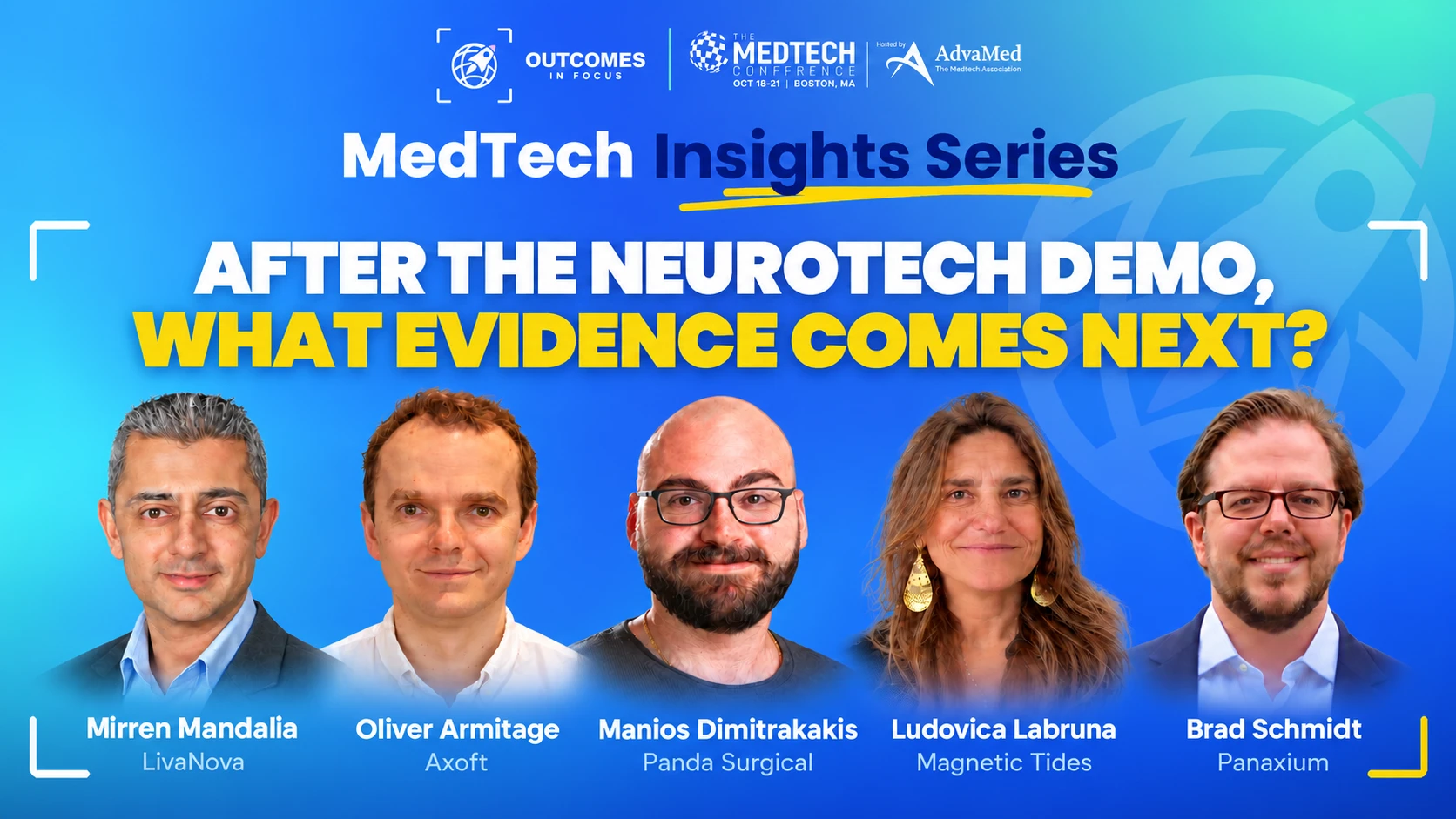
Mirren Mandalia, Vice President of Corporate Development and Venture at LivaNova, moderated the session featuring Oliver Armitage of Axoft, Manios Dimitrakakis of Panda Surgical, Ludovica Labruna of Magnetic Tides, and Brad Schmidt of Panaxium. Their presentations offered a look at different stages of neurotechnology development and the questions each company is working to address.
What Is the Current Investigation Designed to Establish?
Panda Surgical described its approach to minimally invasive surgery, including the use of robotic and standard instruments within the same operation. The company's investigation focused on safety and feasibility, while its broader ambition included improving surgical workflows.
Manios explained that the investigation was providing opportunities to learn from clinical use and incorporate those findings into the device. However, the company distinguished those learnings from evidence of the workflow improvement it hopes to achieve.
For someone evaluating the technology, that distinction provides a useful starting point. What has the team learned about using the device within an operation, and which aspects of the intended workflow benefit still require evaluation?
The company's account also raises a development question about what happens after those initial findings. As Panda Surgical makes changes informed by its investigation, the next discussion can focus on what the team is modifying and how it intends to evaluate those changes.
Axoft described a different initial objective. Oliver Armitage, Chief Clinical and Data Officer, discussed early human work focused on whether the company's brain-interface device could be implanted into and removed from brain tissue safely. The company reported a successful experience against that objective, while also sharing an observation that opened another area for investigation.
What Can Brain Signals Reveal Over Time?
During neurosurgery, Axoft's team reviewed a patient's brain signals and observed that its models appeared to detect emergence from anesthesia before clinicians identified outward signs.
The observation was exploratory, but it gave the company a reason to investigate further. Axoft discussed plans for longitudinal brain-signal recording in patients with disorders of consciousness, extending its work beyond the initial surgical setting.
The two situations involve different clinical questions. Observing changes during emergence from anesthesia does not establish how the technology would perform in patients with disorders of consciousness, and the conference presentation did not provide the detailed methods for the planned longitudinal work.
For a clinical partner interested in that next stage, the relevant questions concern how recordings would be collected over time, how they would be considered alongside clinical assessments, and what the investigation would be designed to establish.
Axoft's presentation connected its early experience with a proposed direction for further research. Understanding that direction in greater detail will depend on the methods and clinical objectives of the planned investigation.
What Changes When a Technology Reaches a New Application or Setting?
Magnetic Tides and Panaxium described different directions for extending their work. One discussed further clinical investigation and possible additional applications, while the other presented plans to move part of its therapy beyond the clinic.
Ludovica Labruna, CEO of Magnetic Tides, discussed the company's stimulation approach and plans for further clinical investigation. She also described ambitions to explore additional applications for the technology.
The presentation established the direction of that work without supplying detailed study protocols, comparators, or endpoints. Those details would be important for understanding which patient population an investigation would address and what results it could support.
For a prospective partner, the next conversation could focus on the specific application being investigated first and how the proposed study relates to it. The company's plans involve further clinical work, but the showcase did not provide enough detail to assess the design of those investigations.
Panaxium's proposed next step involved a change in treatment setting. Brad Schmidt, CEO and Co-Founder, described plans for a pilot involving hardware changes intended to extend therapy from the clinic into patients' homes.
The company anticipated additional benefit from that extension, although the presentation described it as an expectation rather than an established outcome. The planned pilot therefore introduces questions about the home component, including what changes in the therapy, how patients would use it, and what the pilot would evaluate.
There is also a distinction between evaluating whether therapy can be delivered at home and evaluating whether the home component contributes additional benefit. The proposed pilot's design would determine what the resulting evidence could address.
Both companies described future work, but their immediate questions differ. Magnetic Tides is considering further investigation of its stimulation approach and additional applications, while Panaxium is planning to evaluate changes associated with extending therapy into the home.
Follow the Question Into the Next Study
The four presentations described different clinical and technical objectives. Panda Surgical is learning from a safety and feasibility investigation while developing its device. Axoft is exploring longer-term brain-signal recording following its initial human work, Magnetic Tides is planning further clinical investigation, and Panaxium is preparing a pilot involving an extension of therapy into the home.
For investors and clinical partners following these companies, the next useful conversation depends on the work each company proposed. Panda Surgical's discussion invites questions about how it will evaluate workflow improvement. Axoft's plans call for more detail about longitudinal recording methods and clinical assessments.
Magnetic Tides' future investigations raise questions about the applications, patient populations, and outcomes being studied. Panaxium's planned pilot invites a closer look at the home component and how its contribution would be evaluated.
These are follow-up questions suggested by the presentations, rather than study endpoints or commitments provided by the speakers.
Each company has described a different next step. Understanding that step requires looking at the objectives of the proposed work and the evidence it is intended to generate, rather than treating every new investigation as the same kind of milestone.
The showcase offered a view of several technologies moving through different stages of development. The details of their next investigations will help clarify what each team is working to learn and how that work connects to the applications it hopes to pursue.
About the Conversation
This article draws on MedTech Innovator Showcase: Innovative Neurology Implants & Tools, held at The MedTech Conference in Boston on October 19, 2026. The session featured emerging neurological technologies, early clinical experiences, and plans for further investigation.
Mirren Mandalia, Vice President of Corporate Development and Venture at LivaNova, moderated the session. Presenters included Oliver Armitage, Chief Clinical and Data Officer at Axoft; Manios Dimitrakakis, CEO of Panda Surgical; Ludovica Labruna, CEO of Magnetic Tides; and Brad Schmidt, CEO and Co-Founder of Panaxium. Roles reflect the conference-date roster.
Resources
MedTech Innovator Showcase: Innovative Neurology Implants & Tools, October 19, 2026
Turn Healthcare Insightinto Accelerated Growth
Our healthcare growth teams work closely with you to design strategies tailored to your unique goals and market dynamics, fully focused on growth.
Book a Strategy Session →
Accelerating your growth with expert strategies in marketing, branding, research & insights, sales and lead generation to maximize healthcare impact.