Outcomes Articles
The Billing Is Automated. Why Are Staff Still Fixing Errors?
October 14, 2026
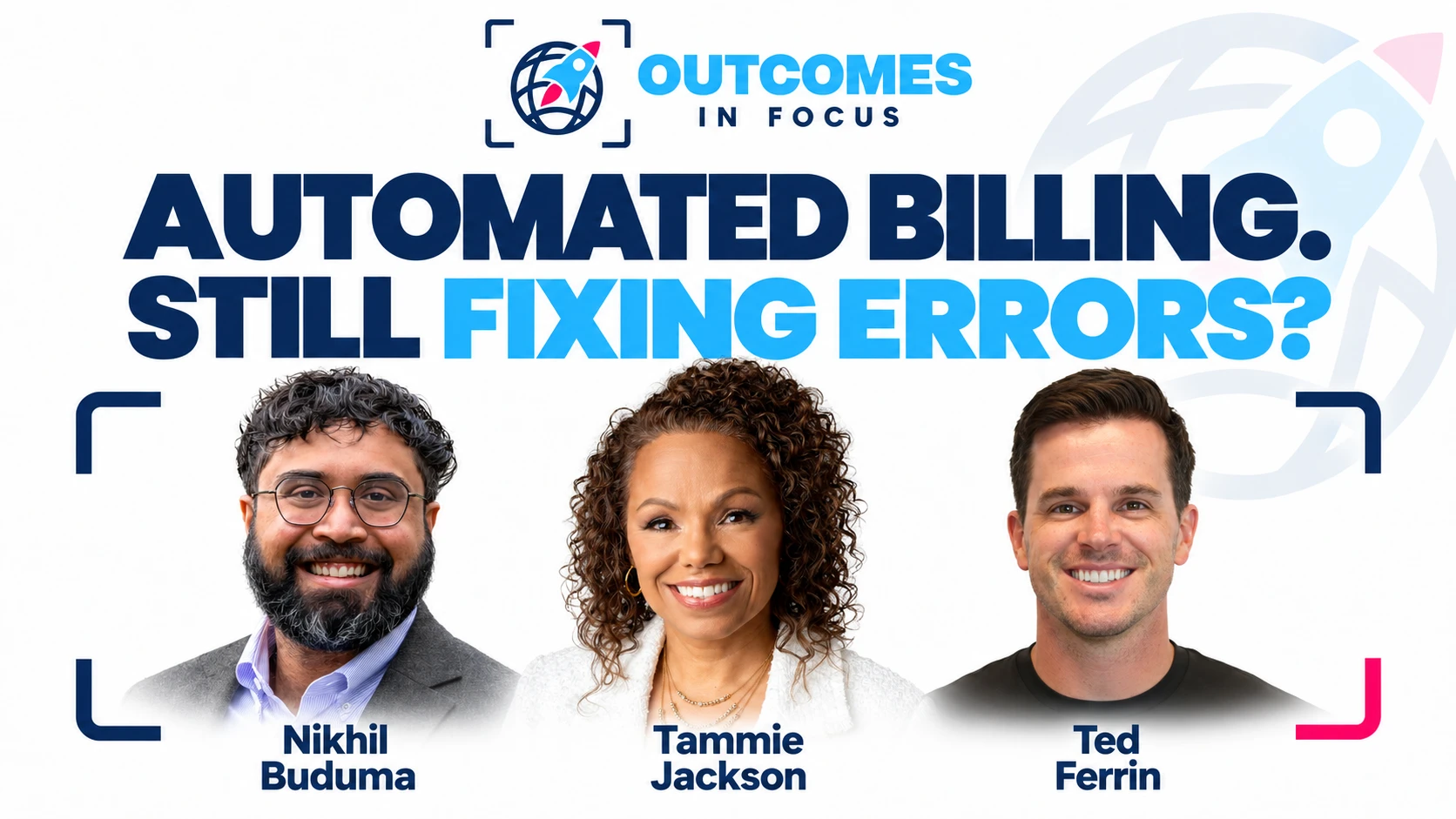
Featuring insights from Nikhil Buduma, Tammie Jackson, and Ted Ferrin hosted by our CEO, Saul Marquez.
A clinician finishes a note. A week later, someone may have to track them down for changes. Nikhil Buduma used that example when discussing Medicare Advantage and HCC risk adjustment: the documentation didn't fit what the next team needed for coding and review. The first task looked complete, but someone else inherited the correction.
If you're asking a health system to renew or expand automation, time saved at the point of care deserves recognition. The buyer also needs to see what happens afterward. Coding staff may still request revisions, revenue-cycle employees may repair avoidable problems, and payment teams may reconcile information by hand. How much of that work did the product remove?
Follow a representative account past the first completed task. Identify the recurring defect, what the product can reliably remove, what evidence establishes completion, and who handles the exceptions. A renewal claim becomes easier to assess when the buyer can see which repair disappeared and which work remains.
Find the Correction Before It Travels
What happens to the note after the clinician considers it finished? The downstream review determines whether the information supports the next authorized step or sends another request back to the physician. That difference matters to the person using the automation and to the team responsible for turning the encounter into an accurate, properly supported account.
In his conversation about Ambience Healthcare, Nikhil explained why this becomes complicated across specialties. Primary care, oncology and hospital medicine can involve very different preparation, electronic health record routines, documentation practices and billing requirements. An automated workflow that fits one setting may still leave another with work it wasn't designed to handle. Test the specialty in scope rather than assume uniform fit.
Nikhil used oncology preparation to make that tangible. Before a follow-up visit, an oncologist may review earlier notes, laboratory results and pathology reports. Some documentation can be prepared before the patient enters the room. If a precharting system creates one summary and an ambient documentation system creates another, the clinician may have to combine the outputs into a single usable note. The note still needs assembly.
His separate Medicare Advantage example adds a different requirement. Documentation and coding-model expectations must fit the relevant review context. If they don't, an initially convenient note can trigger a request for later correction. The example doesn't establish current coding instructions.
Nikhil also discussed the risks of contradictions between recorded documentation and selected codes, along with Ambience's practice of commissioning third-party coding reviews. Those are vendor-reported practices. They don't establish universal accuracy or denial prevention.
For the buyer, the evaluation is concrete. Choose the specialty and account type in scope, examine the documentation before and after automation, and follow it through appropriate clinical-documentation and coding review. Record where someone combines information, seeks clarification or requests an amendment. Determine which of those recurring tasks the offer actually removes while preserving legitimate review. A cleaner note is valuable, but the account must still pass through staff processing.
Observe the Work Before Automating It
Once the account reaches the revenue-cycle team, there's a different choice to make. Does this recurring task need software, training, or a change in the procedure? Portal navigation, uncertain procedures and inconsistent information require different interventions.
Tammie Jackson addressed that choice in her August 2024 conversation about Janus Health, where she served as Chief Revenue Officer. She described operational intelligence as a way to see how revenue-cycle staff spend their time and identify opportunities for training, automation or changes to standard operating procedures. Observing the work reveals candidates for improvement. It doesn't, by itself, correct a claim, change a procedure or resolve an account.
Consider a recurring claim-status lookup. If employees repeatedly visit a portal, locate a status and transfer the same information into another system, the stable portion of that sequence may be a reasonable automation candidate. If the underlying issue is that two teams use different instructions to classify the same exception, automating their existing actions can preserve the confusion. A procedure change and shared definitions may need to come first. These are evaluation examples, not measured Janus customer outcomes.
Tammie was candid about another implementation problem. Early at Janus, the company tried to satisfy nearly every customer need. She said that approach produced solutions that weren't necessarily scalable, stretched resources and diverted focus from problems that could be addressed more broadly. Each customization adds testing and maintenance obligations.
She also discussed brittle early automation and the effort required to make systems durable. A buyer should therefore examine how the process behaves when a portal changes, a case falls outside the routine or a staff member needs to intervene. Agree on monitoring, human review, maintenance ownership and completion. No numerical maintenance saving or staffing reduction is established by her interview.
A successful processing step reduces a defined burden. It still leaves the question of what the provider can do with the account when claim and payment information arrives from other systems.
Make Payment Information Usable
Ted Ferrin described that downstream work in his May 2026 Outcomes Rocket conversation. As Senior Vice President of Payments Innovation at Zelis and formerly co-founder and CEO of Rivet, he discussed the fragmentation among payer contracts, claims, remittances, reconciliation and analytics. Their systems and formats differ. Ted described manual postings, spreadsheets and even sticky notes used to manage the work between them.
The practical difficulty begins with knowing what the provider and payer are trying to reconcile. Claims, contracts and remittances supply different parts of the payment picture. Those pieces may not be presented together in a way that lets an employee resolve the discrepancy. A report may leave manual comparison intact.
Ted emphasized clean, normalized structured data reaching the right stakeholder inside the workflow. His discussion of Rivet's capabilities and potential integration with Zelis payments infrastructure described a product direction at the time of the interview. It doesn't prove universal deployment or reduced reconciliation work.
Can the payment team resolve the account with the information now on screen? The buyer can test that question by selecting a real, appropriately protected account and asking the responsible employee to connect the claim, relevant contracted reimbursement terms and remittance. If the values need investigation, the workflow should show what information is missing, whether follow-up belongs with the provider or payer, and who will act on it. A dashboard that displays the discrepancy but leaves those decisions in an untracked spreadsheet has not completed the same job.
The definition of completion matters here. One account may be reconciled and posted appropriately. Another may be correctly identified as an exception awaiting authorized payer follow-up. Calling both processed hides unfinished work. The evaluation should distinguish a resolved account from a documented exception with a responsible owner and next action.
Ted connected trust to reduced disputes, less administrative work and more predictable cash flow. Those were desired outcomes, not measured results. A vendor can discuss those goals while being precise about which step its product has actually changed.
Follow the Account to Resolution
For the next automation renewal or expansion, bring product and commercial teams together with the provider's clinical-documentation, coding, revenue-cycle operations, and payment-reconciliation leads. Trace a representative account, using appropriately protected information, from the original note and coding decisions through staff processing to payment resolution. Include corrections that happen outside the system. Record:
- Origin: where the recurring defect begins.
- Correction: what staff do today and which part the offer actually removes.
- Completion: what evidence shows a resolved account or a correctly documented exception.
- Exceptions: the next required action and the person or team authorized to handle it.
- Required review: the clinical, coding, and payer checks that still need to happen.
Compare that record with the specific speed improvement you are promising. Expand where the targeted correction has demonstrably disappeared and the agreed result can be observed. Limit the next stage when the evidence supports a narrower workflow. If missing data, unclear ownership, or an unsuitable process leaves the same correction outstanding, address that gap before asking for a broader commitment.
At the next renewal review, walk the buyer through one protected account. Show which correction disappeared, what a resolved account looks like, and who owns the remaining exceptions. Then return to Nikhil's example: did the finished note become usable for the next team, or did that team still inherit a repair?
About the Conversations
These are three separate Outcomes Rocket conversations, not a shared case study. During the time of recording, the guest names and titles were as follows: Nikhil Buduma, Co-Founder and CEO of Ambience Healthcare. Tammie Jackson, Chief Revenue Officer at Janus Health. Ted Ferrin, Senior Vice President of Payments Innovation at Zelis.
Resources
Nikhil Buduma: Making Clinical AI Work
Tammie Jackson: Janus, AI in the Revenue Cycle
Ted Ferrin: Bringing Clarity to Healthcare Payments

Turn Healthcare Insightinto Accelerated Growth
Our healthcare growth teams work closely with you to design strategies tailored to your unique goals and market dynamics, fully focused on growth.
Book a Strategy Session →
Accelerating your growth with expert strategies in marketing, branding, research & insights, sales and lead generation to maximize healthcare impact.