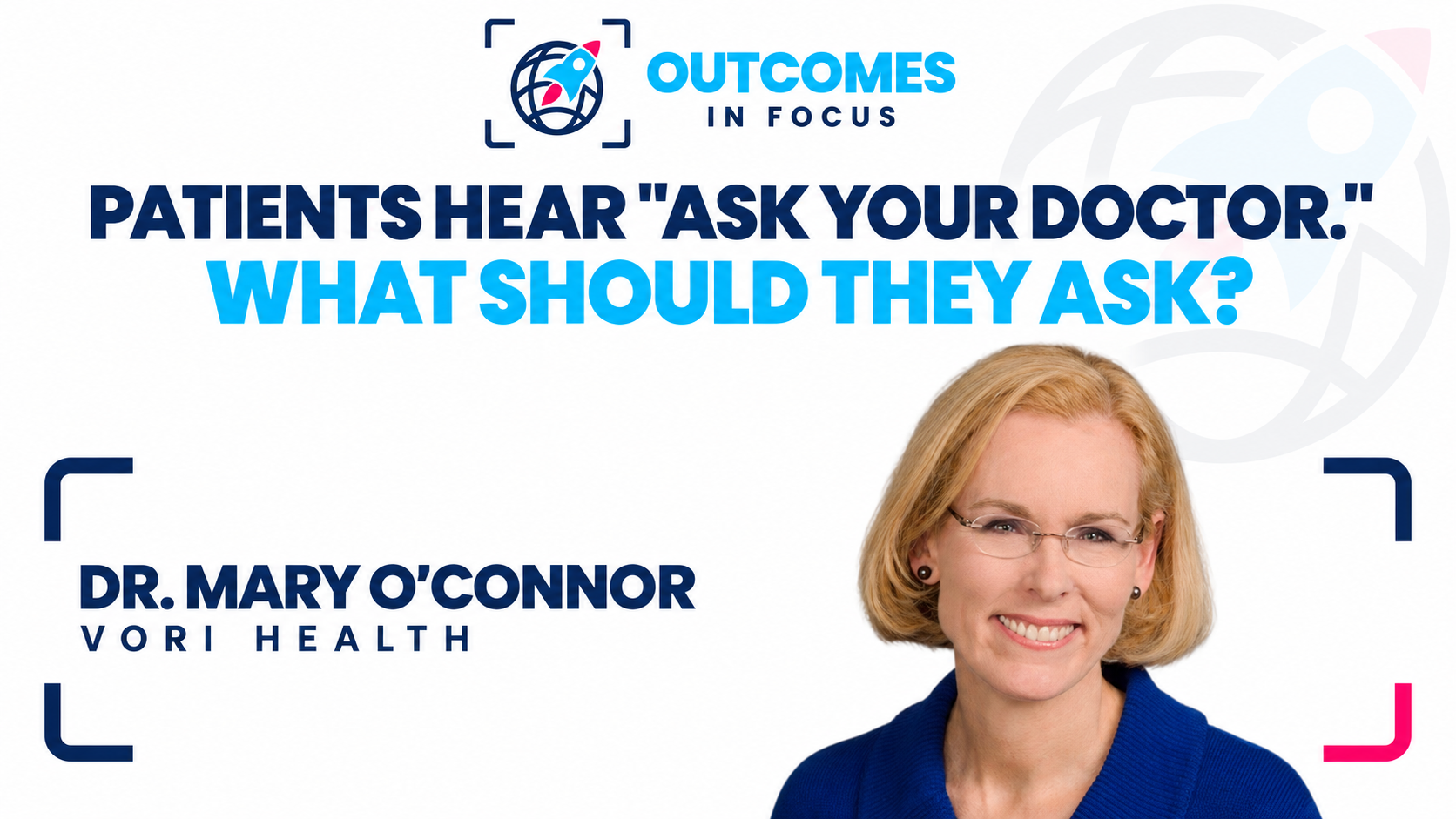
Featuring Dr. Mary O'Connor, Co-Founder and Chief Medical Officer, Vori Health in conversation with Saul Marquez on the Outcomes Rocket podcast.
Dr. Mary O'Connor approved a mechanic's recommendation for new brake pads. When her husband later asked how thin the lining had been, she couldn't answer. She had accepted the recommendation without the frame of reference to question it.
Mary uses that experience to explain why patients may struggle to ask useful questions. They can know their own work well and still lack the reference points for a medical discussion. An invitation to ask questions is only a starting point.
Clinical teams can help by making three things clear: the decision ahead, how the explanation fits together and what happens after the appointment. The first task is to give patients enough context to recognize what they need to ask.
Give Patients a Starting Point for Questions
A patient may understand that a condition matters without knowing which questions would help them discuss it. Mary's analogy points to that missing reference point. Asking for questions assumes some preparation has already happened.
Mary describes one way to provide it through Taking Care of You: The Empowered Woman's Guide to Better Health, co-authored with Kanwal L. Haq. The women-focused resource includes condition chapters, questions to ask healthcare teams and guidance from experts. In her account, those questions help women prepare to discuss their care with a clinician.
A patient resource can explain a condition yet leave someone unsure what the next appointment is meant to resolve. When reviewing those materials, connect the topic to the decision ahead. What will the patient discuss, and which information would help them prepare for that conversation?
Look for a clear description of the decision, the information relevant to it and questions the patient can bring. Check what the resource assumes the reader already knows. A longer handout may still leave that starting point unexplained, while one useful paragraph can make the next conversation easier to prepare for.
Preparation gives the patient somewhere to begin. The appointment then needs to connect the questions with a shared explanation.
Build the Plan in a Shared Conversation
In the interview, Mary describes a Vori Health musculoskeletal evaluation that brings a physician and physical therapist into the same video visit. She identifies this integrated visit as an entry point for patients with more complex issues, greater medical complexity, or more severe pain and worse function.
The patient gives one history. Both clinicians can ask questions and participate in the virtual examination. The physician provides the medical diagnosis, while the physical therapist provides the functional assessment. Everyone hears the discussion, and the plan is developed together.
The patient can hear the medical and functional perspectives together, including how each contributes to the plan. That is a useful feature of the conversation to examine. When reviewing an appointment in another setting, ask whether the patient hears how the recommendations relate or has to piece together separate explanations afterward.
Mary also describes a route that begins with a physical therapy evaluation. Physician involvement can follow when the patient's situation is more complex, when the patient wants to see a physician or when improvement isn't occurring. These are the pathways she describes for that service, with different entry points depending on the patient's circumstances.
What needs to remain clear when the appointment ends?
Make the Next Step Clear After the Visit
Mary describes support beyond the initial evaluation through health coaching, referrals and coordination with a patient's primary care clinician. Her account includes screening for anxiety and depression, help connecting patients with mental-health providers and coaching around behavior changes.
Those responsibilities have boundaries. Vori Health partners with primary care rather than replacing that relationship. Mary explains that the practice does not prescribe antidepressant or anti-anxiety medication and connects patients back to their primary care clinician when screening identifies concerns.
Mary connects the experience of navigating care with engagement and following a treatment plan. Her reasoning brings the communication question beyond the visit: a patient also needs a usable way to seek clarification when the plan becomes difficult to follow.
Review the follow-up instructions alongside the explanation of the plan. Is the next action understandable? Can the patient identify whom to contact if they need help? A recommendation may be clear during the appointment while leaving that route unspecified. The communication should make both the action and the contact point easy to find.
Which current patient communication could the team inspect first?
Review One Patient Resource Against One Real Decision
Bring together a clinician familiar with one common care decision and a patient-facing staff member. Choose a resource patients already receive before or after that conversation, so the review addresses an explanation the team currently relies on.
Identify what the patient needs to understand, one useful question the material helps them ask and the next action or contact route. Mark any explanation that assumes knowledge the resource hasn't supplied. Then choose one explanation to clarify before adding more information.
Turn the review into a revised paragraph or short question prompt attached to the current resource. Start with the missing reference point in Mary's mechanic story: what does this patient need to understand before a question becomes possible? A useful question starts with an explanation the patient can use.
About the Conversation
Dr. Mary O'Connor and Saul Marquez discuss what helps patients prepare for a visit, understand a shared evaluation and stay engaged after the appointment.
Resources

Turn Healthcare Insightinto Accelerated Growth
Our healthcare growth teams work closely with you to design strategies tailored to your unique goals and market dynamics, fully focused on growth.
Book a Strategy Session →
Accelerating your growth with expert strategies in marketing, branding, research & insights, sales and lead generation to maximize healthcare impact.