Outcomes Articles
Patients Agreed to Turn Their Device Off. Then They Asked About Morning.
November 4, 2026
Patients with essential tremor welcomed the idea of turning their deep brain stimulator off at night. But they had one concern: what if their symptoms made it difficult to turn the device back on in the morning?
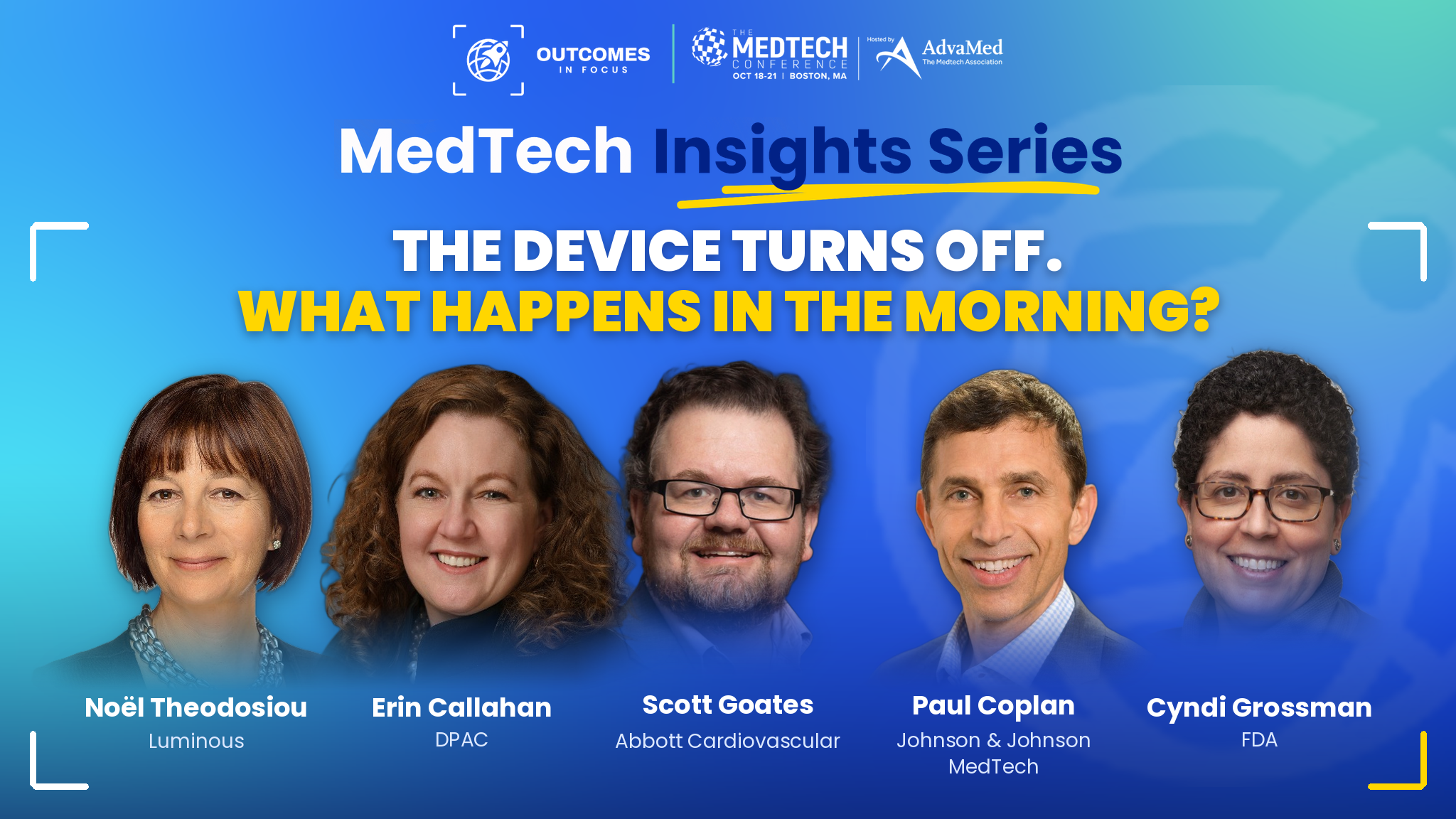
At The MedTech Conference in Boston, Scott Goates, Director of Global Data Science and Analytics at Abbott Cardiovascular, shared how that question helped his team identify an important design problem.
Abbott's engineers responded by developing a sleep timer that could schedule both shutoff and restart.
The patients had already agreed to the proposed feature. But their concerns about what happened afterward revealed an opportunity to make it more useful.
Scott shared this example during "If We Build It, Will They Come? Patient Advocates Are Ready, Are We?", a session on October 19, 2026, moderated by Noël Theodosiou, Principal and CEO of Luminous.
The panel also featured Erin M. Callahan, Chief Operating Officer of the Diabetes Patient Advocacy Coalition; Paul Coplan, Vice President and Global Head of Medical Device Epidemiology at Johnson & Johnson MedTech; and Cynthia (Cyndi) Grossman, Director of the FDA's Division of Patient-Centered Development.
Together, the discussion explored how medical device companies can make patient input a meaningful part of product development and what it takes to act on the feedback they receive.
The First Answer Isn't Always the Whole Story
When a patient agrees to a proposed feature, it's tempting to consider that question settled.
But the experience doesn't end when the feature is activated.
In the example Scott shared, patients needed to turn off their device, sleep, wake up and turn it back on. That final step created anxiety because their symptoms could make operating the device difficult.
By understanding the entire experience, Abbott's engineers were able to address something that might have been missed in a more limited discussion.
For product teams, this raises a useful question: Are we asking patients whether they like a feature, or are we understanding what it takes to use it in their daily lives?
Walking through the steps before and after an interaction can uncover problems that aren't obvious during a demonstration or product review.
Patient Feedback Needs Follow-Through
Listening is important, but Scott also emphasized what happens after patients share their feedback.
Medical device companies won't be able to implement every suggestion. There may be technical, regulatory or practical limitations.
That doesn't mean the conversation should end without an explanation.
Scott encouraged teams to be transparent about what they can and cannot change, while making sure patients feel comfortable continuing to share ideas.
When feedback does influence a product, patients should hear about it.
For example, someone who helped identify a problem with a device should be able to understand whether that concern led to a design change, further investigation or a decision not to proceed.
This kind of follow-through helps patients see that their experiences are being taken seriously.
It also requires someone inside the organization to own the response.
Measure What Changes Because of Patient Input
Paul Coplan of Johnson & Johnson MedTech raised another important consideration: how organizations document and measure the value of patient engagement.
He recommended capturing specific patient recommendations in advisory-board meeting minutes and tracking the actions or outcomes those recommendations influence.
Simply counting meetings doesn't tell an organization whether patient engagement is making a difference.
A more useful question is what happened because of the conversation.
Did a recommendation change a design? Did it prompt an investigation? Did the company decide against a requested feature and explain why?
Paul also encouraged the people responsible for follow-up to hear patients directly.
A written summary can capture a recommendation, but it may miss the details that help someone understand why a particular issue matters in everyday life.
The goal is to connect patient input with the people and decisions that shape the product.
What Happened to the Last Patient Recommendation?
The panel's discussion offers a practical opportunity for medical device teams.
Look at the most recent patient advisory meeting and identify a recommendation that still doesn't have a clear resolution.
Can someone explain what the patient was trying to accomplish?
Does the team know who is responsible for evaluating the request?
Has the patient received an update?
These are relatively simple questions, but the answers reveal whether patient engagement is connected to the organization's actual decision-making process.
Scott's example shows why this matters.
Patients had already said yes to nighttime shutoff. If the conversation had stopped there, the team might have missed their concerns about the morning.
The most useful feedback came from understanding what happened next.
About the Conversation
This article draws on "If We Build It, Will They Come? Patient Advocates Are Ready, Are We?" at The MedTech Conference in Boston on October 19, 2026.
The discussion was moderated by Noël Theodosiou of Luminous, with Erin Callahan of the Diabetes Patient Advocacy Coalition, Scott Goates of Abbott Cardiovascular, Paul Coplan of Johnson & Johnson MedTech, and Cynthia (Cyndi) Grossman of the U.S. Food and Drug Administration.
The session explored how direct patient engagement can inform medical device development and how organizations can turn feedback into meaningful decisions.

Turn Healthcare Insightinto Accelerated Growth
Our healthcare growth teams work closely with you to design strategies tailored to your unique goals and market dynamics, fully focused on growth.
Book a Strategy Session →
Accelerating your growth with expert strategies in marketing, branding, research & insights, sales and lead generation to maximize healthcare impact.