Outcomes Articles
Can the Hospital Deliver the Robotic Procedure You're Selling?
October 14, 2026
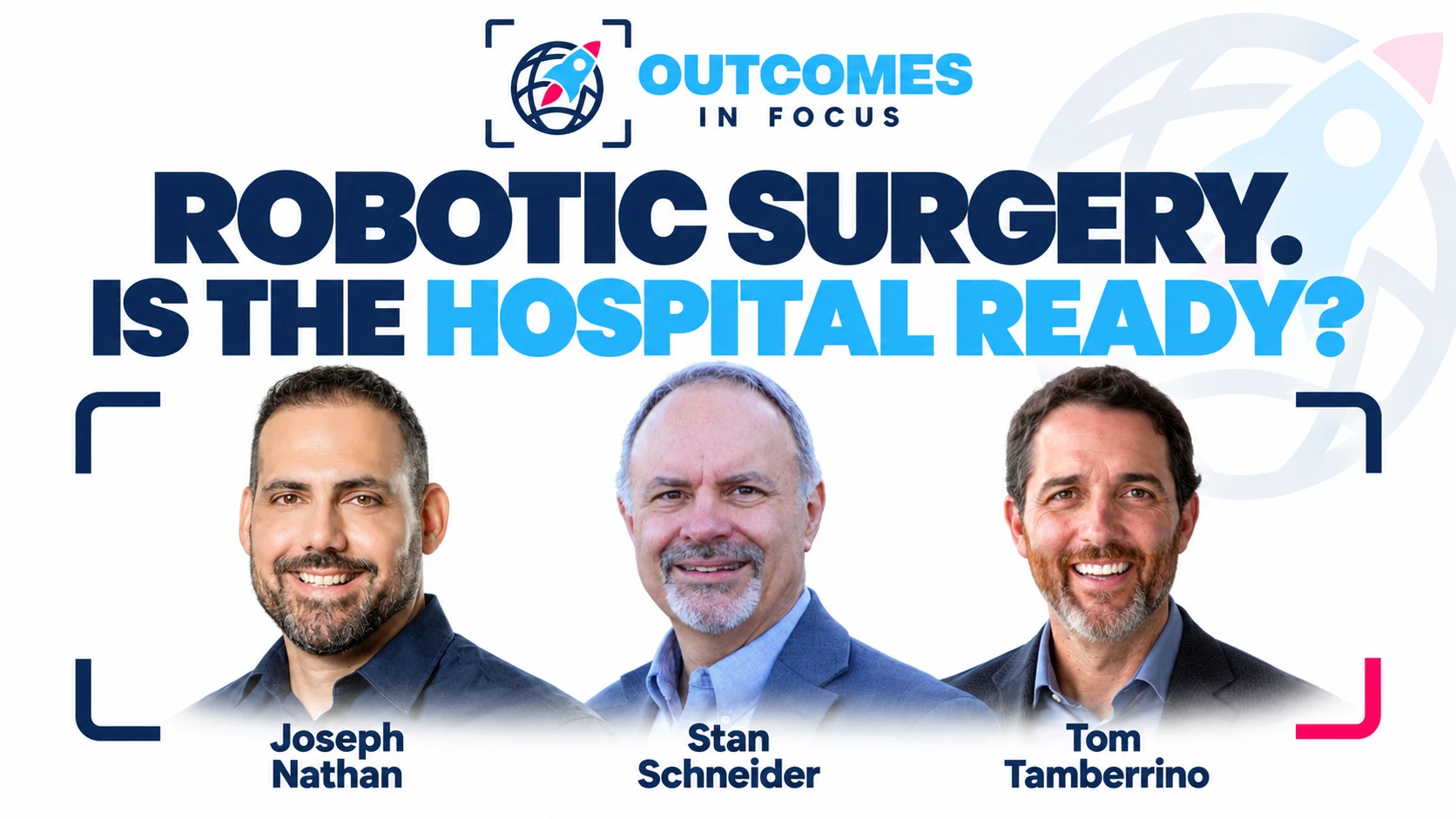
Featuring insights from Joseph Nathan, Stan Schneider, and Tom Tamberrino hosted by our CEO, Saul Marquez.
Joseph Nathan remembers how hard it was to repeat the same precise movements during cataract surgery. The work happens in a very small space, where consistency matters. That experience helped motivate ForSight Robotics and its goal of assisting surgeons with greater precision and predictability. His account explains the ambition; it does not establish better patient outcomes.
For a surgical robotics founder moving toward a clinical-site agreement, production milestone or launch proposal, that promise may already be attracting attention. Can the receiving site actually perform the procedure? It still needs to know what the robot does, what information its controls require and which responsibilities remain with clinicians. Discovering those gaps after a commitment can mean revisiting equipment, staffing, training or the agreed scope.
A surgical robotics deployment plan should answer those questions before the next commitment. Define the task and intended users, the required data and timing, and the manual work and clinical judgment that remain. Check the site's infrastructure. For each unresolved requirement, name an owner and the evidence needed to resolve it. Those details let both teams decide what they can support.
Define the Procedure Before Selling the Precision
Joseph's account begins with an unusually concrete surgical challenge: during cataract surgery, delicate movements and incisions must be performed repeatedly inside the small dimensions of the eye. He describes wanting to make this work more consistent and predictable. For a founder, the next task is translating that clinical ambition into a description that engineers can test and surgeons can assess rather than leaving precision as a general product promise.
What exactly is the robot being asked to do? Specify the procedure and intended clinical user, then identify which movements or functions are proposed for robotic control. Document what the clinician directs, what the system assists with, when a physician needs to intervene and what falls outside the intended use. A prospective clinical partner should be able to read that description and understand which work belongs to the device and which work remains with the operating team.
The distinction is important for design and evaluation. A goal such as reducing variation in a movement can guide engineering tests, but a claim about improved outcomes requires suitable clinical evidence. Joseph describes consistency, predictability and potentially improved throughput as reasons to pursue robotics. His supplied interview doesn't establish patient-study results proving those advantages, nor does it show that every part of cataract surgery would be autonomous.
A commercial proposal should therefore distinguish the purpose of the robotic assistance from what has been demonstrated. Have the product team write the surgical task in ordinary language, then have engineering and the intended clinical users mark the steps requiring verification. If the proposed benefit depends on a particular surgeon workflow, the description should say so. If the team cannot yet substantiate a benefit, call it an intended advantage rather than an established result.
Make the Data Useful When the Robot Needs It
Stan Schneider, CEO of Real-Time Innovations (RTI), explains why software and physical movement have to be considered together. His company's work concerns infrastructure connecting algorithms, sensors and actuators. In his interview, Stan identifies three linked requirements for physical control: the data must be found and routed to the proper destination, its meaning must be usable, and it must arrive at the time the control loop requires it.
Will the right information reach the right component when the physical system needs it? Stan describes an orthopedic surgical-robot example involving knee-replacement work, where sensor inputs and controlled motion support accurate surgical actions. He characterizes the robotic role as augmenting the surgeon rather than replacing the surgeon. This is a separate example from Joseph's ophthalmic technology, not evidence that the two systems use the same infrastructure.
For a proposed clinical deployment, the engineering team should identify each essential input, the component that uses it and the behavior it is intended to govern. It should also establish relevant timing requirements and what the system is expected to do when information is delayed, missing or unusable. A diagram showing that components are connected does not by itself establish that the data flow works under the conditions needed for a physical feedback loop.
Stan also emphasizes the distance between a working prototype and a production system. A demonstration can show that software and movement operate under selected conditions. Production requires the manufacturer and its partners to evaluate reliability, implementation constraints and supporting evidence for the intended use. The interview provides no numerical latency threshold or validated failure rate to copy into another company's requirements. Those details have to come from the actual system design and its testing.
Account for the Clinician and the Clinical Site
Tom Tamberrino, Chief Commercial Officer of Profound Medical, makes the clinical workflow visible through his description of TULSA-PRO, an MRI-guided system for prostate-tissue ablation. This is a different application from Joseph's ophthalmic work and Stan's orthopedic-control example. It also illustrates why a robot-controlled treatment step cannot be the entire deployment description.
Tom explains that the procedure takes place in an MRI-equipped setting. The patient receives general anesthesia. A treating physician manually places an ultrasound applicator through the urethra and an endorectal cooling device. The system assists with outlining the prostate and treatment planning, while the clinician can review or override the plan based on clinical judgment. After planning, the physician initiates robot-controlled ultrasound ablation.
That sequence leaves meaningful responsibilities with the clinical team. Anesthesia, placement, review, decision-making and initiation still have to be assigned to the appropriate people and supported by the facility. Describing the treatment delivery as autonomous cannot erase the work that precedes it, nor can the interview establish that the approach is suitable for every patient or that particular recovery outcomes are guaranteed.
Who is still responsible for the work around the robot? For a receiving site, the answer affects the clinicians involved, the procedure schedule, the available equipment and the steps the facility has to organize before treatment. The commercial team needs to work through those details with the actual clinical users. A proposal focused on the robot's automated portion could otherwise leave responsibilities unsettled that determine whether the intended procedure is practical at that location.
The MRI requirement is equally concrete. Tom describes treatment in hospital MRI suites and discusses other potential settings, including some ambulatory surgical centers and office-based facilities with MRI access. That does not mean every outpatient facility is equipped or appropriate for the procedure. The proposed site must confirm its own imaging availability, relevant equipment, staff and scheduling capacity. A clinical capability at one location cannot simply be copied onto the next site proposal.
Tom also discusses reimbursement as part of the economics of investing in MRI capacity. His interview presents facility payment as a reason some urology groups may consider that investment, but it doesn't establish that every practice qualifies for the same payment or can operate a profitable program. A receiving site's financial review would need current applicable payer policies, actual costs, staffing and expected utilization before that claim could influence a commitment.
Put the Deployment Requirements on the Table
Before the next clinical-site agreement, production milestone or launch proposal, bring commercial and product leadership together with engineering and control-system teams, intended clinical users, quality and regulatory representatives, and the receiving site's operations and infrastructure leaders. Give them one procedure-specific deployment record to review, with the proposed clinical use clearly defined. This is a practical evaluation tool for the next commercial decision, not a replacement for clinical validation or regulatory review.
Make the deployment record easy for each team to check:
- The robot's intended task and the use supported by the available evidence.
- The data inputs and timing needed for physical control.
- The actions clinicians must perform or approve.
- The equipment, staffing and procedural capacity the receiving site can provide.
- Each unresolved requirement, its owner, the evidence needed and what must be tested or verified before the next commitment.
Use that review to set the scope. Proceed when the evidence and the site's capabilities support the proposed procedure. If they support only a narrower setting or a limited deployment stage, state those boundaries in the proposal. Resolve critical control, clinical or infrastructure gaps before expanding the commitment.
Joseph wanted help performing precise movements consistently. Delivering the procedure also takes reliable controls, clinical judgment and a prepared facility. Before you sign the next site agreement or expand a launch proposal, have the clinical team and receiving site review the procedure record. Leave that review with an agreed scope and a named owner and evidence requirement for every open item.
About the Conversations
These are three separate Outcomes Rocket conversations, not a shared case study. During the time of recording, the guest names and titles were as follows: Joseph Nathan, Founder and CEO of ForSight Robotics. Stan Schneider, CEO of Real-Time Innovations. Tom Tamberrino, Chief Commercial Officer of Profound Medical.
Resources
Joseph Nathan: How AI and Robotics Are Transforming Ophthalmology
Stan Schneider: Usable Data Is the Key to Usable AI in Healthcare
Tom Tamberrino: The Rise of Incisionless Surgery

Turn Healthcare Insightinto Accelerated Growth
Our healthcare growth teams work closely with you to design strategies tailored to your unique goals and market dynamics, fully focused on growth.
Book a Strategy Session →
Accelerating your growth with expert strategies in marketing, branding, research & insights, sales and lead generation to maximize healthcare impact.