Outcomes Articles
Better Surgical Precision: What Does the Patient Actually Gain?
October 14, 2026
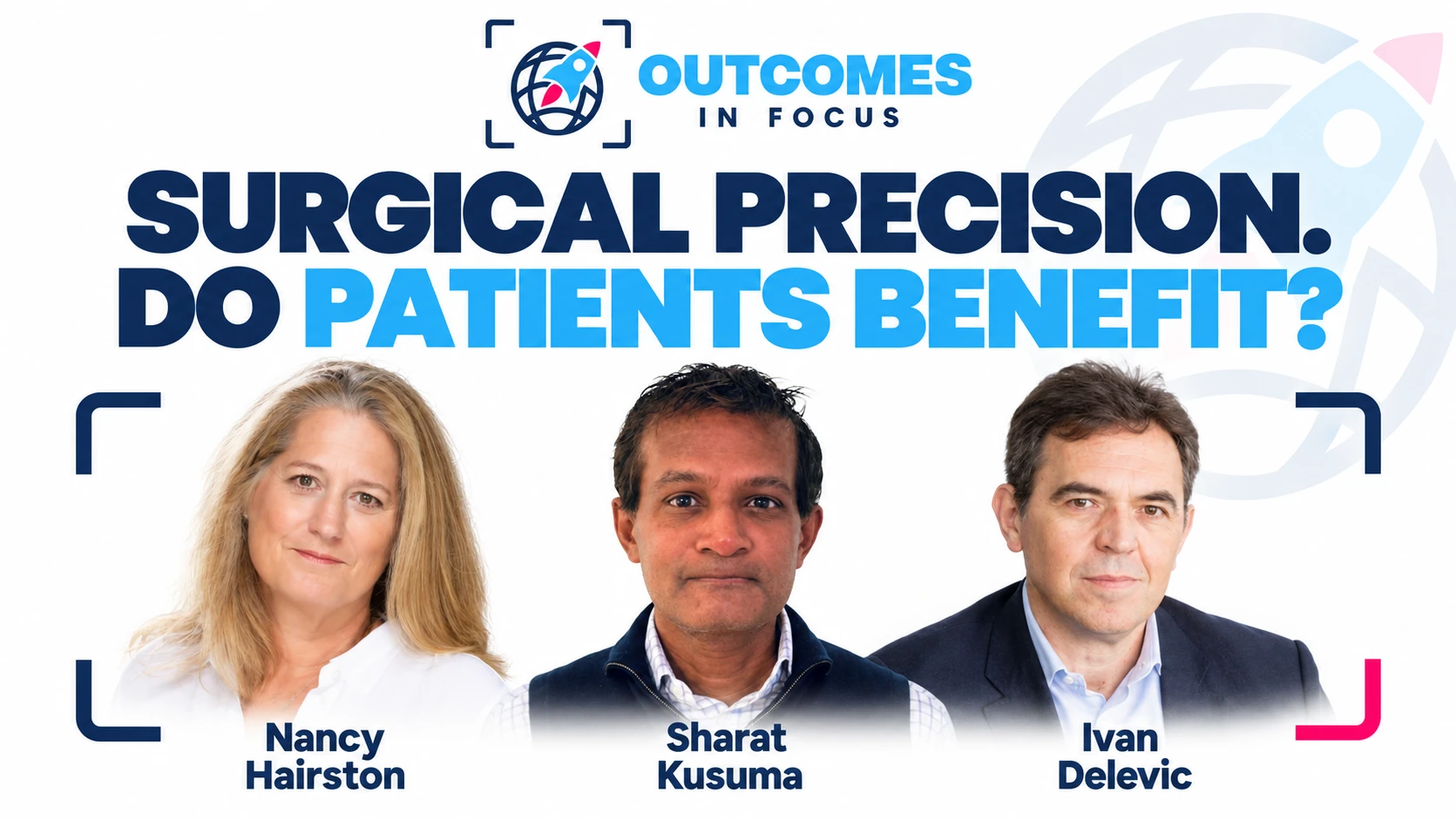
Featuring insights from Nancy Hairston, Sharat Kusuma, and Ivan Delevic hosted by our CEO, Saul Marquez.
The implant is in the intended position. What can the patient do afterward? A system may make a more accurate cut, guide placement or measure something a surgeon once judged by feel. Those are technical achievements. A claim about recovery or everyday function needs evidence of its own.
Orthopedic surgeon and medtech executive Sharat Kusuma explored that question in an Outcomes Rocket conversation about sensor-guided joint surgery. He proposed comparing surgical approaches through later patient activity and function, including walking. He was describing an evaluation to pursue, not reporting better recovery from the newer approach. His question gives surgical-device companies a starting point: which patient outcome matters, and what would show that it improved?
After years spent developing a more precise surgical solution, you may want that achievement at the center of a launch claim or buyer presentation. Before promising faster recovery or better function, put the claim beside the product-specific clinical evidence. Identify what changes during surgery, what benefit the patient is meant to gain and how much of that benefit the evidence supports.
Define What the Technology Actually Changes
Patient-matched surgery can mean several different things. Nancy Hairston, president and CEO of MedCAD, describes using CT scans and other imaging data to tailor surgical solutions to an individual's anatomy. She also acknowledges that customization doesn't make sense in every situation. The intended clinical application needs to justify the approach.
Nancy describes three outputs with different jobs:
- An anatomical model helps the surgeon understand the structures and plan the procedure.
- A surgical guide directs a particular cut or positioning step.
- A patient-matched implant is shaped for the intended anatomy.
They may belong to one planning system. Evidence that a guide performs accurately does not automatically show that the implant or the whole system improves recovery.
Nancy describes a foot-related system combining surgical planning, guides and an anatomy-contoured implant. The guide is intended to help make precise bone cuts, after which the implant fits the prepared anatomy. She reports fitting and operating-room efficiency advantages. Those are MedCAD's accounts of technical and procedural benefits, without supplied comparative patient-outcome results to establish faster recovery, fewer surgeries or better everyday function.
Which part of the operation does the technology actually change? A commercial team should be able to name the planning step, cut, implant positioning task or other defined action before choosing evidence for the claim. A broad label such as personalized is less useful to a buyer than an explanation of what the surgeon does differently and why.
The next step is to identify a postoperative outcome appropriate to the device's intended use and patient population. Accurate fit may matter to a surgeon, but the evidence still needs to establish whether the claimed benefit extends to the patient's experience after surgery. That is a different question from whether the technology performed its designed surgical task.
Choose an Outcome Patients Can Recognize
Patients preparing for joint surgery may want to understand how much they will be able to walk, what daily activities could look like and what recovery will involve. Those concerns help the clinical and product teams decide which outcomes are worth evaluating, rather than choosing endpoints only because a device can record them.
In his 2019 conversation, Sharat Kusuma described how limited engagement before elective joint replacement could leave patients with questions. He explored using activity tracking, education and preparation during the time before surgery to give clinicians and patients more information about an individual's condition and rehabilitation. His scenarios were hypothetical and developmental, not reports of measured improvements.
Sharat also proposed comparing patients who underwent conventional implantation with those treated using newer sensor-guided methods. He suggested examining subsequent activity and function, including walking, to investigate whether greater intraoperative precision translated into a difference outside the operating room. The idea supplies a research question, not a result or a validated rule for choosing treatment.
What would you measure to know whether that precision helped the patient? Walking activity might suit a particular joint-replacement study, while another procedure might call for a validated functional score, pain assessment or patient-reported measure. The endpoint needs to reflect a benefit relevant to the patients and the claim, with a suitable baseline and follow-up.
Measurement also needs interpretation. Activity can change for reasons beyond an implant or surgical technique, including rehabilitation and the patient's broader health. Recording additional steps does not, by itself, show the intervention caused that change. A relevant comparison, appropriate study methods and meaningful follow-up are needed before the commercial statement can move from hoped-for benefit to demonstrated outcome.
Sharat's proposal helps a founder decide which outcome is worth investigating. Once that outcome has been chosen, the more demanding question is whether the actual device has evidence connecting its surgical contribution to that outcome.
Match the Evidence to the Claim
Ivan Delevic discussed this evidence challenge from two distinct experiences: his earlier work at MAKO Surgical and his role leading OrthoSensor during a 2019 Outcomes Rocket conversation. He described how navigation and robotics helped quantify planning and implant placement relative to bone anatomy, while ligament and soft-tissue balance remained a different surgical challenge.
Ivan recounted surgeon Martin Roche's interest in measuring parameters that had relied on subjective judgment. This helped shape OrthoSensor's approach to intraoperative sensor measurement. Its technical objective was to provide surgeons with quantitative information about soft-tissue balance. Whether that measurement produced improved patient satisfaction, function or long-term outcomes required separate clinical evaluation.
Ivan also recalled an earlier randomized MAKO partial-knee study in Glasgow, Scotland. He described a process taking roughly six years from setting up the trial through recruitment, follow-up and publication. He believed that this study strengthened the reception of other work around that particular surgical approach. The supplied interview does not provide independently verified effect sizes or the original study analysis, so his account is best used to illustrate the evidence-development effort.
The stages Ivan described matter to a device company deciding how far its language can go. Demonstrating that an instrument measures reliably or helps execute an intended surgical task is one kind of substantiation. A comparative claim about recovery or function calls for evidence from an appropriate population, a relevant comparison, specified outcomes and sufficient follow-up. A trial is not automatically required to take six years, and a collection of routine sensor readings is not automatically a randomized study.
Does the evidence support that outcome for this particular device and patient population? The MAKO partial-knee account cannot prove a benefit for OrthoSensor's sensor system, Nancy's patient-matched products or Sharat's proposed approaches. Their devices, intended uses and patients differ. Product-specific technical data may justify a narrow statement, while a patient-outcome promise requires evidence addressing that actual promise.
Put the Value Claim Through One Final Check
Before the next launch claim, buyer presentation or proposed clinical expansion, bring commercial and product colleagues together with appropriate clinical, evidence/research and regulatory reviewers. Put one proposed patient-benefit statement in front of them alongside the records offered to support it. The goal is to decide which words the available evidence can carry.
Check the proposed claim against five things:
- The specific intervention and its intended use.
- The surgical task or clinical change it is meant to improve.
- A meaningful patient outcome and the population it concerns.
- The product-specific evidence: who was studied, what was measured, the comparison, the reported results and the length of follow-up.
- The uncertainty that remains.
Choose the wording the evidence can support. Use the patient-benefit statement when the findings establish that benefit within its stated limits. Narrow or qualify it when the results establish technical performance but leave recovery or function unproven. If expansion depends on an outcome that has not been established, identify the additional clinical evaluation needed. This organizes editorial and commercial review; qualified clinical and regulatory decisions still belong with the appropriate reviewers.
Nancy helps identify what changes during surgery. Sharat asks which patient function is worth evaluating. Ivan's historical MAKO experience shows the work involved in building stronger clinical evidence. Their products, populations and evidence bases remain distinct.
Before the next buyer presentation, write the exact sentence you want to say about patient benefit. Bring that sentence and its supporting evidence to your clinical, research and regulatory reviewers. Keep the words the evidence supports, qualify the uncertainty and remove any promise it cannot carry.
About the Conversations
These are three separate Outcomes Rocket conversations, not a shared case study. During the time of recording, the guest names and titles were as follows: Nancy Hairston, President and CEO of MedCAD. Dr. Sharat Kusuma, SVP & CMO at Exactech. Ivan Delevic, CEO at OrthoSensor.
Resources
Nancy Hairston: A Bright Future for Patient-Matched Surgical Technology
Sharat Kusuma: Enabling Meaningful Orthopedic Innovation
Ivan Delevic: The Importance of Clinical Validation for Commercialization of Orthopedic Devices

Turn Healthcare Insightinto Accelerated Growth
Our healthcare growth teams work closely with you to design strategies tailored to your unique goals and market dynamics, fully focused on growth.
Book a Strategy Session →
Accelerating your growth with expert strategies in marketing, branding, research & insights, sales and lead generation to maximize healthcare impact.