Outcomes Articles
A Payment Workflow Can Be Digitized and Still Be Disconnected
November 17, 2026
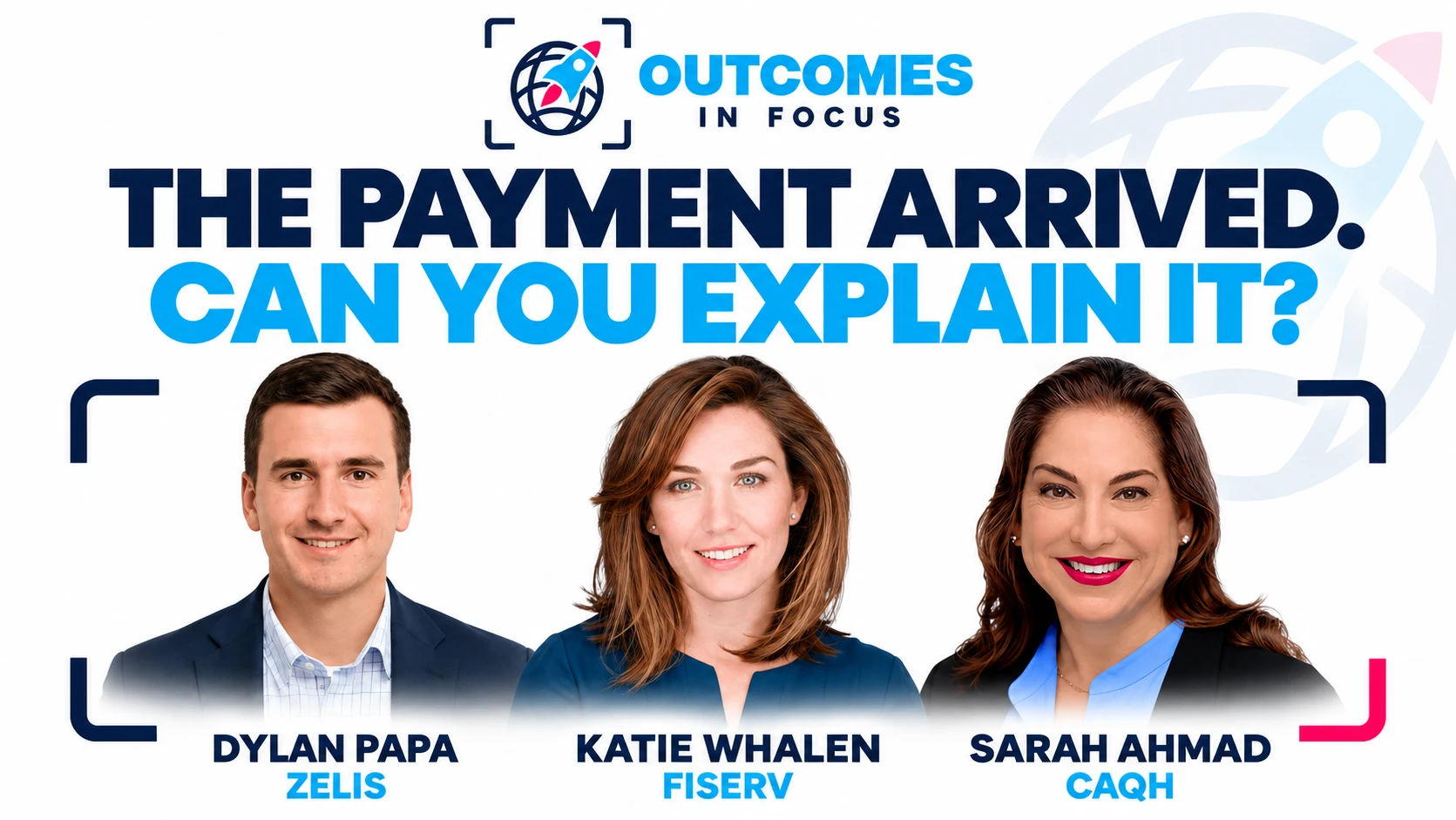
Featuring insights from Dylan Papa of Zelis, Katie Whalen of Fiserv, and Sarah Ahmad of CAQH on The Beat and Outcomes Rocket podcasts, hosted by our CEO, Saul Marquez.
A printed check-in instruction was taped to the door of a doctor's office. Inside, patients were directed to an iPad mounted on a trolley, while the front-desk administrator worked in a separate system. Behind those interactions was another process for reconciling payments.
Katie Whalen, Head of Strategic Partnerships for Merchant Solutions at Fiserv, described this experience during a conversation on the Outcomes Rocket podcast with our CEO, Saul Marquez. The practice had introduced digital tools, but the systems supporting the patient interaction, administrative work, and financial processes were still disconnected.
It's a challenge that extends beyond the front desk. In separate podcast conversations, Dylan Papa of Zelis discussed the transition to electronic healthcare payments and the information those transactions can provide, while Sarah Ahmad of CAQH explained the role of reliable provider and member data in healthcare administration.
Their perspectives raise a useful question for healthcare organizations: When a transaction becomes digital, how much of the work surrounding it actually becomes easier?
Electronic Payments Create Opportunities Beyond Speed
On The Beat, Dylan Papa, then Senior Vice President of Commercial Growth for Payments Optimization at Zelis, discussed how healthcare organizations are moving away from traditional paper-based payments.
He described an Arizona health network transitioning from checks to electronic transactions. Beyond the improvement in how payments were delivered, Dylan emphasized the opportunity to use transaction information to better understand financial activity.
That information can help payers and providers investigate payment discrepancies, including overpayments, underpayments, and denials. For provider organizations managing transactions across multiple payers, being able to examine payments alongside their supporting information can make financial activity easier to understand.
The distinction matters because receiving money and understanding a payment are separate activities. A provider may receive an electronic payment but still need to determine which services it covers, what reimbursement was expected, and whether the amount requires additional review.
Dylan's perspective suggests that payment modernization has value beyond replacing checks with faster transactions. The information accompanying those transactions can become useful for financial oversight, provided organizations can access and interpret it.
The Practice Needs More Than a Working Payment Terminal
Katie Whalen approached the problem from the perspective of smaller healthcare practices, where patient payments, payer reimbursements, and administrative records often involve different systems.
During her Outcomes Rocket interview, she discussed how payment information from a payer can arrive separately from the data describing the services being reimbursed. Staff may then need to connect those records manually to understand what has been paid and whether additional action is required.
That work has consequences for the practice's financial operations. Before deciding whether a patient owes an additional amount or may be due a refund, the practice needs an accurate picture of the services provided, payments collected, and reimbursement received.
Katie described Fiserv's Clover PracticePay as an effort to bring these activities into a more connected workflow. The approach combines patient-facing payment capabilities with tools for managing payments, supporting claims reconciliation, and connecting information with practice management systems.
The example of the iPad mounted on a trolley illustrates the problem she was discussing. Individual technologies may serve their immediate purpose while leaving staff to manage the connections between them.
For a practice reviewing its payment operations, the more revealing question may be what happens after a payment is captured. Can the people responsible for reconciliation find the information they need within their existing workflow, or must they reconstruct the transaction across separate systems?
Connected Systems Still Depend on the Right Data
Sarah Ahmad, CEO of CAQH at the time of her Outcomes Rocket interview, discussed another part of healthcare administration: how organizations collect, verify, and use information about providers and members.
She described how CAQH supports provider-data management by collecting professional information and verifying details against primary sources. Information about a provider's education, training, and hospital privileges can then support administrative activities such as maintaining provider directories.
Sarah also discussed member eligibility and coordination of benefits, which serve different purposes from provider-data verification. While these information systems support healthcare administration, each answers a different set of questions.
That distinction is relevant when considering how data moves between systems. Accurate provider credentials can support decisions about provider information, but they do not establish a patient's eligibility or explain whether a particular payment has been reconciled.
Similarly, information about coverage and payment serves a different purpose from the professional details used to verify a provider's identity and qualifications.
Sarah's conversation highlights the importance of understanding what information has been verified and what it is intended to support. Connecting administrative systems is useful, but organizations still need to distinguish the purpose of the data moving through them.
Find the Work That Remains After a Payment Is Digitized
Dylan, Katie, and Sarah discussed different parts of healthcare's administrative infrastructure. Dylan focused on electronic payments and transaction visibility, Katie described the relationship between patient payments and practice reconciliation, and Sarah addressed the accuracy and management of provider and member information.
Taken together, the conversations suggest a practical place to examine existing operations: the work that continues after an electronic transaction has been completed.
For a revenue-cycle team, that could mean following one payment from receipt through reconciliation. Identify where staff find the service information, expected reimbursement, remittance details, and final posted amount. Then examine which steps require someone to move between systems, re-enter information, or investigate a discrepancy.
The same review should distinguish information that is missing from information that is available but serves a different purpose. A reliable data source can still be insufficient for the particular question a team is trying to answer.
The goal is to understand which parts of the process have become easier through digitization and which still depend on manual work. That provides a clearer starting point for deciding where better connections, more accessible information, or changes to the workflow could make a difference.
A payment may now move electronically from payer to provider, or from patient to practice. The question is whether the people responsible for the next step have the information they need to finish the work.
About the Conversations
These are three separate Outcomes Rocket conversations, not a shared case study. During the time of recording, the guest names and titles were as follows: Dylan Papa, Senior Vice President of Commercial Growth for Payments Optimization at Zelis. Katie Whalen, Head of Strategic Partnerships for Merchant Solutions at Fiserv. Sarah Ahmad, CEO at CAQH.
Resources
How Dylan Papa and Zelis Are Modernizing Healthcare Payments Through Speed, Transparency, and Trust
From Fragmented Data to a More Connected Healthcare System with Sarah Ahmad, CEO of CAQH

Turn Healthcare Insightinto Accelerated Growth
Our healthcare growth teams work closely with you to design strategies tailored to your unique goals and market dynamics, fully focused on growth.
Book a Strategy Session →
Accelerating your growth with expert strategies in marketing, branding, research & insights, sales and lead generation to maximize healthcare impact.