Outcomes Articles
Steps to a Strong and Compliant Healthcare Marketing Strategy
January 7, 2026
Your organization’s success in today’s healthcare landscape depends on more than the care you provide. Patients must be able to find you, trust you, and feel confident choosing your services over countless alternatives. With 77% of patients researching online before booking an appointment, marketing has become a core driver of patient acquisition and long-term loyalty.
But healthcare marketing comes with unique pressure. You’re expected to stand out in a crowded market, prove measurable ROI, and deliver personalized communication, while navigating strict regulatory requirements and maintaining unwavering professionalism. One misstep can damage trust, limit growth, or create compliance risk.
This guide gives you a clear and practical blueprint for building a strong and compliant healthcare marketing strategy. You’ll learn how to differentiate your brand, activate a digital-first acquisition engine, engage patients throughout their journey, and measure what truly drives growth, without compromising privacy, credibility, or patient trust.
Key Takeaways
- Compliance is competitive advantage: Organizations that master HIPAA-compliant marketing build deeper trust and differentiate themselves in a crowded market
- Differentiation requires authenticity: Move beyond generic "quality care" messaging to articulate your unique value proposition through research, patient insights, and authentic storytelling
- Digital-first is non-negotiable: With 77% of patients researching online before appointments, your digital presence directly impacts patient acquisition
- Measurement drives optimization: Track metrics that matter: CPA, patient lifetime value, conversion rates, and patient satisfaction to prove ROI and guide strategy
- Balance automation with humanity: Use technology to scale personalization while maintaining authentic human connection that builds trust
Understanding the Unique Healthcare Marketing Landscape
Healthcare marketing operates under conditions unlike any other industry. Every decision carries higher stakes, stricter regulations, and deeper emotional impact, requiring marketers to balance growth with responsibility. Patients aren’t simply choosing a service; they’re trusting you with their health, privacy, and vulnerable moments.
This environment makes trust your most valuable asset. Unlike consumer brands that can lean on aesthetic appeal or celebrity endorsements, healthcare organizations must earn trust through accuracy, transparency, and consistently positive experiences. According to a Deloitte health report, nearly 80% of patients would not return to a provider after an experience that damaged their trust, showing how fragile patient confidence truly is.
This transforms marketing from a promotional function into a responsibility. Every message, interaction, and digital touchpoint must reinforce reliability and credibility. You’re not only competing for attention in a crowded market, you’re competing for the privilege to provide care, and that requires intentional, patient-centered communication shaped by real expectations.
The Foundation: Compliance as Your Competitive Advantage
Many healthcare marketers see compliance as a constraint, but the most effective organizations treat it as an advantage. When you demonstrate consistent respect for privacy, accuracy, and regulatory expectations, you build credibility in a marketplace where trust drives patient decision-making. Compliance becomes a differentiator because patients associate ethical communication with higher-quality care.
Navigating HIPAA in Your Marketing Efforts
HIPAA defines how protected health information (PHI) can be used in marketing, and understanding these rules is essential for safe execution. Direct B2C communication is permitted only under specific conditions, and any use of PHI requires the patient’s authorization. By building compliant processes early, your marketing can stay personalized without introducing risk.
Patient Authorization Requirements
HIPAA requires healthcare organizations to obtain signed authorization forms when PHI will be used for marketing purposes. Incorporating these authorizations into your digital and in-person intake workflows ensures consistency and reduces friction later. This process allows you to deliver personalized outreach while staying within regulatory boundaries.
De-Identification Strategies
Even when patients authorize the use of their PHI, HIPAA requires that identifying details be removed before marketing content is created. De-identification helps protect patient privacy while allowing you to highlight real outcomes and experiences. Having a clear internal process ensures stories remain compelling and compliant.
Marketing Tool Selection
A marketing tool is only HIPAA-compliant if there is a signed Business Associate Agreement (BAA) in place. Review your full marketing technology stack and verify that each vendor handling PHI has executed a BAA. Tools without BAAs may still be usable if configured so that they never receive any identifiable information.
Tracking and Analytics Compliance
Analytics and tracking systems must be configured to avoid collecting PHI or exposing sensitive data. This includes reviewing form fields, URL parameters, event tracking, ad platforms, and integrations to ensure compliance. Many healthcare organizations adopt HIPAA-friendly analytics solutions to maintain insight without compromising privacy.
Strategic Differentiation: Standing Out in the Sea of Sameness
Differentiation is essential in a healthcare landscape where most organizations make the same claims about quality, compassion, and patient-centered care. Patients, however, are more discerning and less trusting than ever, and generic messaging fails to stand out. A strong differentiation strategy helps your brand rise above competitors by showing what you uniquely deliver.
Discovering Your Authentic Unique Value Proposition
Many hospital and practice leaders struggle to articulate what truly sets them apart. A clear unique value proposition (UVP) distills your greatest strengths through structured discovery: workshops, stakeholder interviews, competitive analysis, and brand audits. The output is a focused, authentic expression of the value your organization consistently delivers.
Ask yourself these strategic questions to uncover your UVP:
- What do patients already believe about us that we're not fully leveraging?
- What outcomes do we consistently deliver that competitors struggle with?
- What aspects of the patient experience do we execute exceptionally well?
- What community needs are we uniquely positioned to address?
Conducting research helps you understand patient attitudes, unmet needs, and emerging opportunities. Insights from panels, market trends, behavior patterns, and competitive dynamics allow you to shape a UVP that reflects reality, not assumptions.
Building Trust Through Transparency and Storytelling
Trust should guide every part of your communication strategy, shaping how your organization uses marketing to build credibility. This includes the tone you use, the transparency you provide, and the way patient stories are sourced, approved, and shared. Your goal as a healthcare marketer is to help patients feel informed, supported, and confident in their decisions.
Effective storytelling supports three objectives:
- Humanize Your Brand: Share how your organization was founded and highlight stories from patients, caregivers, and clinicians to create connection and relatability.
- Demonstrate Real Expertise: Produce high-quality, authoritative content that reflects clinical depth and distinguishes you from generic health information found online.
- Foster Emotional Connection: Combine segmentation insights with creative storytelling to show how your organization supports patients during meaningful health moments.
Executing Your Healthcare Marketing Strategy: The Essential Components
With compliance as your foundation and differentiation as your positioning, the next step is to activate an execution framework that delivers measurable outcomes. A strong healthcare marketing strategy connects digital visibility, patient engagement, and data-driven decision-making into a unified system that supports growth.
To manage this complexity, successful organizations often rely on a healthcare marketing framework, commonly applied by specialized agencies, to align strategy, channels, content, and analytics.
Digital-First Patient Acquisition
Patients increasingly begin their healthcare journey online, and multiple studies confirm this shift. According to the CDC, 58.5% of U.S. adults searched online for health or medical information within the past year. The Annenberg Public Policy Center reports that 79% of U.S. adults go online when they have a health symptom or question, underscoring how central digital search has become in health decision-making.
Additionally, Kaiser Family Foundation found that 55% of adults use social media at least occasionally to find health information or advice.
Your goal is to meet patients where they already are through a cohesive digital strategy that guides them into your care pathways. This requires visibility across search, social, and content-driven channels, supported by messaging that builds trust and reduces friction.
Your digital strategy should include:
Search Engine Optimization (SEO)
SEO is essential for helping patients find your services at the moment they need them. Healthcare websites face unique challenges due to sensitive topics, strict accuracy requirements, and regulatory expectations, making strong technical SEO and authoritative content critical. Ranking well not only increases visibility but reinforces trust.
Omnichannel Marketing Approach
An omnichannel strategy creates a consistent patient experience across web, email, social, paid media, and offline channels. Aligning messaging across platforms helps patients move smoothly through their journey while tracking interactions provides insight into behavior, intent, and channel performance. These insights guide better targeting and more effective campaigns.
AI-Powered Personalization
AI continues to expand its role in personalized healthcare experiences, smarter ad optimization, and improved acquisition strategies. Use AI to tailor search ads, segment audiences, and deliver relevant content without replacing genuine human touch. Technology should guide personalization, not diminish the empathy patients expect from healthcare providers.
Video Content Strategy
Video remains one of the most effective formats for patient education and engagement. Short educational videos, testimonials, behind-the-scenes tours, and live Q&A sessions simplify complex medical information and build credibility. Video content also performs strongly across platforms and helps humanize your organization.
Building Authentic Patient Engagement
Having a patient engagement strategy is essential for a healthcare marketing plan as it fosters stronger relationships between patients and providers, enhances patient satisfaction, improves health outcomes, and increases loyalty to healthcare services.
Your engagement strategy should create touchpoints throughout the entire patient journey:
Pre-Appointment Engagement
Provide educational content that helps patients understand their conditions and prepare for visits. This reduces anxiety and improves the quality of appointments.
Active Treatment Communication
Establishing clear and open lines of communication between healthcare providers and patients is essential, including leveraging digital channels such as secure messaging platforms and telehealth to facilitate ongoing dialogue.
Post-Care Follow-Up
Engagement should continue after the appointment ends. Offer tailored follow-up messages, recovery resources, and wellness content to maintain connection. Consistent follow-up keeps your organization top-of-mind while demonstrating ongoing commitment to patient well-being.
Community Building
Community-building efforts reinforce trust and deepen patient loyalty. According to NRC Health’s 2025 Experience Perspective Report, patients are nearly 300% more likely to recommend a healthcare organization when they trust it, making trust-driven engagement a powerful brand differentiator. Hosting support groups, wellness events, or education sessions helps your organization foster real-world connection that strengthens that trust.
Marketing Automation and Personalization
Marketing automation streamlines repetitive tasks across campaigns, reminders, and patient communications. Automation increases efficiency, reduces manual workload, and frees your team to focus on strategy. When implemented thoughtfully, it enhances personalization without compromising authenticity.
Use automation strategically:
- Appointment reminders: Reduce no-shows and help patients stay on schedule with timely notifications.
- Educational email sequences: Deliver content based on patient interests, conditions, or service lines.
- Personalized content recommendations: Share relevant videos, articles, or resources tailored to each patient segment.
- Automated review requests: Encourage satisfied patients to share positive feedback at the right moments.
- Re-engagement campaigns: Reconnect with inactive patients with supportive, value-driven outreach.
Even with automation, human connection must stay at the center of your communication. Patients want transparency, empathy, and honesty. Qualities that distinguish your brand when competitors rely purely on AI-generated content.
Measuring What Matters: Healthcare Marketing ROI
ROI measures whether your marketing investments are generating meaningful financial returns. In healthcare, ROI analysis expands beyond clicks or impressions; it evaluates how marketing efforts influence appointments, procedures, revenue, and long-term patient relationships. Clear ROI tracking supports better decision-making and stronger budget justification.
Essential Metrics for Your Healthcare Marketing Strategy
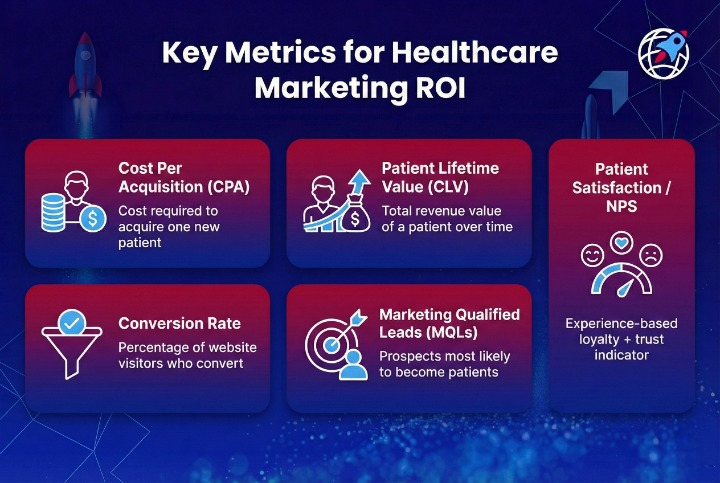
Cost Per Acquisition (CPA)
CPA measures the cost of acquiring a new patient by dividing marketing spend by new patient volume. Tracking CPA by channel and campaign helps identify the most efficient sources of new appointments.
Patient Lifetime Value (CLV)
CLV calculates the total economic value a patient brings throughout their relationship with your organization. It highlights which acquisition channels deliver not only volume, but high-quality, long-term patient relationships.
Conversion Rate
Conversion rate reflects the percentage of people who take a desired action: scheduling appointments, signing up for services, calling your office, or completing forms. Monitoring conversion rates helps you identify friction points and optimize user experience.
Marketing Qualified Leads (MQLs)
MQLs represent individuals who have shown genuine interest in your services and are likely to convert. Tracking MQLs helps your team prioritize resources and improve nurture strategies.
Patient Satisfaction and Net Promoter Score (NPS)
Patient satisfaction surveys and NPS reflect real-world patient experience. These metrics link the impact of marketing to how patients feel about your care, which influences loyalty and reputation.
Building Your Measurement Framework
To calculate and optimize ROI in healthcare marketing, start by identifying core metrics such as awareness, form fills, phone calls, scheduled appointments, completed visits, new patient percentages, and surgeries or procedures. From there, expand your measurement scope to include conversions, customer lifetime value, and total revenue driven by patients.
Your measurement framework should follow these steps:
- Align With Business Goals: Connect every metric to a strategic objective. If your goal is to grow a specific service line, prioritize performance indicators tied to that specialty.
- Implement Proper Tracking: Use conversion tracking tools such as appointment sign-ups, contact forms, call tracking, and analytics tags. Make sure every lead and conversion is accurately tied to appointments, procedures, and revenue outcomes.
- Provide Regular Reporting: Establish monthly, quarterly, or mid-campaign reporting cadences to support agile decision-making. Frequent reviews help you identify insights early and adjust campaigns before they conclude.
- Demonstrate Value to Leadership: Work with clinical and operational leaders to translate marketing performance into clear, meaningful impact. Turning ROI insights into compelling internal stories helps protect budgets and reinforces marketing’s strategic role.
Adapting to Healthcare Marketing Trends
Marketing has evolved beyond simply promoting services, now it's about connecting authentically, earning trust, and adapting to and meeting the needs of today's well-informed patients.
Key Trends Shaping Your Strategy
Consumerization of Healthcare: Aligning with the consumerization of healthcare is crucial, as patients expect the same quality and convenience from healthcare providers as they do from retail experiences, and embracing this shift can increase market relevance and patient satisfaction.
Data-Driven Personalization: Healthcare marketing leverages data analytics to deliver highly personalized experiences for patients by analyzing data from electronic health records, wearable devices, and online interactions to understand patient preferences, behaviors, and health needs.
Strategic Brand Partnerships: From a marketing perspective, significant trends include strategic brand partnerships, AI-driven healthcare information delivery, and the fundamental shift in social media engagement paradigms. Consider how partnerships can extend your reach and credibility.
Related Read: AI’s Sources of Truth: How Chatbots Cite Health Information
Privacy-First Marketing: As data privacy regulations tighten, the rise of AI, privacy regulations, and patient-centered approaches redefines healthcare marketing, making a shift toward innovation, trust-building, and compliance essential for healthcare organizations to thrive.
Practical Implementation: Your 90-Day Action Plan
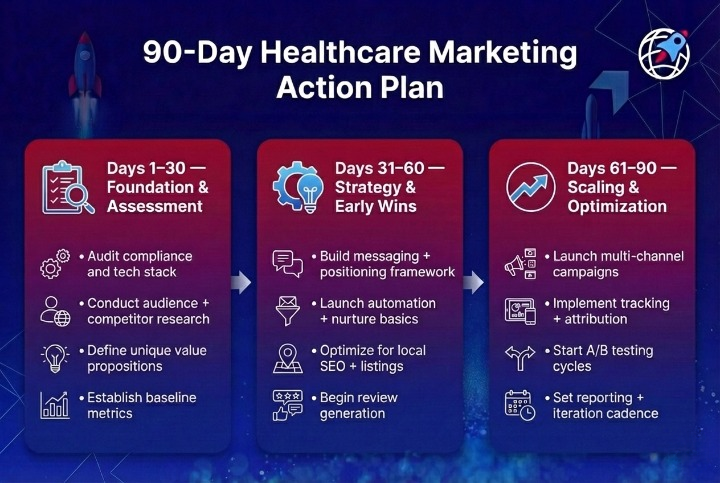
Transforming strategy into results requires systematic execution. Here's how to begin:
Days 1-30: Foundation and Assessment
- Audit current compliance status across all marketing channels
- Conduct competitive analysis and patient perception research
- Define your unique value proposition
- Establish baseline metrics for key performance indicators
Days 31-60: Strategy Development and Quick Wins
- Develop your differentiated messaging framework
- Implement basic marketing automation
- Optimize your digital presence for local search
- Launch patient review generation program
Days 61-90: Scaling and Optimization
- Launch multi-channel campaigns based on your strategy
- Implement comprehensive tracking and attribution
- Begin A/B testing key marketing elements
- Establish regular reporting cadence with leadership
Common Pitfalls to Avoid
Even well-intentioned healthcare marketing strategies can fail. Avoid these critical mistakes:
Compliance Shortcuts: Never compromise on patient privacy for marketing convenience. The reputational damage far exceeds any short-term gains.
Generic Messaging: If your brand looks and sounds like every other, why would patients choose you? Having a strong brand identity and differentiating your brand is about giving patients a compelling reason to pick you over competitors, being the purple cow in a field of brown ones.
Measurement Neglect: Measuring ROI is essential for justifying marketing budget allocation, as limited resources make it crucial to determine which marketing initiatives are most effective, allowing organizations to identify strategies worth further investment and those needing adjustments or elimination.
Short-Term Focus: Building a strong healthcare brand doesn't happen overnight, and while short-term sales targets are important, truly differentiated brands invest in long-term equity, cultivating a reputation for innovation, quality, and trustworthiness rather than just selling products.
Ignoring Patient Feedback: Your patients are providing valuable insights through reviews, surveys, and social media. Failing to listen and respond represents a missed opportunity for improvement and engagement.
Moving Forward: Building Your Healthcare Marketing Strategy
Successful healthcare organizations treat marketing as a strategic investment that evolves with their patients, services, and industry expectations. When you combine digital fluency with human connection, data with privacy, and personalization with purpose, your strategy becomes a reliable driver of trust, engagement, and measurable growth.
The healthcare brands that thrive view marketing as an extension of patient care, a way to guide, educate, and support people throughout their journey.
Your patients are searching for you. The question is whether they will find you, trust you, and ultimately choose you. With the right healthcare marketing strategy, the answer is yes.
Sources
- Healthcare Success. "11 Healthcare Marketing Predictions for 2025." https://healthcaresuccess.com/blog/healthcare-marketing/11-healthcare-marketing-predictions-for-2025.html
- MarcomCentral. "Marketing Trends in Healthcare to Incorporate in Your Marketing Strategy." https://marcom.com/marketing-trends-in-healthcare-to-incorporate-in-your-marketing-strategy/
- IPG Health. "Healthcare Marketing Trends Shaping 2025 and Beyond." https://ipghealth.com/news/healthcare-marketing-trends-shaping-2025-and-beyond
- Big Sea. "Top Healthcare Digital Marketing Trends in 2025." https://bigsea.co/ideas/healthcare-digital-marketing/
- U.S. Department of Health and Human Services. "Marketing | HHS.gov." https://www.hhs.gov/hipaa/for-professionals/privacy/guidance/marketing/index.html
- HIPAA Journal. "What are the HIPAA Marketing Rules?" https://www.hipaajournal.com/hipaa-marketing-rules/
- Compliancy Group. "HIPAA and Healthcare Marketing | What is HIPAA Compliant Marketing." https://compliancy-group.com/what-is-hipaa-compliant-marketing/
- Workshop Digital. "Guide to HIPAA-Compliant Digital Marketing for Healthcare." https://www.workshopdigital.com/blog/hipaa-compliant-digital-marketing/
- SundaySky. "2025 Healthcare Marketing Strategy: Trends You Need to Know." https://sundaysky.com/blog/2025-healthcare-marketing-trends/

Turn Healthcare Insightinto Accelerated Growth
Our healthcare growth teams work closely with you to design strategies tailored to your unique goals and market dynamics, fully focused on growth.
Book a Strategy Session →
Accelerating your growth with expert strategies in marketing, branding, research & insights, sales and lead generation to maximize healthcare impact.