You're facing intense competition, shifting regulations, and evolving patient expectations. How do you cut through the noise and make strategic decisions that actually move the needle? A well-executed SWOT analysis provides insights to enhance market position and set your organization apart. By regularly assessing Strengths, Weaknesses, Opportunities, and Threats, healthcare organizations can identify growth areas and address risks early. This tool supports both new service launches and brand repositioning by enabling informed, data-driven choices.
Key Takeaways
- Strategic clarity through structured analysis: SWOT analysis helps you systematically evaluate internal strengths and weaknesses alongside external opportunities and threats to make informed strategic decisions.
- Competitive advantage identification: By analyzing your organization's unique capabilities against market conditions, you can identify differentiators that set you apart from competitors.
- Risk mitigation and opportunity capture: Regular SWOT assessments enable you to anticipate market shifts, address vulnerabilities proactively, and capitalize on emerging opportunities before competitors do.
- Cross-functional alignment: The collaborative SWOT process brings together diverse perspectives from clinical, operational, and administrative teams to create comprehensive strategic insights.
- Actionable strategic roadmap: A properly executed SWOT analysis translates into concrete action items that guide resource allocation, marketing strategies, and organizational priorities.
What SWOT Analysis Really Means for Healthcare Organizations
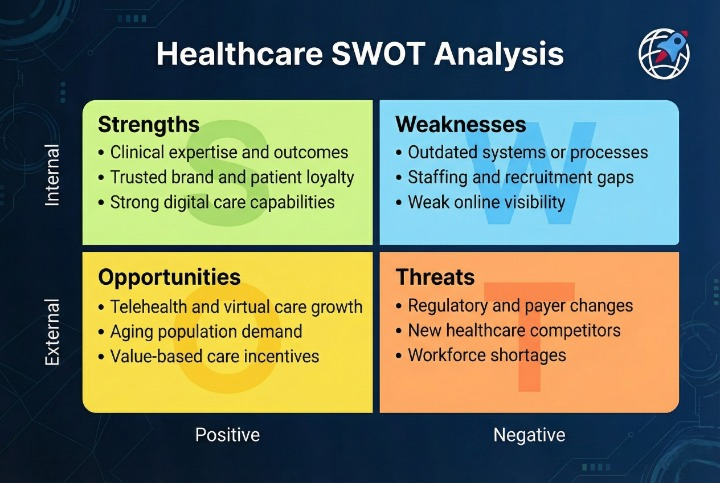
SWOT analysis examines four critical dimensions of your organization. Strengths and weaknesses represent internal factors you can control. Opportunities and threats are external forces that require strategic responses.
The healthcare industry faces unique challenges including regulatory complexity, reimbursement pressures, and rapidly evolving technology. Your SWOT analysis must account for these industry-specific factors. Generic business frameworks often fail to capture the nuances of healthcare delivery and marketing.
Why SWOT Analysis Is Essential for Today’s Healthcare Market
You're operating in an environment where healthcare spending in the United States reached approximately $4.9 trillion in 2023, representing 17.6% of GDP. This massive market attracts intense competition and constant disruption. SWOT analysis helps you navigate this complexity systematically.
The framework forces you to look beyond day-to-day operations. You'll identify strategic blind spots and uncover opportunities your competitors might miss. This structured approach prevents reactive decision-making that wastes resources and dilutes your brand.
Core Strengths That Define a High-Performing Healthcare Organization
Start by cataloging what your organization does exceptionally well. Look for clinical, operational, or experiential capabilities that competitors cannot easily replicate. These become the foundation of your competitive positioning.
Internal Strengths to Evaluate
- Clinical excellence and specialization: Assess your quality metrics, patient outcomes, and specialized services that exceed industry benchmarks.
- Technology infrastructure: Evaluate your EHR systems, telehealth capabilities, and data interoperability infrastructure that enhance care delivery.
- Physician relationships and talent: Consider your ability to attract top clinical talent and maintain strong physician partnerships.
- Brand reputation and patient loyalty: Measure your Net Promoter Score where applicable, patient satisfaction ratings, and community recognition.
- Financial resources and stability: Review your cash reserves, access to capital, and ability to invest in strategic initiatives.
Your strengths should be specific and measurable. Avoid vague claims like "quality care" without supporting data. Organizations with strong patient experience scores see higher patient retention and referral rates.
Leveraging Strengths for Competitive Advantage
Once you've identified strengths, determine how to amplify them. If you excel at orthopedic care, can you expand subspecialties or create a center of excellence? Strong financial performance might enable strategic acquisitions or technology investments.
Your marketing strategy should highlight these differentiators consistently through creative campaigns that make your strengths visible. Build campaigns around proven strengths rather than aspirational claims. Authenticity resonates with healthcare consumers who research providers extensively before making decisions.
Recognizing Weaknesses That Limit Growth
An honest assessment of weaknesses requires organizational courage. You must examine gaps that competitors might exploit or that prevent you from capturing market opportunities.
Common Healthcare Weaknesses to Address
- Outdated technology systems: Legacy IT infrastructure that hampers efficiency, creates poor patient experiences, and limits data analytics capabilities.
- Limited geographic reach: Restricted service areas that prevent you from accessing growing population centers or underserved markets.
- Physician recruitment challenges: Difficulty attracting specialists in competitive markets, creating service line gaps and limiting growth potential.
- Weak digital presence: Inadequate online visibility, poor website user experience, or limited social media engagement that reduces patient acquisition.
- Operational inefficiencies: High costs, long wait times, or complex processes that frustrate patients and reduce profitability.
Healthcare organizations that fail to address operational weaknesses experience higher patient attrition and lower staff satisfaction. Organizations often rationalize weaknesses or minimize their impact, but acknowledging them clearly is essential. Quantify the cost of inaction to build urgency for improvement initiatives.
How to Prioritize and Address High-Impact Weaknesses
You can't fix everything simultaneously. Rank weaknesses by their impact on strategic goals and feasibility of improvement. Focus resources on high-impact areas where you can make measurable progress within 12-18 months.
Some weaknesses require long-term investment. Others demand immediate attention because they create competitive vulnerabilities. Your prioritization should align with overall strategic objectives and available resources.
Capitalizing on Market Opportunities
External opportunities come from shifting demographics, technology adoption, and payer incentives. Identifying these trends early helps organizations expand reach, strengthen differentiation, and capture new demand.
Key Market Trends Creating New Growth Opportunities in Healthcare
- Aging population demographics: By 2030, all baby boomers will be over the age 65, driving long-term demand for chronic care, home-based services, and specialized senior programs.
- Telehealth expansion: Virtual care adoption accelerated during the pandemic and remains strong in many segments, though growth varies by specialty.
- Value-based care models: Shift from fee-for-service to value-based reimbursement rewards organizations that can demonstrate quality outcomes and cost efficiency.
- Consumerism in healthcare: Patients increasingly expect retail-like experiences, including greater transparency, convenience, and digital access, creating opportunities for organizations that prioritize convenience and transparency.
- Strategic partnerships: Collaborations with technology companies, retail health providers, urgent care chains, payer-led primary care models, and telehealth platforms can expand capabilities and market reach.
Market research should guide how you assess these opportunities. Analyze demographic trends, competitor movements, and emerging technologies to determine where your organization can gain an advantage. Healthcare leaders who recognize these shifts early and adapt their strategies are best positioned to capture new demand and build long-term growth.
How to Evaluate Which Market Opportunities Are Worth Pursuing
Not all opportunities are worth pursuing. Assess each against your strengths, available resources, and strategic priorities. The best opportunities align with existing capabilities while addressing unmet market needs.
Calculate potential return on investment for major opportunities. When evaluating each option, review the following factors:
- Implementation timelines: Determine how quickly the opportunity can be executed with existing resources.
- Required capital: Assess the level of financial investment needed to launch and maintain the initiative.
- Competitive intensity: Understand how saturated the space is and how strong current competitors are.
- Strategic fit: Prioritize opportunities that leverage your strengths and expose competitor weaknesses.
Opportunities that build on your core strengths and address competitor weaknesses typically offer the highest probability of success.
Managing Regulatory, Competitive, and Workforce Threats
Threats represent external forces that could damage your competitive position or financial performance. Early identification enables proactive response rather than reactive crisis management.
Critical Healthcare Threats to Monitor
- Regulatory and compliance changes: New regulations, reimbursement cuts, or policy shifts that increase costs or restrict operations.
- Competitive market entry: New competitors, including retail health providers, urgent care chains, or telehealth platforms entering your market.
- Reimbursement pressure: Medicare and commercial payer rate reductions that compress margins and force operational changes.
- Workforce shortages: Difficulty recruiting and retaining clinical staff in tight labor markets, impacting service delivery and costs.
- Cybersecurity risks: Healthcare data breaches continue to rise in frequency and sophistication, with the industry experiencing some of the highest breach costs across all sectors.
Threat assessment requires ongoing monitoring. Establish systems to track regulatory developments, competitor activities, and market trends. Monthly or quarterly reviews ensure you don't miss emerging threats.
Developing Threat Response Strategies
For each significant threat, develop contingency plans. What actions will you take if a major competitor enters your market? How will you respond to reimbursement cuts?
Proactive threat mitigation is more effective than reactive responses. If workforce shortages threaten service delivery, implement retention programs and alternative staffing models before you face critical gaps. Strategic planning should include specific threat response protocols.
Conducting Your SWOT Analysis Process
A structured methodology strengthens the quality and reliability of SWOT analysis. Ad hoc brainstorming sessions produce superficial insights. You need systematic data collection and cross-functional participation. This process is most effective when embedded within a broader healthcare marketing framework that connects strategic planning, execution, and performance measurement.
Step-by-Step SWOT Implementation
- Assemble diverse stakeholders: Include representatives from clinical operations, finance, marketing, and administration to ensure comprehensive perspectives.
- Gather quantitative data: Collect performance metrics, market research, patient satisfaction scores, and competitive intelligence before analysis sessions.
- Facilitate structured discussions: Use worksheets or digital tools to systematically evaluate each SWOT quadrant with specific examples and supporting evidence.
- Validate findings externally: Compare internal assessments against patient feedback, market data, and competitive benchmarking to ensure accuracy.
- Prioritize strategic implications: Rank findings by strategic importance and develop action plans for high-priority items.
The process typically requires 4-6 weeks for thorough analysis. Rapid or incomplete processes often result in superficial insights. Invest adequate time in data collection and stakeholder engagement.
Translating SWOT into Strategic Action
Effective SWOT analyses typically generate specific initiatives with defined owners, timelines, and metrics. Generic findings without action plans waste the effort invested in analysis. These initiatives should directly inform your healthcare marketing strategy, guiding positioning, channel selection, and investment priorities.
Create a strategic action matrix that matches strengths with opportunities and addresses weaknesses that prevent opportunity capture. Develop threat mitigation plans that leverage organizational strengths. This translation from analysis to action separates effective SWOT from academic exercises.
Conclusion
SWOT analysis strengthens strategic planning by replacing limited insight with a more systematic, evidence-based approach. You gain clarity about your competitive position, identify actionable opportunities, and develop proactive responses to market threats. The framework works only when you commit to honest assessment and translate findings into concrete initiatives.
Your healthcare organization operates in an increasingly complex and competitive environment. Regular SWOT analysis provides the strategic foundation you need to allocate resources effectively, differentiate your brand, and achieve sustainable growth. Start your next SWOT analysis by assembling cross-functional stakeholders and gathering comprehensive market data. The insights you uncover will guide strategic decisions that strengthen your market position and drive measurable results.
Sources
- Cost-Efficiency in Healthcare: Value-Based Care vs. Fee-for-Service - https://www.researchgate.net/publication/390037550_Cost-Efficiency_in_Healthcare_Value-Based_Care_vs_Fee-for-Service
- 5 Ways AI Can Make You a Better B2B Healthcare Marketer - https://www.clarityqst.com/blog/5-ways-ai-can-make-you-a-better-b2b-healthcare-marketer
- Cybersecurity Risks in Healthcare Are an Ongoing Crisis - https://www.ibm.com/think/insights/cybersecurity-in-healthcare-onging-crisis
- Strengths–Weaknesses–Opportunities–Threats Analysis for a Hospital: A Case Study – https://pmc.ncbi.nlm.nih.gov/articles/PMC7056287/
- Health Care SWOT Analysis - https://healthcaresuccess.com/blog/case-studies-best-practices/swot.html
- Telehealth: A Quarter-Trillion-Dollar Post-COVID-19 Reality -https://www.mckinsey.com/industries/healthcare/our-insights/telehealth-a-quarter-trillion-dollar-post-covid-19-reality
- Digital Transformation in Healthcare: Assessing the Role of Digital Technologies for Managerial Support Processes - https://www.sciencedirect.com/science/article/pii/S0040162524005791
- Administrative Challenges to the Integration of Oral Health With Primary Care - https://pmc.ncbi.nlm.nih.gov/articles/PMC5585172/

Turn Healthcare Insightinto Accelerated Growth
Our healthcare growth teams work closely with you to design strategies tailored to your unique goals and market dynamics, fully focused on growth.
Book a Strategy Session →
Accelerating your growth with expert strategies in marketing, branding, research & insights, sales and lead generation to maximize healthcare impact.