Outcomes Articles
Establishing Thought Leadership Through Healthcare Content Marketing
January 3, 2026
Healthcare organizations provide essential, life-changing services, yet many struggle to communicate their value effectively. Healthcare content marketing bridges this gap by helping organizations explain complex offerings, build trust, and reach the right audience with clarity and authority.
Because the industry is highly regulated (e.g., HIPAA regulations) and grounded in evidence-based decision-making, healthcare marketers face unique challenges. They must balance accuracy, compliance, clinical rigor, and engaging storytelling, all while simplifying complex topics for a diverse set of stakeholders.
This guide outlines how to create a strategic, compliant, and impactful content marketing engine that strengthens credibility, generates demand, and supports the full healthcare buyer journey.
Key Takeaways
- Healthcare content marketing requires accuracy, regulation-aware communication, and evidence-based messaging tailored to highly educated audiences.
- Thought leadership is essential, positioning your organization as a trusted source before creating demand.
- A documented strategy aligned with the buyer journey ensures relevance, consistency, and better conversion paths.
- Medical content writing must balance expertise with accessibility, supporting both clinical and business readers.
- Inbound marketing consistently outperforms outbound, driving high-intent traffic and qualified leads.
Why Healthcare Content Marketing Demands a Different Approach
Healthcare operates under strict compliance frameworks, complex decision-making processes, and heightened expectations for accuracy. Organizations aren’t simply promoting consumer products, they’re explaining medical innovations, clinical processes, and operational solutions that directly impact patient safety. Trust becomes the central currency.
COVID accelerated the shift toward digital education. Disruptors proved that high-quality, educational content drives search visibility and inbound demand. But today, basic blog posts are no longer enough. Content must:
- Demonstrate clinical and operational expertise
- Meet stringent accuracy and compliance standards
- Serve both AI-driven search engines and sophisticated human readers
Healthcare marketers need disciplined planning, clear messaging, and consistent delivery. Every piece of content must reinforce an organization’s commitment to accuracy, ethics, and patient outcomes.
Building Thought Leadership: Your Foundation for Credibility
Before you can generate demand, you must establish authority. Healthcare thought leadership is the process of publishing content that demonstrates your organization’s expertise and provides meaningful insights to the industry. It is not about self-promotion. It is about helping your audience understand complex issues, breaking down medical concepts, and contributing to conversations that matter.
Digital opinion leaders earn trust by educating rather than selling. They engage clinical advisors, medical directors, and scientific experts to share insights that decision-makers rely on when evaluating trust and credibility. When this expertise is shared consistently, your organization becomes a reliable source for both clinical and business audiences.
How to Build Healthcare Thought Leadership
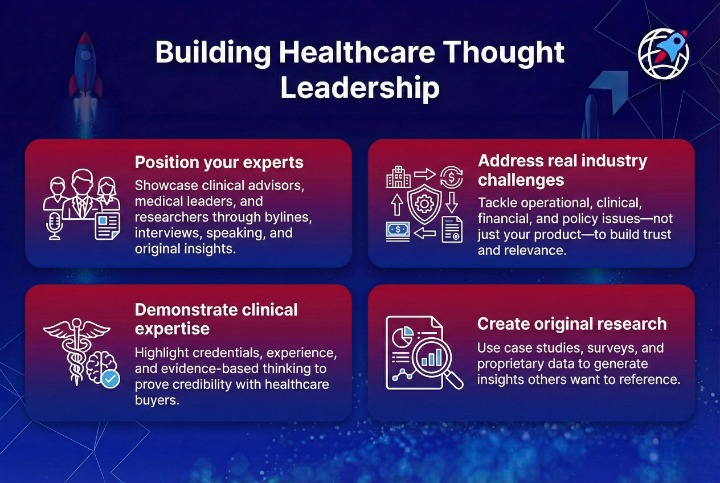
- Position your experts strategically
Highlight clinical advisors, medical directors, and researchers who hold insights that your audience values. Give them platforms through bylined articles, interviews, speaking opportunities, or original research. - Address real industry challenges
Go beyond your product. Discuss operational, clinical, financial, and policy issues shaping the industry. Buyers trust organizations that understand systemic problems and propose credible solutions. - Demonstrate clinical expertise
Leverage your clinical credentials and experience to build credibility. Hospitals, payers, and life sciences companies want partners who show mastery of evidence, best practices, and emerging trends. - Create original research
Case studies, market surveys, and proprietary data elevate your authority. Original insights give journalists, analysts, and decision-makers a reason to reference your organization.
Thought leadership strengthens every marketing initiative. When your brand is recognized as an authority, educational content carries more weight, sales conversations begin with higher trust, and your organization becomes the preferred option for sophisticated healthcare buyers.
Developing Your Healthcare Content Strategy: The Strategic Blueprint
Random acts of content do not move the needle in healthcare. You need a structured healthcare marketing strategy that aligns with business goals, addresses audience needs, and supports the full buyer journey. The right framework ensures every asset has a purpose and contributes to meaningful outcomes.
This kind of structure is most effective when content strategy operates within a broader healthcare marketing framework that connects messaging, channels, analytics, and long buyer journeys.
A strong content strategy begins with clarity. You must understand what the organization is trying to achieve, who you are trying to reach, and how content can reduce friction throughout long and complex evaluations. This clarity guides your content mix, distribution choices, and success metrics.
Define Your Content Marketing Objectives
Start by identifying the outcome you want to influence. Your goals determine which formats you create and how you prioritize your efforts.
- Brand awareness: Establish your presence in new markets and educate early-stage buyers.
- Lead generation: Attract qualified prospects with content that demonstrates expertise.
- Customer retention and expansion: Support existing clients with insights that improve adoption and long-term value.
Understand Your Healthcare Audience
Healthcare audiences are highly specialized. A hospital Chief Financial Officer evaluating a financial solution has different needs than a Chief Medical Officer assessing clinical performance. Decision-makers expect clarity, accuracy, and content that reflects their realities.
Create detailed personas that capture:
- Role-specific pain points and priorities
- Information preferences and channel behavior
- Regulatory and compliance expectations
- Procurement requirements and budget cycles
Map Content to Business Goals
Every piece of content should support a strategic purpose. Awareness content builds authority, educational content deepens trust, and consideration content helps buyers compare approaches. Decision-stage content reduces risk, provides clarity, and supports stakeholder alignment.
Establish Content Governance
Healthcare content must meet regulatory, clinical, and brand standards. Clear governance prevents bottlenecks while maintaining accuracy. Create a review process that includes medical experts, compliance stakeholders, and marketing owners. Use clear language, avoid unnecessary jargon, and ensure every clinical claim is supported by evidence.
Medical Content Writing: Accuracy Meets Accessibility
Healthcare content writing must balance clinical accuracy with clear communication. Your audience expects evidence-based information, but they also need explanations that are easy to understand. The goal is to simplify complex topics without losing precision or weakening the scientific foundation.
Writers must translate medical and regulatory concepts into language that supports decision-making. This requires careful phrasing, structured presentation, and a review process that protects accuracy. When done well, content becomes both informative and accessible to clinical and business readers.
Best Practices for Medical Content Writing
- Prioritize accuracy above all
Provide information that is current, correct, and supported by credible evidence. Every clinical claim must be validated. Every statistic must be sourced. Your reputation depends on getting the details right. - Write for the audience, not for peers
Show expertise without overwhelming readers. Explain clinical concepts clearly, using simple examples where possible. Assume a high level of sophistication, but do not assume medical training. - Structure content for scanability
Decision-makers are busy. Use clear headings, short paragraphs, and bullet points to make information easy to find. Place the most important insights early in each section. - Cite your sources
Proper documentation strengthens credibility and helps readers validate information. Citations are essential in regulated environments and support compliance with internal review processes. - Balance precision with clarity
Use direct, concise language. Avoid jargon unless it is essential, and define it when introduced. Precision matters, but clarity determines whether the message resonates. - Collaborate with clinical experts
Work closely with medical advisors and subject matter experts. Their review ensures accuracy and protects against outdated terminology, incorrect claims, or compliance risk.
Effective medical content writing brings accuracy and accessibility together, creating information that supports both clinical and business decision-makers.
Storytelling in Healthcare: Making Complex Ideas Memorable
Storytelling makes healthcare content easier to understand, remember, and act on. Accuracy builds trust, but narrative helps audiences connect solutions with real outcomes. In long B2B buying cycles, logic alone rarely drives change. Stories help decision makers visualize impact and reduce uncertainty.
62% of B2B marketers find storytelling effective in content marketing, which validates that narrative improves both engagement and influence. This makes storytelling valuable for organizations that need to communicate clinical outcomes, operational efficiency, or workflow improvement.
A strong healthcare story shows a challenge, highlights insight, and demonstrates measurable results. When stakeholders can picture the before and after state, internal buy-in becomes easier to achieve. Story frameworks give data context and make expertise memorable across teams.
Storytelling does not replace evidence. It amplifies it. When medical accuracy and narrative work together, content becomes both trusted and persuasive.
Mapping Content to the Healthcare Buyer Journey
The healthcare buying cycle is long and complex, often spanning twelve months or more. Your content strategy must guide stakeholders through each phase with information that reduces confusion, supports evaluation, and builds confidence. Effective content meets buyers where they are and gives them the clarity they need to move forward.
Healthcare decisions involve clinical, financial, operational, and compliance considerations. This means your content must progress from broad education to detailed evaluation materials. When each stage is supported with the right assets, you keep the conversation active and reduce friction across the journey.
Awareness Stage: Educating and Establishing Presence
Buyers enter the awareness stage when they recognize a challenge and begin searching for information. Across major healthcare categories, 61 to 84% of consumers run an online search before scheduling an appointment, reinforcing why digital visibility shapes early decision-making. This shows how strongly digital research shapes early decision-making and highlights the importance of clear, educational content that helps buyers understand their options.
Effective awareness content includes:
- Educational blog posts that explain industry challenges
- Research reports with original data and insights
- Infographics that simplify complex healthcare trends
- Webinars with clinical experts
- Market landscape guides and trend analyses
Consideration Stage: Building Trust and Demonstrating Value
Buyers in the middle of the funnel are comparing approaches and evaluating vendors. They want to understand how solutions work, what makes each option different, and what outcomes they can expect. Your content must help them progress toward a shortlist.
Effective consideration content includes:
- Testimonials and case studies that highlight real outcomes
- Comparison guides that outline different solution paths
- White papers that explain your methodology
- Product demonstrations and explainer videos
- ROI tools and implementation timelines
Decision Stage: Supporting Final Evaluation
At the bottom of the funnel, stakeholders want proof, clarity, and certainty. They need materials that support internal buy-in and remove the last barriers to commitment. Your content should equip them with practical details that make the decision process easier.
Effective decision content includes:
- Detailed case studies with measurable results
- Technical specifications and integration documentation
- Pricing and implementation guides
- Security and compliance materials
- Customer success stories from similar organizations
- Proposal templates or business case frameworks
A buyer journey that is supported by relevant content at each stage keeps prospects engaged. It also creates a smooth progression from initial awareness to final agreement, giving your sales team stronger momentum throughout the cycle.
Structuring Your Content Funnel for Maximum Impact
A strong content funnel guides healthcare buyers from early awareness to final decision with clear, logical steps. Each stage should build on the last, offering information that reduces uncertainty and supports evaluation. When this structure is intentional, your content creates momentum and keeps prospects engaged across long buying cycles.
Top-performing funnels move buyers forward with purpose. They link related assets, support progressive learning, and reflect the questions buyers ask at each stage. This approach strengthens authority and makes your content more discoverable in search.
Create Content Pathways
Buyers should be able to move deeper into your content without friction. Awareness content should connect to consideration assets, followed by decision-focused materials. This creates guided journeys that encourage continued engagement and prevent buyers from dropping off.
Use Progressive Profiling
Not every asset needs to be gated. Start with light requests, such as an email address for early-stage content. Reserve more detailed forms for ROI tools, research reports, and decision-stage resources. This approach helps identify intent while maintaining a smooth user experience.
Align Content with Search Intent
Search queries reflect the questions buyers have at each stage of the journey. Align your content with the intent behind those terms. Awareness topics target broad questions, while deeper content addresses comparisons, integrations, and results. This improves visibility and relevance.
Measure Funnel Performance
Tracking the impact of each stage helps refine your strategy. Focus on metrics that indicate meaningful movement, not vanity numbers. Evaluate how content influences engagement, lead progression, and conversion. Look for patterns that show which assets support pipeline growth.
A well-structured content funnel supports discovery, evaluation, and decision-making in a complex healthcare environment. When each stage is designed with intent, your content becomes a reliable system that attracts, nurtures, and converts sophisticated buyers.
Inbound Marketing: Attracting Qualified Healthcare Leads
Inbound tactics generate 54% more leads than traditional outbound practices, making them especially valuable in healthcare where trust and credibility drive buyer decisions. High-quality educational content allows you to attract qualified leads, earn authority early, and support the extended buying cycles that define this industry.
Healthcare buyers research solutions independently. They compare data, read expert insights, and seek proof of value. Inbound marketing supports this behavior by providing clear, relevant content that answers their questions and guides them toward deeper engagement.
Optimize for Search Visibility
Leads gained through SEO have a 14.6% close rate, compared to just 1.7% for outbound leads. Inbound search traffic performs better because buyers initiate the interaction and actively seek solutions. Strong SEO ensures your content appears when these high-intent healthcare decision-makers are evaluating their options.
Create Compelling Calls-to-Action
Every content asset should offer a logical next step. Clear calls-to-action encourage buyers to continue their journey, whether by downloading a guide, watching a webinar, or subscribing for updates. Strong CTAs help turn interest into measurable engagement.
Develop Premium Content Assets
High-value gated materials identify serious buyers. These assets, such as research reports, implementation guides, and assessment tools, deepen trust and offer detailed insights. Keep the access process simple to avoid drop-off.
Nurture Leads with Email Marketing
Email remains one of the most effective channels for healthcare organizations. Automated sequences deliver helpful content at the right time and keep your brand visible throughout the long buying cycle. Consistency strengthens trust and supports pipeline growth.
Leverage Social Media Strategically
Social media can amplify your expertise and build community. Share educational content, engage in discussions, and highlight clinical or operational insights. These interactions expand reach and support your broader inbound engine.
A strong inbound program attracts buyers with relevant, helpful content. It also supports long evaluation cycles by reinforcing credibility at every stage, helping your organization earn trust before direct sales engagement begins.
Supporting Your Sales Team with Content
Your content strategy should strengthen sales effectiveness by giving teams clear and credible materials they can use throughout the buying cycle. Decision-makers expect accurate information, practical guidance, and evidence that supports internal discussions. When content aligns with sales needs, it reduces friction and builds confidence across all stakeholders.
Create Sales Enablement Content
Provide resources that help your sales team explain value, answer questions, and guide prospects through late-stage evaluation. These assets support productive conversations and make it easier for buyers to move forward. Common examples include:
- One-page solution overviews
- Objection-handling sheets
- Competitive comparison documents
- ROI calculators
- Implementation timelines
- Security and compliance documentation
Align Content with Sales Stages
Work closely with sales leaders to understand where deals typically slow down. Identify the questions that arise most often and the information buyers need to advance. Use these insights to create targeted content that addresses real friction points.
Make Content Easy to Find and Use
Centralize your sales materials in a simple, organized repository. Structure assets by funnel stage or use case so that sales representatives can quickly locate the right information. This improves consistency and reinforces your core messages.
Gather Sales Feedback
Your sales team has the closest view into buyer concerns and objections. Ask which assets drive productive conversations and which areas require more clarity. Use this feedback to refine your content strategy and strengthen future materials.
A strong partnership between marketing and sales increases trust, improves buyer experience, and accelerates movement through the final stages of the healthcare buying process.
Measuring Healthcare Content Marketing Success
Increasing budgets and rising competition make it essential to measure how well your content performs. Healthcare organizations invest heavily in marketing, so teams must show clear evidence of impact. Strong measurement helps you understand what drives engagement, which assets influence the pipeline, and where to refine your strategy.
Effective analysis focuses on meaningful progress, not vanity metrics, and should align with the KPIs in your documented marketing plan. You need to understand how content contributes to awareness, lead quality, and sales momentum across long buying cycles. This requires a mix of engagement insights, funnel performance data, and indicators of growing authority.
Key Metrics for Healthcare Content Marketing
These categories provide a clear structure for evaluating performance and identifying where your content creates measurable value.
Engagement Metrics
Track how audiences interact with your content. Time on page, scroll depth, and downloads help determine whether your material resonates with target readers and supports their informational needs.
Lead Generation Metrics
Monitor how many qualified leads your content produces and the associated cost. Top-performing healthcare organizations often achieve efficient cost-per-lead benchmarks because their educational content attracts high-intent prospects.
Lead Quality Metrics
Assess how content-generated leads progress through the funnel. Quality is more important than volume, so evaluate conversion rates, meeting readiness, and how well leads match your personas.
Pipeline Influence
Review how content shapes opportunity creation and movement. Multi-touch attribution helps you understand which assets assist buyers throughout the sales cycle and contribute to closed revenue.
SEO Performance
Measure organic traffic growth, search visibility for target keywords, and ranking improvements. Strong SEO signals confirm that your content aligns with buyer intent and establishes domain authority.
Sales Enablement Impact
Track how often sales teams use your materials, which assets they rely on most, and how content correlates with faster deal progression or higher win rates.
Thought Leadership Indicators
Monitor speaking invitations, media mentions, analyst interest, and inbound partnership requests. These signals show that your expertise is gaining recognition across the industry.
When measured consistently, these metrics reveal how content strengthens awareness, influences buying decisions, and contributes to long-term growth. They also help you refine your strategy and focus on the initiatives that create meaningful value.
Conclusion
Healthcare content marketing succeeds when it aligns strategy, clinical accuracy, and consistent execution. A strong framework builds authority, supports long buying cycles, and gives decision-makers the clarity they need to move forward. When your content delivers reliable information, your organization becomes a trusted partner rather than another vendor.
The healthcare organizations that win are the ones that communicate value clearly and earn trust at every stage of the journey. With a structured strategy and a steady flow of meaningful content, you create a system that attracts qualified buyers, strengthens sales conversations, and drives sustainable growth in a competitive and highly regulated industry.
Sources
- https://intrepy.com/9-biggest-trends-in-healthcare-marketing-in-2023/
- https://www.promodo.com/blog/healthcare-digital-marketing-benchmarks-2024
- https://nytlicensing.com/latest/methods/healthcare-content-marketing/
- https://www.researchgate.net/publication/352081993_The_role_of_content_marketing_in_the_promotion_of_medical_goods_and_services
- https://digitalagencynetwork.com/best-healthcare-content-marketing-ideas-examples/
- https://www.mckinsey.com/industries/healthcare/our-insights/health-media-how-consumer-content-informs-the-future-of-healthcare
- https://www.kunocreative.com/blog/healthcare-content-marketing-patient-trust
- https://themedwriters.com/healthcare-content-marketing-strategies/
- https://leapmesh.com/storytelling-marketing-statistics
- https://contentmarketinginstitute.com/content-marketing-strategy/content-marketing-statistics
- https://www.forbes.com/councils/forbescommunicationscouncil/2024/08/05/the-power-of-storytelling-in-modern-marketing/

Turn Healthcare Insightinto Accelerated Growth
Our healthcare growth teams work closely with you to design strategies tailored to your unique goals and market dynamics, fully focused on growth.
Book a Strategy Session →
Accelerating your growth with expert strategies in marketing, branding, research & insights, sales and lead generation to maximize healthcare impact.