Outcomes Articles
Podcasts as a Marketing Powerhouse: Strategies, Impact, and Future Outlook (2026)
July 14, 2026
Podcast Adoption: Strong Growth, But Skepticism Holds Many Back
Podcast adoption among marketing organizations is considerable but far from universal. Nearly half of respondents (44.9%) say their organization currently incorporates podcasts into its marketing strategy in some form. Of these, 16% host their own branded podcast, 16.6% advertise or sponsor on external podcasts, and 12.3% do both. An additional 25% plan to begin using podcasts within the next 12 months, pointing to continued momentum in the channel.
44.9%
already use podcasts in their marketing
45.8%
of non-hosts doubt podcasts work for their goals
16.8%
track formal ROI, cost versus return
56.9%
plan to increase podcast spend in 12 months

That still leaves 30.1% with no plans for podcasting.
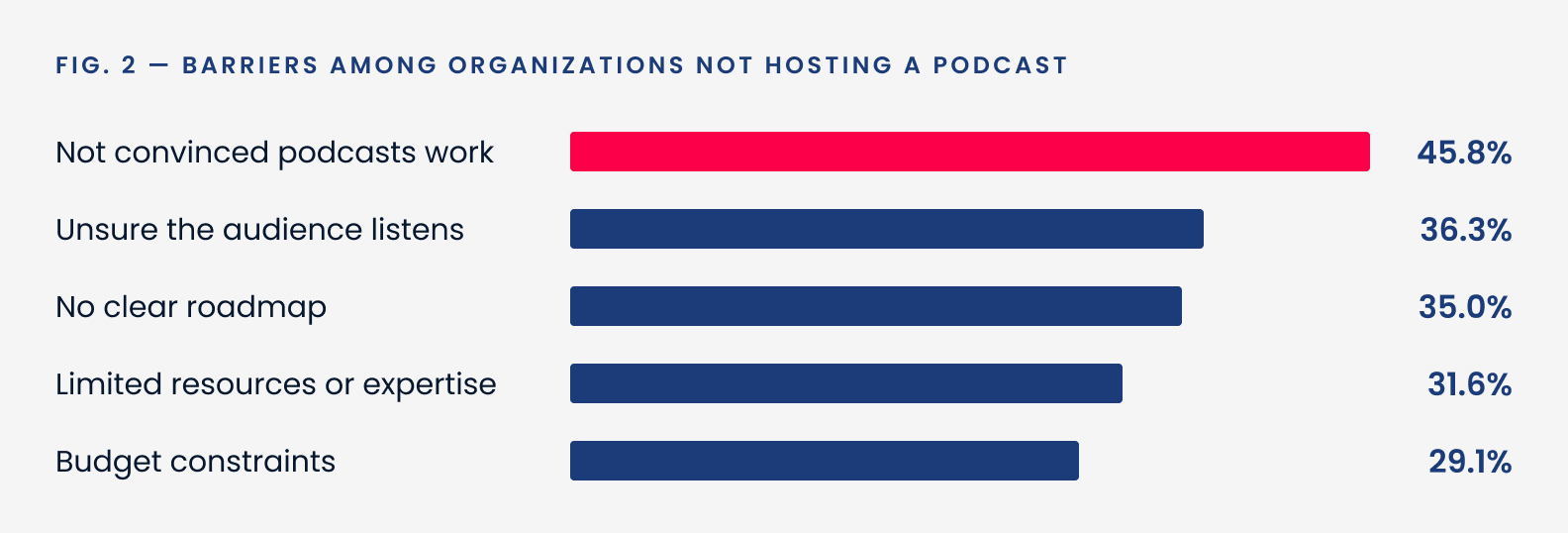
Among organizations not currently hosting a branded podcast, the most cited barrier is a lack of belief. 45.8% of respondents are not convinced that podcasts are effective for their marketing goals, making skepticism about effectiveness the top obstacle ahead of uncertainty about audience listenership (36.3%), a lack of clear roadmap (35.0%), limited internal resources or production expertise (31.6%), and budget constraints (29.1%).
Despite this skepticism, 28.5% of non-hosting organizations say they are interested in launching a branded podcast within the next 12–18 months, signaling an openness to the channel even when confidence is not yet established.
Getting Started: Most Organizations Move Quickly, Then Slow Down
For organizations that commit to launching a branded podcast, getting to air is not a prolonged process. 65.3% publish their first episode within six months of the initial idea, with 32.0% going live within one to three months. Only 10.3% take longer than a year from concept to first episode.
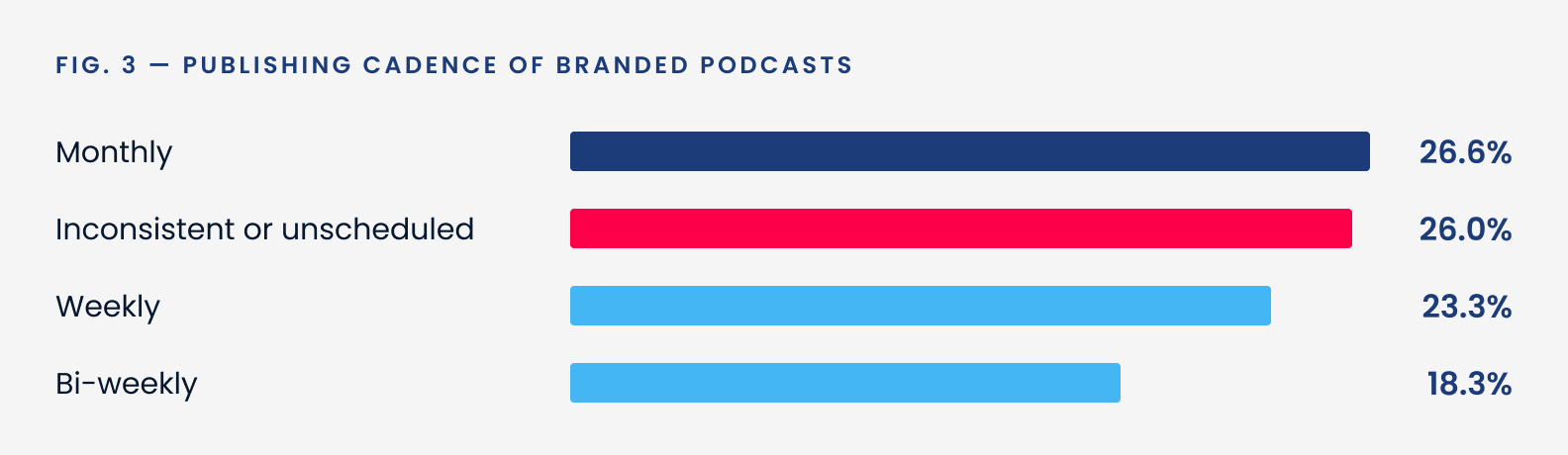
The challenge is maintaining publishing consistency after launch. Monthly episodes (26.6%) and inconsistent or unscheduled releases (26.0%) together account for over half of all branded podcast operations. Only 23.3% publish weekly and 18.3% maintain a bi-weekly cadence. For a channel that builds audience trust and algorithmic visibility through consistent output, irregular publishing is a compounding disadvantage.
Format And Audience: Conversation-First, Mostly Top-Of-Funnel
On format, the market has consolidated around conversation-driven content. Interview or guest-led podcasts are the most common approach, used by 32.8% of organizations, followed closely by co-hosted formats (28.9%). Panel or roundtable discussions account for 15.9%, while solo monologues represent just 9.4% of productions.
Conversational formats offer practical advantages: guests bring their own audiences, shared networks expand distribution organically, and dialogue rarely exhausts itself for content. It is also a format well-suited to building the guest relationships that can translate into commercial value beyond the episode itself.
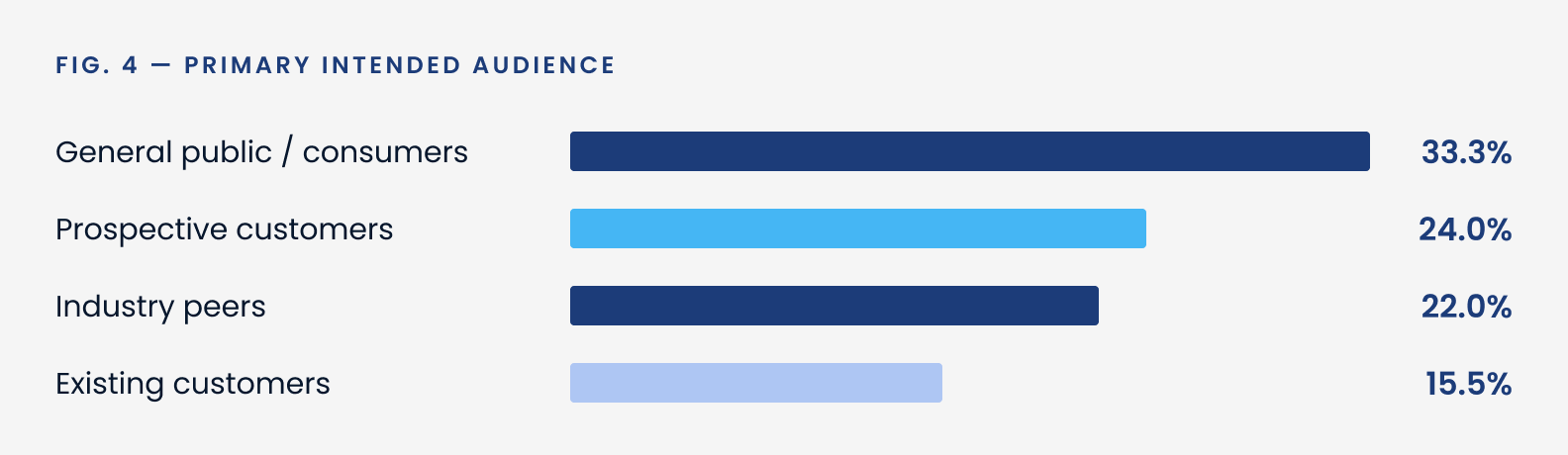
In terms of intended audience, 33.3% of podcast hosts target the general public or a broad consumer audience, while 24.0% focus on prospective customers and 22.0% on industry peers and professional communities. Existing customers are the primary target for only 15.5% of organizations, a relatively small proportion, given that loyal customers are often among the most receptive and commercially valuable podcast audiences for B2B brands.
Strategic Goals: Podcasts Are A Brand Channel, With Growing Commercial Ambition
When it comes to strategic intent, podcasts are firmly positioned as a top-of-funnel tool. 58.1% of podcast marketers say their primary goal is brand awareness and brand building, with mid-funnel consideration and education (43.9%) and customer retention (42.1%) also featuring prominently. Bottom-funnel goals, lead generation and conversion, are cited by 23.3%.

Thought leadership is a strategic objective for 30.0%, while SEO and organic search traffic are priorities for 16.5%. Notably, 12.9% of podcast-running organizations already list AEO (Answer Engine Optimization) or AIO (AI Optimization) as explicit goals, a share that is likely to grow as AI-mediated discovery becomes a more significant part of how audiences find content.
Budget allocation reflects the level of investment organizations are making in the channel. The estimated average share of total marketing budget directed toward podcast activities stands at approximately 7.3%, with 39.3% spending less than 5% and 35.4% spending between 5–10%.
Looking ahead, investment appetite is positive: 56.9% of organizations currently engaged in podcasting say they are likely or very likely to increase podcast marketing spend over the next 12 months.
7.3%
Estimated average share of total marketing budget directed to podcast activities. 39.3% spend under 5%; 35.4% spend 5–10%.
56.9%
of organizations engaged in podcasting say they are likely or very likely to increase podcast spend over the next 12 months.
Measurement: Engagement Leads, But Business Outcomes Lag
How podcast success is measured reveals the clearest tension in the data. Audience engagement (completion rates and shares) is the dominant metric, tracked by 70.8% of podcast marketers. Downloads and listens follow at 61.2%. Brand awareness (43.4%) and website traffic or SEO referrals (43.4%) are also commonly tracked.

Further down the value chain, measurement drops off sharply. Lead generation metrics are tracked by only 32.8% of organizations. Direct sales or revenue attribution is measured by 20.4%, and formal ROI (cost versus return) is tracked by just 16.8%.
The gap between what gets measured and what drives commercial decisions is significant. 47.3% of podcast marketers rate their overall ROI as strong. But without systematic tracking of business outcomes, that positive assessment often rests on engagement signals rather than pipeline or revenue data. Only 26.4% track audience sentiment, and just 10.6% measure AI search visibility or citations.
A related structural challenge is where podcast budgets are spent. 41.8% of organizations allocate more budget to production (recording, editing, hosting, and equipment) than to marketing and promotion, while only 26.1% invest more in distribution and promotion than production. Nearly one in five (17.8%) directs more than 80% of their podcast budget toward production alone.
Ai And Search: Early Movers Gaining Ground
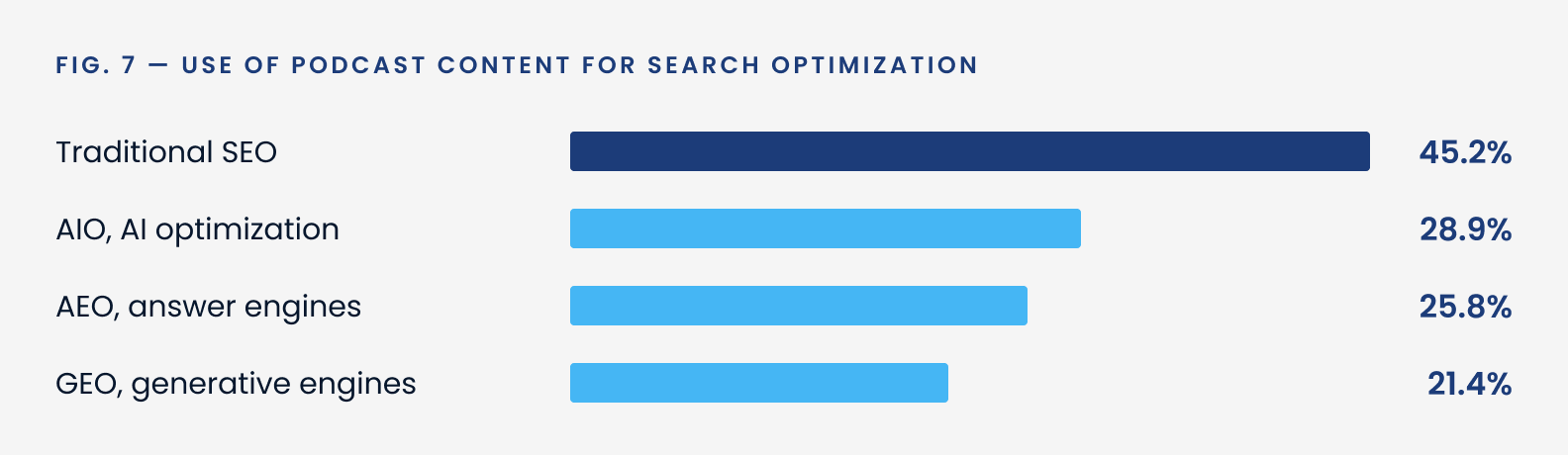
One of the more forward-looking signals in the data is the growing use of podcast content to support AI-driven search and discovery. 45.2% of podcast marketers already use podcast content to support traditional SEO. A growing cohort is going further: 28.9% are applying podcasts to AIO, 25.8% to AEO, and 21.4% to GEO (Generative Engine Optimization).
The most widely adopted tactic is content repurposing: 37.0% adapt podcast clips and transcripts for AI search engines, and 33.6% are producing transcript-rich, question-based episodes specifically designed to be cited in AI responses. Sponsoring podcasts that rank well in AI answers is a strategy used by 21.4%.
More than four in ten respondents (41.6%) rate their effectiveness at generating AI-driven visibility as high, even as 28.9% say they are not yet using podcasts for search optimization at all, suggesting a clear divide between early movers and the broader market.
Challenges And Future Outlook: Production Costs, Audience Reach, And Saturation
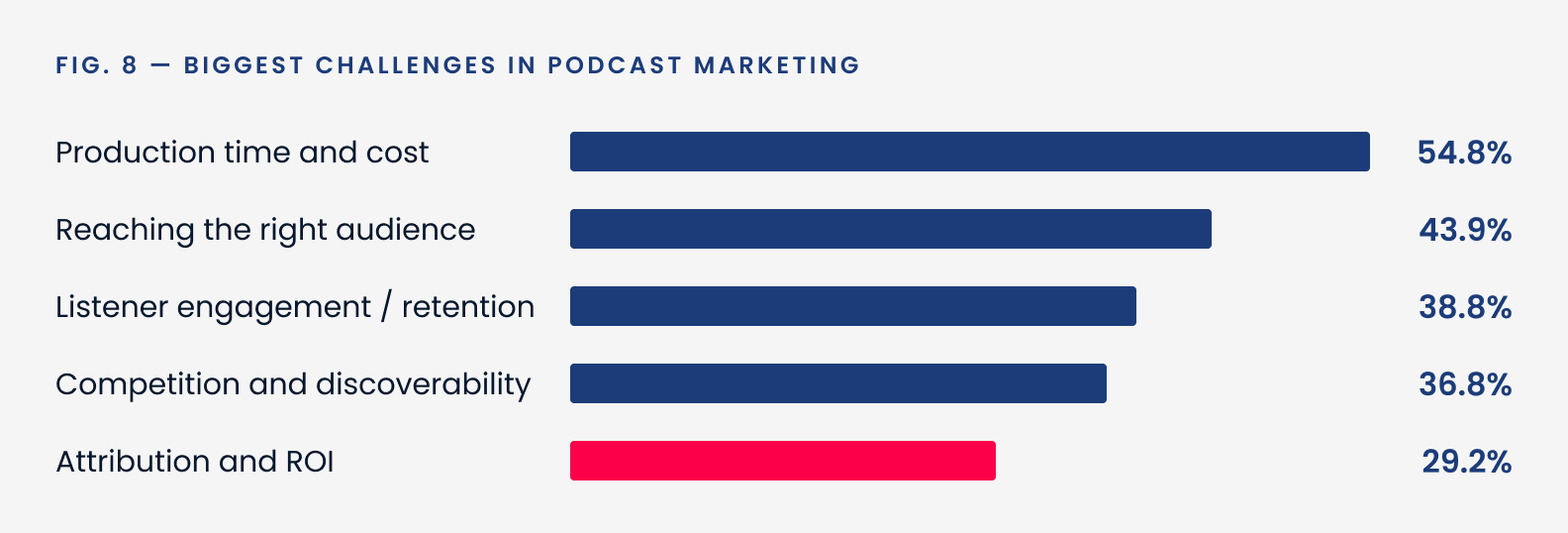
When asked about the biggest challenges in using podcasts for marketing, 54.8% of respondents name production time and cost as the dominant concern. Discovering and reaching the right audience is a close second at 43.9%, followed by low listener engagement or retention (38.8%), competition and discoverability (36.8%), and measuring attribution and ROI (29.2%).
Looking toward 2027 and beyond, respondents hold a nuanced view of where the channel is heading. 43.1% predict that podcasting will evolve toward greater specialization: smaller, more targeted audiences and deeper trust-based relationships. 35.0% expect stronger integration with AI and emerging content formats. At the same time, 32.3% anticipate growing saturation and competition, and 29.6% see increasing importance and broader adoption as the defining trend.
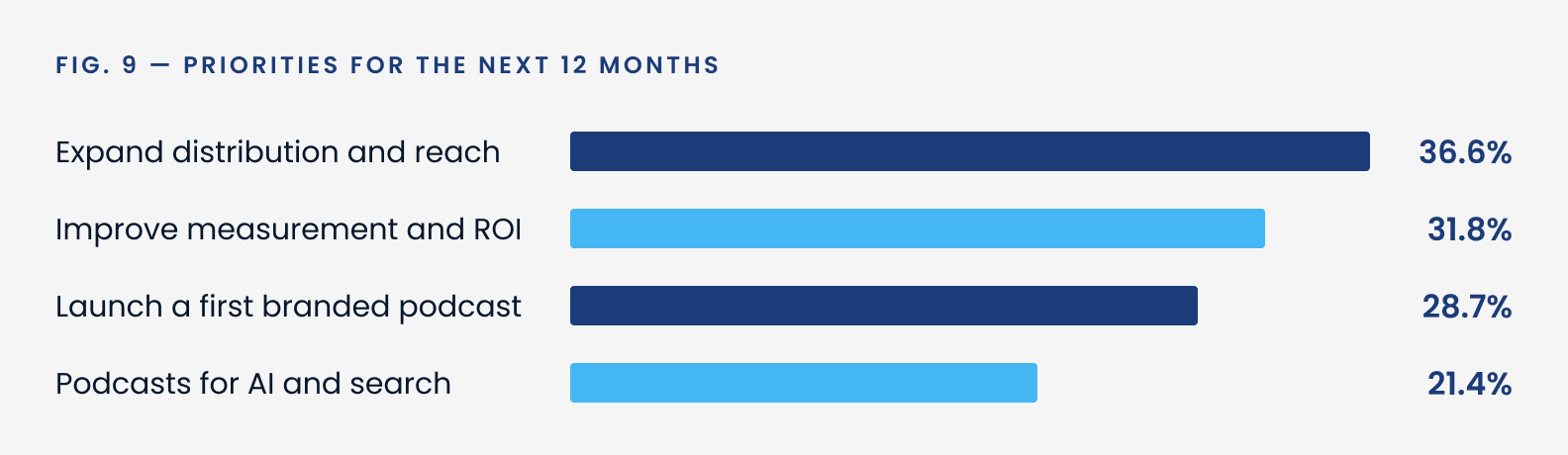
In the near term, expanding distribution and reach is the top priority for the next 12 months, cited by 36.6% of respondents, followed by improving measurement and ROI (31.8%) and launching a branded podcast for the first time (28.7%). Leveraging podcasts for AI and search visibility is a priority for 21.4%, reflecting the strategic interest building around this dimension of the channel.
Conclusion
The data from this survey points to a podcast marketing landscape that is growing in reach and ambition but is still maturing in its approach to accountability. Adoption is increasing, investment intent is positive, and a meaningful cohort of marketers are already thinking beyond traditional SEO toward AI-era search strategies. Yet the measurement gap, between commonly tracked engagement metrics and demonstrable business outcomes, remains the central challenge the industry has yet to fully close.
“Downloads are vanity. Contacts and contracts are sanity,” says Saul Marquez, CEO and Founder of Outcomes Rocket, which conducted this research. “Most people are measuring the wrong things, and that is exactly why so many organizations remain skeptical about the channel. Organizations need to think about podcasting as a spoke in a broader content and commercial flywheel, and start measuring what actually moves the needle for their business.”
The organizations best placed to benefit from podcasting's continued growth will be those that move beyond listenership as the primary signal of success, building the measurement infrastructure to connect their podcast activity to the awareness, pipeline, and revenue outcomes that justify the investment.
Respondent Profile
The survey captures a broad cross-section of marketing and communications professionals, spanning seniority levels, company sizes, and geographies.
By seniority, managers represent the largest share of respondents at 33.9%, followed by individual contributors (33.2%) and senior or lead professionals (20.2%). Directors account for 7%, with C-suite executives at 5.2% and VPs at 0.5%.
In terms of marketing orientation, 43.1% are primarily B2C focused, 29.3% are B2B, and 26.1% operate across both equally.
Organizations of all sizes are represented. The largest cohort comes from small businesses with 1–50 employees (35%), followed by mid-size organizations with 51–200 staff (21.3%). Larger organizations with 201–500 employees make up 13%, while enterprises with 5,000 or more employees account for 11.7%.
On geographic spread, respondents are predominantly based in Europe: 31% are headquartered in Europe (excluding the UK), and 30.8% in the United Kingdom. The United States represents 18.8% of the sample, with the Middle East and Africa at 8.8%.
Methodology
This report is based on a global survey of 861 marketing and public relations/communications professionals, representing a diverse mix of industries, company sizes, and seniority levels. Data was collected in May 2026 via Prolific, a widely used research platform for obtaining high-quality, pre-screened professional respondents. Participants were selected based on their involvement in marketing, PR, or communications functions within their organizations, ensuring relevant domain expertise.
Download the Full Report
Access the complete report for the full research findings, benchmarks, and analysis.

Turn Healthcare Insightinto Accelerated Growth
Our healthcare growth teams work closely with you to design strategies tailored to your unique goals and market dynamics, fully focused on growth.
Book a Strategy Session →
Accelerating your growth with expert strategies in marketing, branding, research & insights, sales and lead generation to maximize healthcare impact.